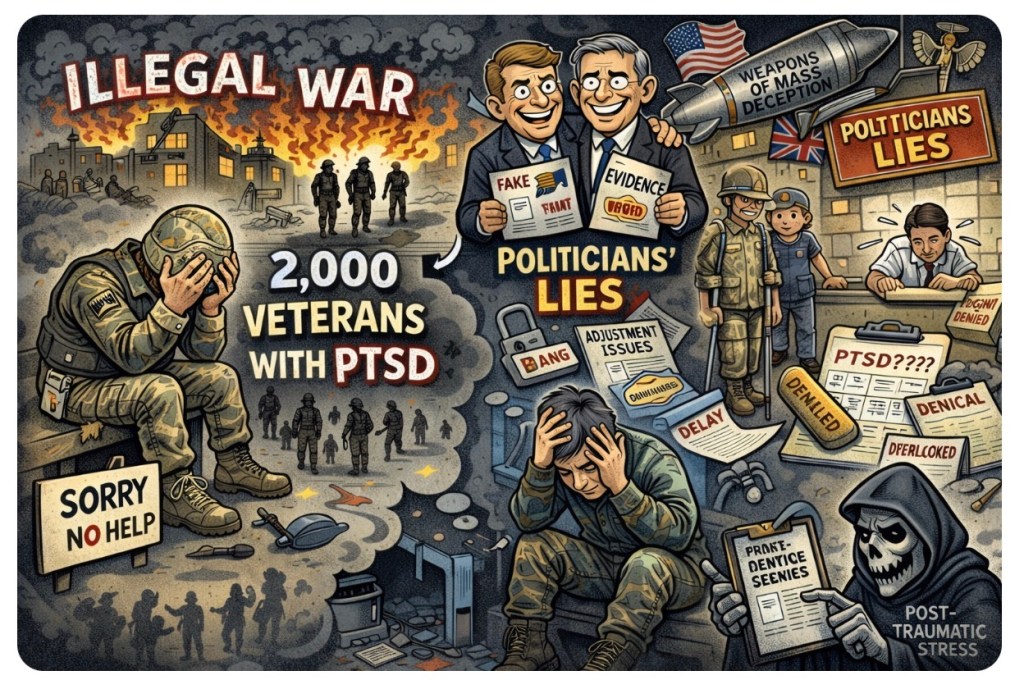
🎖️💔Two thousand veterans came home from war carrying more than medals. They carried trauma. PTSD. Night terrors. Guilt. Silence.
And instead of proper diagnosis, structured support, and urgent care… too many were met with paperwork, delay, disbelief — or worse — dismissal.
They were sent into a war later branded by many as illegal. A war justified with confident speeches and intelligence that unravelled under scrutiny. A war built, critics argue, on political spin rather than solid truth. And when the dust settled overseas, the real battlefield began at home. 🏠
🏛️ Sent to Fight. Left to Cope.
Imagine this:
You serve. You deploy. You see things no human should see.
You come back expecting at least acknowledgment — if not care.
Instead?
Long waits. Underdiagnosis. “Adjustment issues.” A culture that still whispers rather than confronts mental injury head-on.
PTSD isn’t weakness. It isn’t drama. It isn’t a footnote. It’s a wound. Invisible, yes — but just as real as shrapnel. And when thousands slip through the cracks, it stops being oversight. It becomes systemic failure.
Meanwhile, the architects of the war move on to book deals, boardrooms, and lecture circuits. The soldiers move on to sleepless nights and battles that don’t end when the uniform comes off. 🌙
This isn’t anti-military. It’s the opposite. It’s pro-accountability.
If leaders can mobilise thousands for combat, surely they can mobilise resources for care. If they can find funding for intervention abroad, they can find funding for intervention at home.
🔥 Challenges 🔥
How many veterans have to fight twice — once overseas, once for recognition — before we admit something is deeply broken?
What does true support actually look like? Faster diagnosis? Automatic screening? Lifetime mental health coverage? And who should answer for sending them in the first place?
Take this to the blog comments. Not just sympathy — solutions. Not just outrage — accountability. 💬
👇 Comment. Like. Share. Honour them properly by demanding better.
The most powerful responses will be featured in the next issue of the magazine. 📝🔥


 Chameleon Magazine
Leave a comment