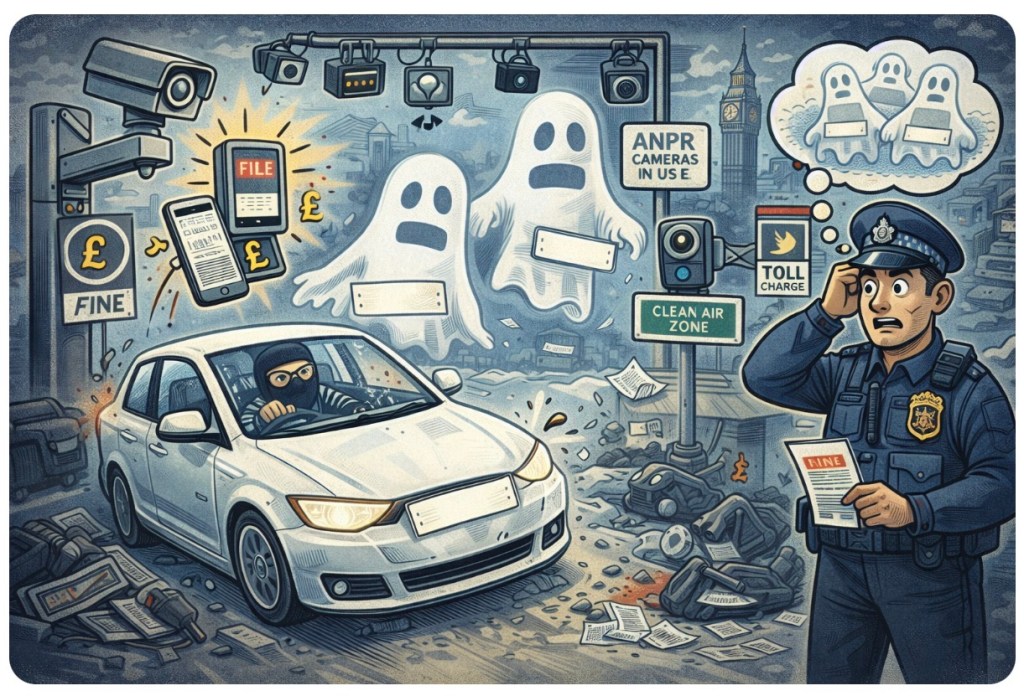
Britain’s roads are now watched more closely than a reality TV house. Speed cameras. ANPR. Bus lane traps. Clean air zone scanners. Red light sentinels.
And now — enter the “ghost” number plate.
These so-called invisible plates are designed to dodge infra-red cameras, slipping under the digital radar while the rest of the nation’s motorists flash their details like contestants on Britain’s Got Fined.
Criminal gangs are using them. Rogue drivers are using them. And police are warning they’re becoming increasingly sophisticated.
📸 Every Corner, Every Turn, Every Ping
But let’s address the frustration bubbling under the bonnet.
At every junction — camera.
At every bus lane — camera.
At every whisper of 32mph — letter in the post.
For many drivers, it doesn’t feel like road safety. It feels like a subscription service to the Treasury.
And here’s where the debate splits in two directions faster than a dual carriageway:
On one side — police argue these ghost plates allow serious criminals to:
- Avoid detection after robberies
- Evade tolls
- Skip congestion charges
- Bypass enforcement after dangerous driving
On the other side — ordinary motorists feel squeezed, surveilled, and monetised.
Because when enforcement expands relentlessly, trust shrinks proportionally.
Is it about safety?
Is it about revenue?
Or has it quietly become both? 💷
The uncomfortable truth: when people start actively trying to become “invisible,” it suggests a breakdown in public faith. Not necessarily justification — but frustration.
And yet, ghost plates aren’t rebellion. They’re illegal. Full stop. They undermine investigations. They protect criminals more than commuters.
But here’s the deeper issue:
When the public perceives enforcement as primarily financial rather than behavioural, compliance becomes resentment. And resentment breeds workaround culture.
🚨 The Real Question
If fines genuinely changed dangerous habits, would they need to multiply?
If enforcement was transparently about safety rather than budgets, would motorists feel hunted?
And if ghost plates spread, do we get:
- Smarter policing?
- Even more intrusive tech?
- Or a road system built on mutual distrust?
🔥 Challenges 🔥
Are ghost plates a criminal evolution — or a symptom of enforcement overload?
Has Britain struck the right balance between safety and surveillance? Or are we drifting toward automated revenue extraction with a speed gun?
Take it to the blog comments. Not just “stick it to the man” — but where should the line be? 💬
👇 Comment. Like. Share. Let’s debate whether the roads are policed — or priced.
The sharpest takes will be featured in the next issue of the magazine. 📝🔥


 Chameleon Magazine
Leave a comment