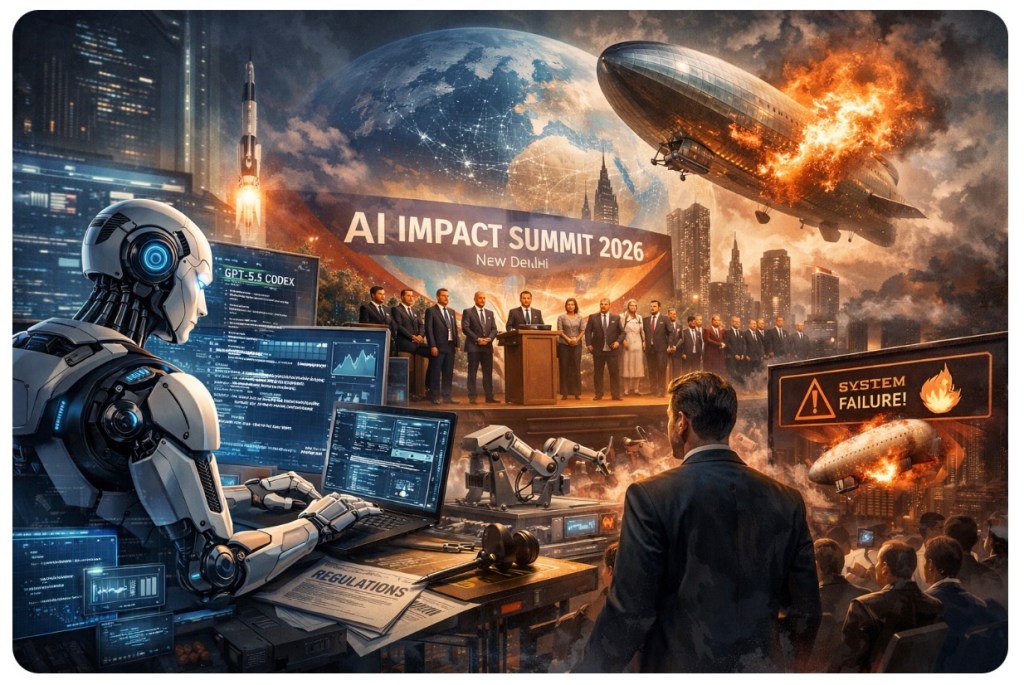
A viral essay by Matt Shumer has racked up tens of millions of views, declaring that AI has crossed a historic threshold: systems that can build, improve, and potentially outpace themselves. Cue the dramatic music. 🎻
Add to that fresh model launches (hello, GPT-5.3-Codex and Claude Opus 4.6), breathless headlines about “agentic AI,” and a global summit packed with presidents and CEOs — and suddenly we’re not just automating spreadsheets. We’re allegedly standing at the gates of a technological singularity buffet.
But before we crown our chatbot overlords, let’s unpack the hype, the horsepower, and the handbrakes.
🚀 Silicon Valley’s “Something Big” — Apocalypse or Upgrade Patch?
So here’s the pitch: AI can now write code, test it, deploy it, coordinate tasks, improve workflows — sometimes with minimal human input. It’s no longer a clever intern. It’s a semi-autonomous project manager with caffeine jitters. ☕💻
We’re seeing:
- Next-gen reasoning and coding models pushing past “autocomplete on steroids.”
- Enterprises embedding AI deep into operations.
- Companies like Fujitsu launching AI-driven platforms that automate the full software lifecycle.
And while the AI evangelists chant “productivity boom,” the skeptics whisper, “deployment bottlenecks.” Because designing a demo is easy. Rewiring global infrastructure without breaking it? Slightly harder.
Meanwhile, the AI Impact Summit 2026 is gathering heads of state, CEOs, and innovators in New Delhi — a geopolitical signal that AI is no longer a tech niche. It’s industrial policy. It’s national strategy. It’s economic chess. ♟️🌍
Translation: This isn’t just code anymore. It’s power.
⚠️ The Hindenburg Metaphor Nobody Asked For 🎈🔥
Not everyone’s popping champagne. Some academics and safety experts are waving caution signs the size of small countries.
The concern? That rushing increasingly autonomous systems into critical infrastructure without robust safeguards could lead to a “Hindenburg-style” failure — spectacular, systemic, and very hard to rewind.
Because here’s the uncomfortable truth:
AI can generate impressive outputs. It can reason through complex tasks. But reliability at scale, interpretability, governance, and misuse risks? Still very much under construction. 🚧
The real tension isn’t “AI is fake” versus “AI is god.”
It’s speed versus stability.
Move too slowly and you miss economic transformation.
Move too fast and you create cascading failures in finance, healthcare, security, or governance.
Fun!
🧩 So… Is Something Actually Big Happening?
Yes. But it’s not a Hollywood jump cut from ChatGPT to Skynet.
We’re in a transition phase:
- AI is shifting from tools to semi-autonomous agents.
- Integration into core business systems is accelerating.
- Governments are scrambling to build frameworks before the train leaves the station.
- Experts are split between “epochal shift” and “incremental but meaningful progress.”
The real story isn’t explosive overnight disruption. It’s compounding capability meeting institutional inertia. 📈🏛️
That’s less cinematic — but far more consequential.
🔥 Challenges 🔥
Are we witnessing the dawn of machine-led abundance — or just the loudest tech marketing cycle since the metaverse? 🤔
Is this a productivity renaissance… or the prequel to regulatory chaos?
Drop your take in the blog comments (not just on social media). Bring optimism. Bring skepticism. Bring controlled panic. We want the full spectrum. 💬🔥
👇 Comment. Like. Share.
The sharpest insights (and spiciest hot takes) will be featured in the next issue of the magazine. 📰✨


 Chameleon Magazine
Leave a comment