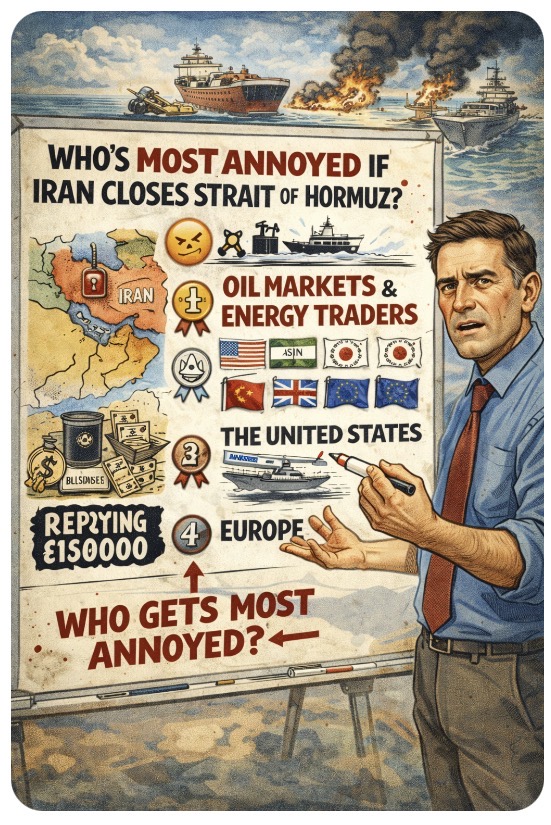
🚢🔥Iran announces the temporary closure of the Strait of Hormuz for “live-fire drills” — the first such move since the 1980s — while Ayatollah Ali Khamenei warns that Donald Trump’s aircraft carrier could be sent “to the bottom of the sea.”
Whether it’s theatre, deterrence, or brinkmanship, one thing is certain:
When Hormuz tightens… the world’s blood pressure spikes. 🩸📈
Because roughly 20% of global oil supply passes through that narrow strip of water.
So who gets annoyed first? Let’s rank the irritation scale.
🥇 Oil Markets & Energy Traders
💰📊They don’t wait for missiles to fly. They react to headlines.
Even a temporary disruption means:
- Oil prices spike instantly
- Insurance premiums for tankers soar
- Shipping reroutes add costs
- Futures markets panic
The result? Higher petrol prices before most people even know where Hormuz is.
🥈 Asia (Especially China, India, Japan, South Korea)
🇨🇳🇮🇳🇯🇵🇰🇷These countries rely heavily on Gulf oil flowing through Hormuz.
China in particular buys significant crude from Iran and the Gulf states. A prolonged disruption would:
- Strain supply chains
- Drive up energy costs
- Hit manufacturing
For export-heavy economies, that’s not just annoying — it’s destabilising.
🥉 The United States
🇺🇸Yes, America produces more of its own oil now.
But:
- Global price spikes still hit US consumers
- A threat to a US carrier is symbolic escalation
- The US Navy exists largely to keep lanes like this open
So even if Washington isn’t energy-dependent in the old way, strategically? This is a direct challenge.
🎖️ Europe
🇪🇺Already sensitive to energy volatility after recent geopolitical shocks, Europe does not need:
- More supply instability
- Another inflation surge
- Another security flashpoint
😤 But Who Gets Most Annoyed?
If this remains temporary and symbolic:
👉 Energy markets react first and loudest.
If it escalates militarily:
👉 The United States becomes the primary actor — and therefore the most directly challenged.
If it drags on economically:
👉 Asian importers feel the deepest sustained pain.
🔥 The Real Question
Is this:
- Military theatre?
- Diplomatic leverage?
- Or a test of US resolve?
Because closing Hormuz isn’t just annoying someone.
It’s pressing a global economic panic button.
And that button affects petrol stations in Birmingham as much as oil terminals in Shanghai.
If you want, we can break down:
- What happens if a tanker is actually hit
- Whether Iran could realistically sustain a blockade
- Or how quickly the US Navy would respond 🚢


 Chameleon Magazine
Leave a comment