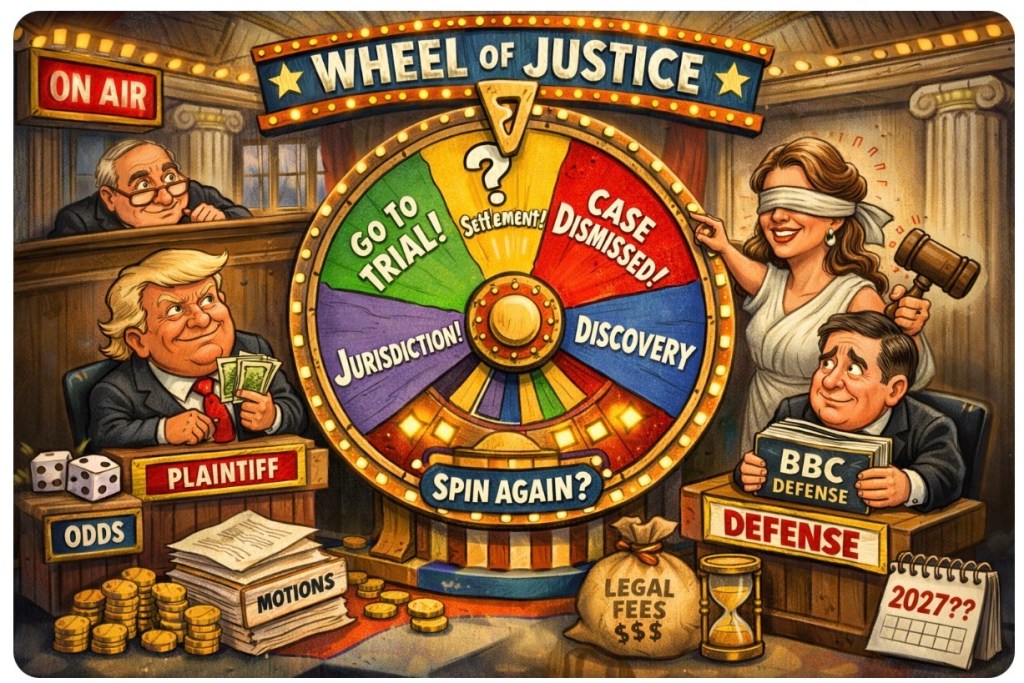
A former (and possibly future) U.S. president taking a British public broadcaster to court for $10 billion? That’s not just litigation — that’s geopolitical theatre with a billing department.
The lawsuit targets an edit in Panorama, produced by BBC, which Donald Trump claims crossed the line into defamation. The BBC has apologised for the edit but argues the case should collapse as a matter of law. A U.S. federal judge has allowed it to proceed into discovery and pencilled in a 2027 trial date.
But a scheduled trial is not the same as a seated jury. Not even close.
🎭 The $10 Billion Question: Courtroom Drama or Legal Mirage?
Let’s translate the spectacle into legal reality.
Yes, the case survived the pleading stage. That’s step one — the legal equivalent of being allowed into the lobby. It means the complaint isn’t legally absurd on its face. It does not mean the BBC is halfway to writing a cheque the size of a small nation’s GDP.
The real mountain? “Actual malice.”
Under U.S. constitutional law, public figures must prove that a broadcaster either:
- Knew a statement was false, or
- Acted with reckless disregard for whether it was false.
Not sloppy.
Not biased.
Not unfair.
Reckless. Or knowingly false. 🔥
That’s a brutal standard — deliberately so. It exists to protect political journalism from being sued into silence. And courts routinely throw out defamation claims when plaintiffs can’t clear it.
Discovery is now the battlefield. Internal emails. Editorial notes. Producer discussions. If those documents reveal awareness of falsity and conscious risk-taking, the plaintiff’s position strengthens dramatically. If they show routine editorial judgment, imperfect editing, or simple error? The defence breathes easier.
Then comes the summary judgment phase — the legal bouncer. If a judge decides no reasonable jury could find actual malice based on the evidence, the case ends before a single juror is sworn in. Many high-profile defamation suits die right there. ⚖️
And that’s before jurisdictional challenges fully settle. Cross-border media cases aren’t simple. Courts must decide whether Florida is even the proper venue and whether the alleged harm was sufficiently “published” there. Technical? Yes. Potentially fatal to the case? Also yes.
Oh — and let’s not forget settlement. High-profile defamation cases often resolve quietly. Not because someone “lost.” But because litigation is expensive, reputations are fragile, and unpredictability is terrifying.
🎯 The Probability Reality
The most statistically common outcomes in cases like this?
• Dismissal at summary judgment
• Settlement before trial
A full jury verdict? Possible. Inevitable? Not remotely.
The $10 billion headline is spectacle. The legal architecture underneath it is slow, technical, and ruthless. 🧱
Will it reach a jury?
Maybe.
Will it easily reach a jury?
Absolutely not.
The real turning point won’t be press conferences or headlines. It will be what discovery reveals — and whether a judge believes a jury genuinely needs to weigh in.
🔥 Challenges🔥
Is this a fight for press freedom? A high-stakes reputational battle? Or political theatre wrapped in legal paperwork? 🤔
If you think you know how this ends, prove it. Drop your prediction in the blog comments (not just social media). Who blinks first? The broadcaster or the billionaire? 💬🔥
👇 Comment. Like. Share. Take a side.
The sharpest takes and boldest predictions will be featured in the next issue of the magazine. 📰✨


 Chameleon Magazine
Leave a comment