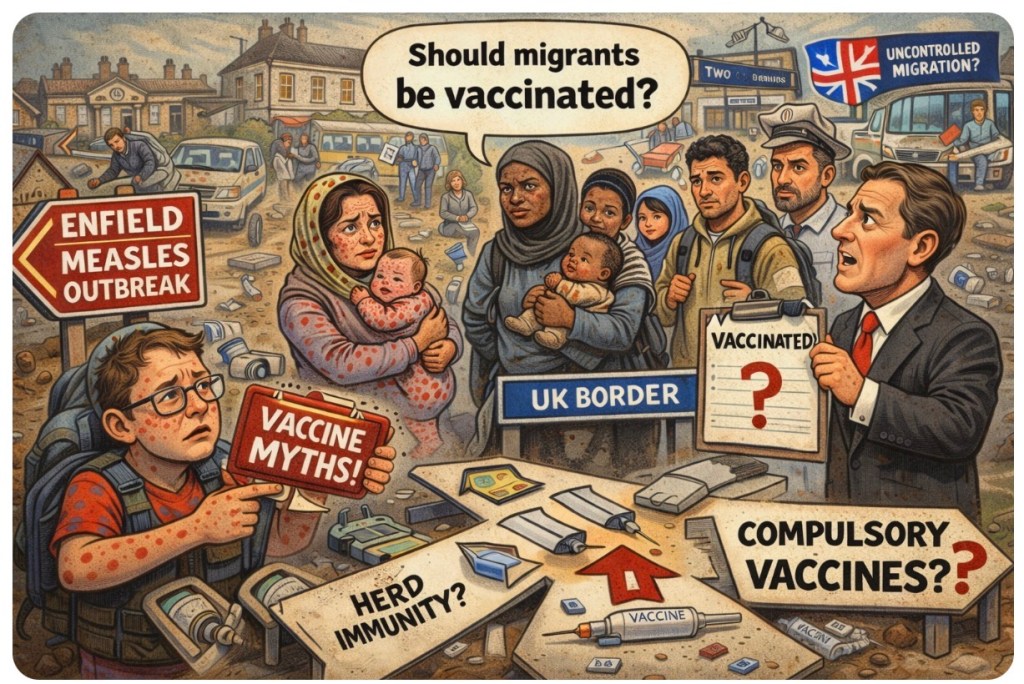
When a third of England’s recent measles cases land in one borough, it stops being a “blip” and starts looking like a bonfire. And right now, that bonfire is burning in Enfield.
Vaccination rates there have slumped to 65.8%. For herd immunity against measles, you need about 95%. That’s not a small gap — that’s a canyon.
Meanwhile, the government insists uncontrolled migration isn’t driving the outbreak. The virus, apparently, didn’t check passports at the border.
🦠 £1m Houses, Two Bus Rides, and a Virus That Doesn’t Care
Here’s the twist: Enfield isn’t some Dickensian backwater. It’s a London borough where Georgian homes can fetch seven figures. Yet beneath the property listings lies a different story.
Experts point to:
- Clinics “two bus rides away”
- Overstretched local services
- Poverty pockets hidden behind postcode prestige
- And yes — debunked vaccine myths still doing the rounds
Measles is brutally efficient. It doesn’t politely circulate — it burns through communities where vaccination coverage dips. One infected person can spread it to 12–18 others. That’s not politics. That’s epidemiology.
So what’s really going on?
Blaming migration might be politically convenient for some. Dismissing public concern outright might be convenient for others. But viruses operate on maths, not manifestos.
If immunisation rates fall below herd immunity thresholds, outbreaks happen. It’s that simple — and that uncomfortable.
And when parents describe becoming “hermits” to protect premature babies, this stops being abstract.
This is what public health erosion looks like in real time.
🌍 The Question Nobody Wants to Touch
Now let’s address the uncomfortable question being whispered — and shouted — online:
Are migrants automatically vaccinated before entering or mixing with the general public? And should they be?
In reality, the UK does not operate a blanket, compulsory vaccination programme at the border for all migrants. Vaccination policies vary depending on status (asylum seekers, refugees, visa holders), access to GP registration, and local public health outreach. Many arrivals are offered health screenings and encouraged to register with primary care services, where routine vaccinations — including MMR — are available free of charge.
But “available” and “administered” are not the same thing.
So should vaccination be mandatory before integration into the wider community? That’s where public health, civil liberties, logistics, and ethics collide.
Compulsory vaccination at entry points sounds straightforward — until you factor in:
- Legal rights and medical consent laws
- Administrative feasibility
- International obligations
- The reality that domestic uptake in places like Enfield is already below target
Because here’s the hard truth: if local vaccination rates sit at 65.8%, the outbreak can’t be explained by migration alone. Herd immunity collapses when overall community coverage falls — regardless of origin.
Viruses don’t distinguish between “new arrival” and “long-time resident.” They exploit gaps. And right now, those gaps are wide.
🔥 Challenges 🔥
Should the UK introduce mandatory vaccination checks for migrants? Or is that political theatre distracting from declining domestic uptake?
Is this outbreak about borders — or about broken trust in public health systems?
Head to the blog comments and tell us where responsibility really lies — and what practical solutions would actually stop the spread. 💬
👇 Comment. Like. Share. Debate.
The most compelling arguments will be featured in the next issue of the magazine. 📰🔥


 Chameleon Magazine
Leave a comment