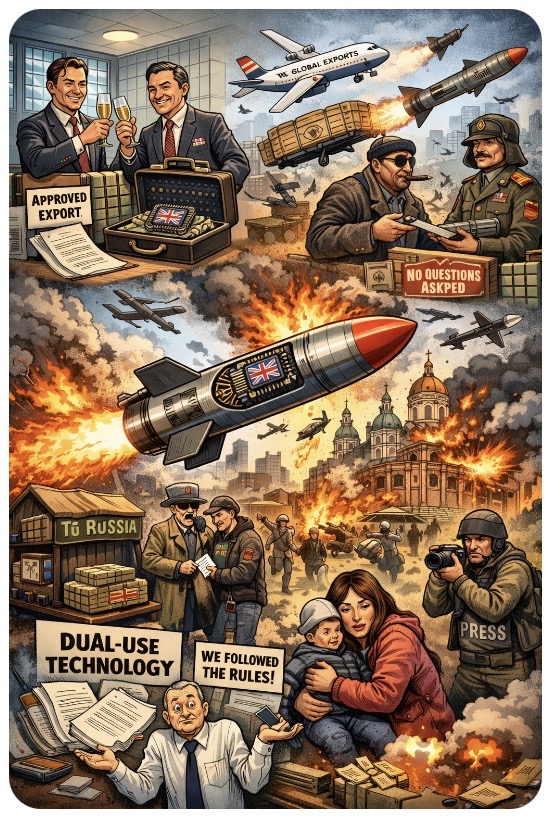
💻🚀💥Today’s “global success story” comes with a blast radius. British-designed microchips—conceived in tidy offices in Berkshire, polished in pitch decks about innovation and growth—have allegedly found themselves embedded in Russian missiles lighting up the skies over Kyiv.
Ah yes, globalisation. Delivering shareholder value… and occasionally high-explosive consequences. 🌍📈
Governments cheer exports. Companies celebrate “worldwide distribution.” And somewhere between a semiconductor lab and a smouldering apartment block, the phrase “dual-use technology” stops sounding like a footnote and starts sounding like an obituary.
🌍 Exporting Excellence… One Explosion at a Time
It’s almost poetic, isn’t it? A chip designed to optimise efficiency—now optimising trajectory. A component built to power cars, computers, or kettles—now powering a warhead. Innovation, but make it ballistic. 🎯
Let’s not pretend this is a spy thriller. There’s no tuxedoed villain stroking a cat in a volcano lair. It’s supply chains. It’s intermediaries. It’s third-party distributors. It’s “we complied with all regulations at the time.” It’s paperwork so thick it could stop a bullet—if only it were stacked in front of the right building.
We’re told this is the cost of doing business in a complex world. That chips are small, markets are vast, and control is difficult. Fair enough. But when “global reach” stretches from Berkshire to a crater in Kyiv, the slogan starts to feel less like a boast and more like a confession. 🧾🔥
And of course, everyone is “deeply concerned.” Concern is free. Accountability? That’s premium tier.
The uncomfortable truth? In the 21st century, the line between civilian progress and military application is thinner than a silicon wafer. The same microchip that helps your washing machine think can also help a missile calculate. Progress doesn’t pick sides. People do.
But hey, at least we’re competitive in the global marketplace. 🏆💣
🔥 Challenges 🔥
If innovation is neutral, who isn’t? Companies? Governments? Regulators? Or all of the above?
When does “we followed the rules” stop being enough? And who writes those rules in the first place? 🤔
Don’t just rage-scroll. Head to the blog and drop your take in the comments. Is this the inevitable messiness of global trade—or a failure hiding behind buzzwords?
👇 Comment. Like. Share. Tag the phrase “dual-use” and ask it how it sleeps at night.
The sharpest takes and fiercest replies will be featured in the next issue of the magazine. 📰✨


 Chameleon Magazine
Leave a comment