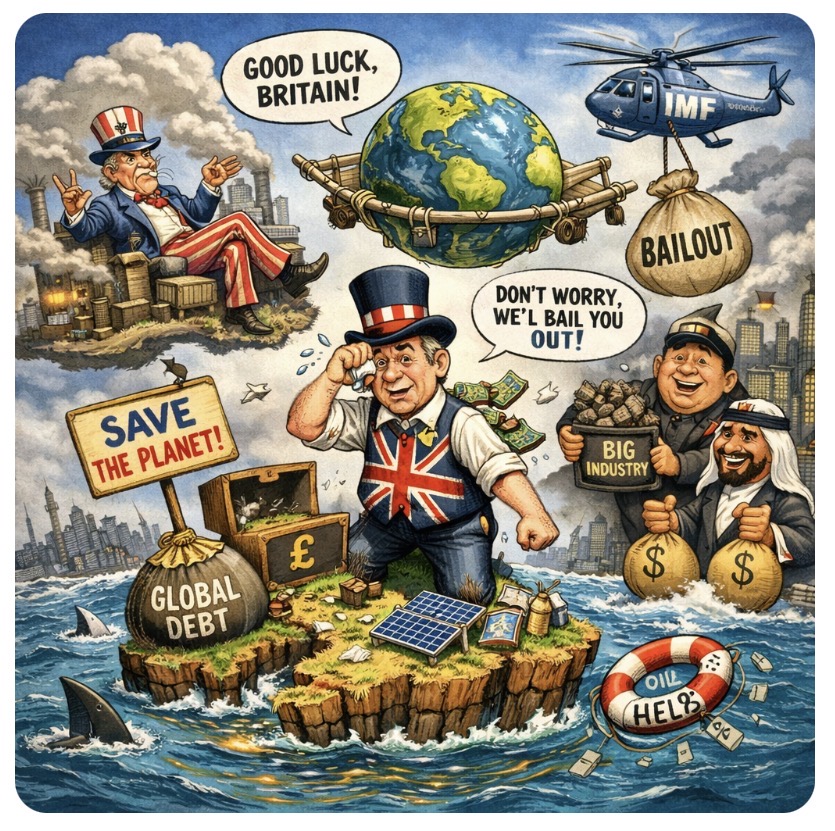
Let’s zoom out for a second. Have you seen the size of Britain on a globe? You practically need a magnifying glass and good lighting. Yet somehow this modest, rain-soaked archipelago is expected to bankroll planetary redemption while continents the size of dinner plates carry on business as usual. 🌧️🗺️
The frustration is simple: why should British families shoulder soaring costs for a global moral crusade if others aren’t equally invested? Why bankrupt ourselves for virtue points, only to need a bailout later? That’s not climate policy—that’s fiscal performance art. 🎭💷
🏝️ The Mighty Micro-Nation vs. The Mega-Emitters
Yes, Britain should innovate. Yes, we should lead in clean tech. Yes, sharing expertise in offshore wind, grid systems, and carbon reduction makes strategic sense. That’s smart economics. That’s exporting knowledge instead of exporting apologies. ⚡📈
But there’s a difference between leadership and self-immolation.
If a handful of nations aggressively decarbonise while others expand fossil fuel production, the atmospheric math doesn’t magically rebalance out of politeness. Carbon doesn’t carry passports. 🌫️
And here’s the awkward bit: not every country wants lectures. Not every government prioritises long-term environmental planning over short-term growth. Some are racing to industrialise now—exactly as Britain once did—because lifting populations out of poverty tends to win elections.
So the real debate isn’t “Should Britain do nothing?” It’s “What’s proportionate?”
Investing in innovation? Sensible.
Collaborating globally? Essential.
Deliberately crippling your own economy to make a philosophical point? That’s less Churchill, more cautionary tale.
Because if a country hollows out its productive base chasing unattainable moral purity, someone eventually writes the rescue cheque—and that cheque always comes with strings. 🎯
Leadership that strengthens your economy while lowering emissions? Strategic.
Leadership that weakens your economy while hoping others follow? Risky.
The planet needs cooperation, not martyrs. 🌎🤝
🔥 Challenges 🔥
Is Britain’s role to lead through innovation—or to atone through austerity?
Where’s the line between responsibility and recklessness? Between moral duty and economic suicide?
Don’t just simmer about it—drop your argument in the blog comments. Bring facts. Bring fire. Bring fiscal logic. 💬🔥
👇 Comment. Like. Share. Let’s have the debate properly.
The sharpest takes will be featured in the next issue of the magazine. 📝⚡


 Chameleon Magazine
Leave a comment