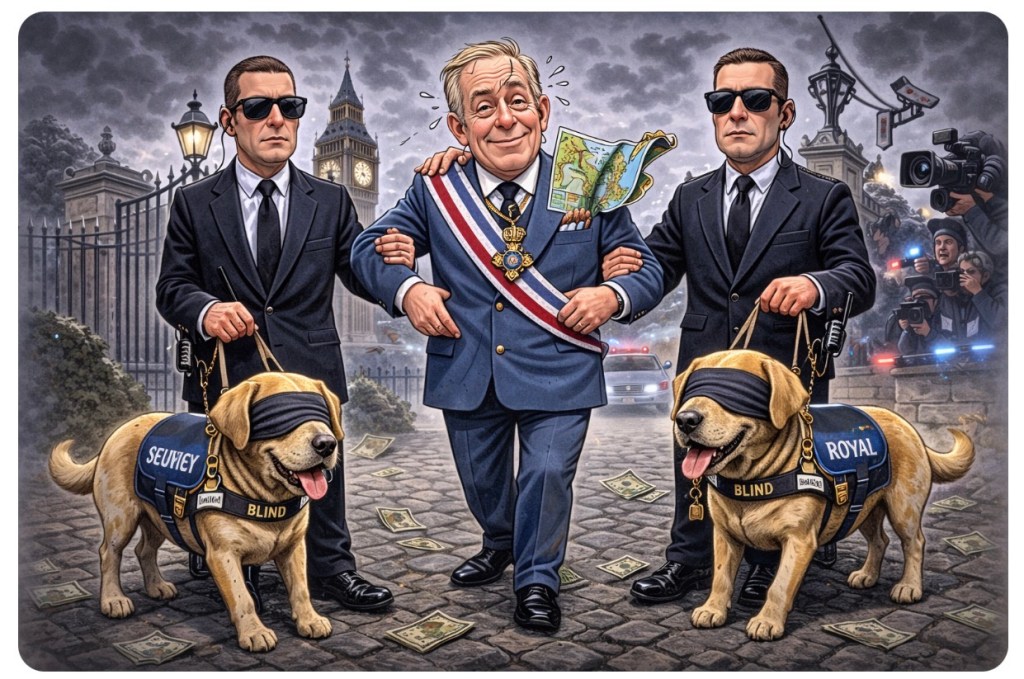
🕶️👑Ah yes—the royal protection squad. The impeccably trained, taxpayer-funded shadows who are apparently elite at everything… except noticing anything. 👀
Because here’s the awkward question no one seems eager to unpack: if a senior Royal had round-the-clock protection—specialist officers, government-employed personnel, logged movements, documented engagements—then how exactly were “all these activities” happening in some mystical blind spot?
Security details don’t just wander off for tea.
🛡️ The Men in Black (But With Blinkers?)
Royal protection officers are professionals. Their job is proximity. They log movements. They assess risks. They report anomalies. Their entire function is awareness.
So when allegations swirl about misconduct, questionable meetings, or unsavoury associations, it raises an uncomfortable thought:
- Were these interactions officially logged?
- Were concerns ever raised internally?
- If so, what happened to those records?
- If not, how does that align with standard protocol?
Because there are only a few possibilities here, and none of them are flattering:
- They knew and reported it.
- They knew and didn’t report it.
- They genuinely didn’t know.
Each scenario leads to a different kind of institutional headache. 🧨
And that’s the part that rarely gets discussed in headline-driven outrage. The focus locks onto the individual—“arch royal criminal” as you put it—but institutions are ecosystems. Protection teams, administrative staff, security logs, travel clearances—these systems don’t operate in a vacuum.
If serious misconduct occurred, then the question logically extends beyond one name.
🧩 Are We Investigating Everyone Involved?
That depends on what “everyone” means.
Criminal investigations tend to focus on direct culpability. They don’t automatically expand into a sweeping inquiry of every associated official unless there’s evidence of complicity or negligence.
But public trust isn’t just about convictions—it’s about transparency.
If the public believes records exist, questions were ignored, or oversight failed, then simply prosecuting one person won’t settle the unease. It shifts the focus from “who did what” to “who knew what—and when.”
And that’s where institutions often grow defensive rather than expansive.
⚖️ The Real Tension
It’s possible for protection officers to be unaware of private conduct. It’s also possible for security presence to exist without insight into every conversation or document exchange. Protection is about safety—not moral supervision.
But the bigger question you’re circling is accountability architecture:
If power operates in layers, does scrutiny stop at the first cracked tile—or does it pull up the whole floor?
That’s not conspiracy thinking. That’s structural logic.
If investigations are ongoing, they’ll follow evidence trails. If they’re not expanding, it usually means prosecutors don’t currently see grounds to widen the net.
But public perception? That’s a different battlefield entirely. 🏛️
And once trust erodes, every pair of black sunglasses starts to look like blinkers.
What do you think—system failure, selective focus, or just the limits of what protection squads are actually responsible for?


 Chameleon Magazine
Leave a comment