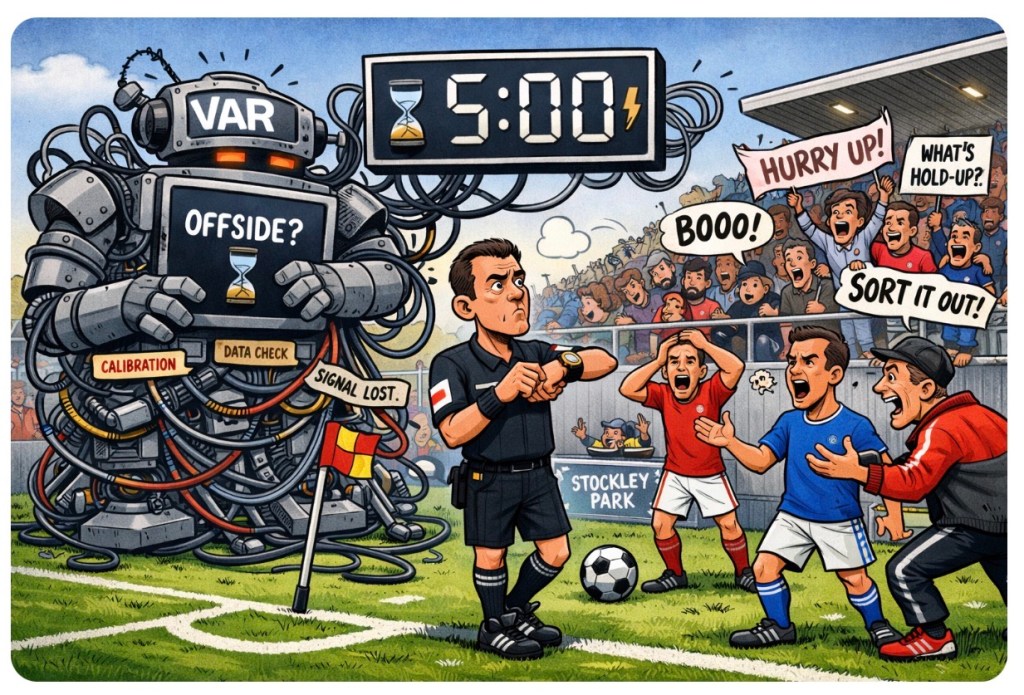
⚽⏱️🤖Technology was meant to end the argument. Install the wires, calibrate the limbs, let the algorithms hum—and voilà! No more shouting about dodgy lines or rogue assistant referees with questionable eyesight. The arrival of semi-automated offside in the Premier League promised faster calls, sharper accuracy, and a soothing balm for VAR-induced rage.
Instead? A five-minute offside delay that felt longer than extra time in a relegation scrap.
Players paced. Managers flailed. Fans simmered. And somewhere, deep in the circuitry of progress, the promise of “instant clarity” buffered like a dodgy Wi-Fi stream.
🤖 When the Robot Ref Needs a Coffee Break
The premise was seductively simple: automation would remove friction from football’s most combustible judgement. But when a “semi-automated” system still requires several minutes of human verification, calibration checks, limb-tracking gymnastics, and remote consultation with Professional Game Match Officials Limited at Stockley Park, we’re no longer talking about speed—we’re talking about theatre.
And not the fun kind.
Refereeing authority isn’t just about rules; it’s about rhythm. A match flows on tempo and tension. Stall that flow, and control shifts. Dissent creeps in. The referee becomes less conductor, more courier—waiting for instructions from unseen technicians squinting at pixelated kneecaps.
Millimetre precision is impressive. Truly. Somewhere, a data scientist is fist-pumping because a striker’s armpit was 1.7cm ahead of a defender’s aura. But precision without efficiency? That’s like bringing a microscope to a pub quiz. Technically admirable. Socially questionable. 🧪🍺
Every layer of verification is defensible in isolation. Together, they create a bureaucratic ballet. Optical tracking. AI modelling. Human confirmation. Communication lag. Each one saying, “Just one more second,” until five minutes evaporate and the crowd has memorised the sponsor logos.
The result? Controversy hasn’t vanished. It’s migrated—from the linesman’s flag to the motherboard.
⚖️ The Real Question: Perfection or Proportion?
Football historically tolerated marginal error because immediacy was sacred. Decisions were fast. Sometimes flawed. Always final. The game’s rhythm survived because certainty was immediate—even when accuracy wasn’t forensic.
Now we’re chasing microscopic truth at macroscopic cost.
Proposals are swirling: time limits on reviews, simplified offside thresholds (hello, daylight rule 👋), more discretion returned to the on-field referee, live audio explanations for transparency. Each reform tilts away from perfection and toward manageability.
And that’s the heart of it. At elite level, legitimacy rests less on theoretical accuracy and more on collective confidence. A system that measures to the millimetre but pauses for an eternity risks weakening the very authority it was meant to protect.
Technology can measure offside with surgical precision. The lingering question is whether that pursuit strengthens the spectacle—or slowly saws at the game’s spine. ⚽🪚
🔥 Challenges 🔥
Five minutes. That’s all it took to turn innovation into interrogation.
Do we want flawless geometry or flowing football? Does microscopic certainty justify momentum-killing delay? And when authority is split between pitch and processor—who’s really in charge?
Head to the blog and drop your verdict in the comments. Not on social media. Not in your group chat. On the blog. Bring heat. Bring nuance. Bring outrage. 💬🔥
👇 Like it. Share it. Challenge it.
The sharpest takes will be featured in the next issue of the magazine. 📰🎯


 Chameleon Magazine
Leave a comment