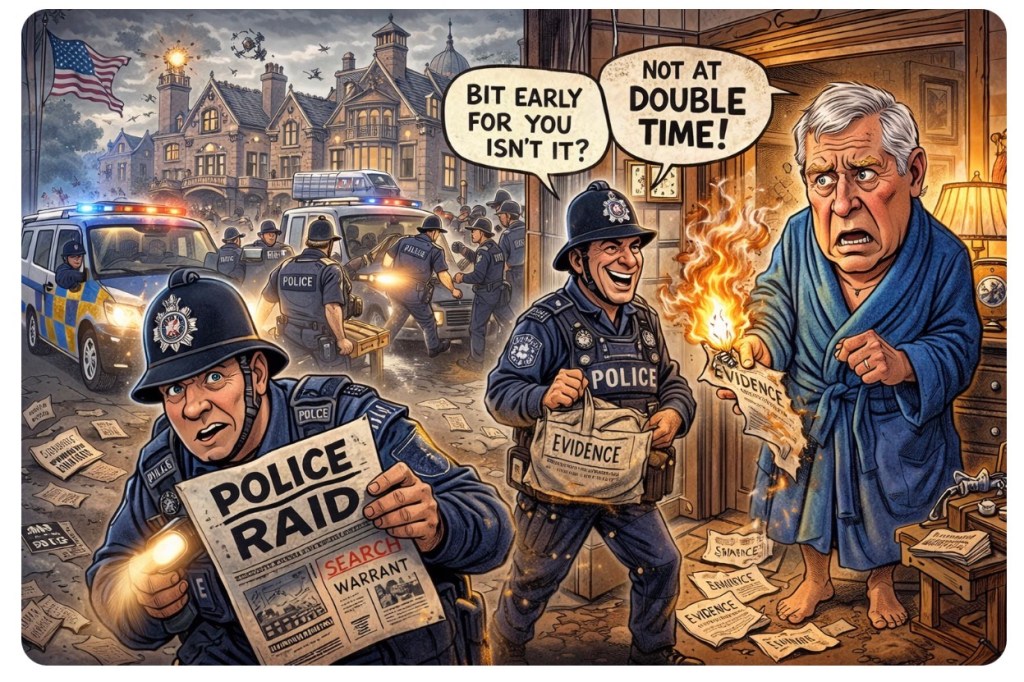
There’s something almost poetic about a Saturday morning police raid.
While most of Britain is nursing tea and toast, a team of officers is reportedly making its way into the new home of Andrew Mountbatten — blue lights flashing, paperwork ready, and overtime forms quietly smiling in the background.
Some might mutter: “A couple of years too late.”
Others might say: “Better late than never.”
And somewhere in the ranks, a few officers might be thinking:
“Well, that’s double time sorted.” ☕💷
🚪 Operation: Belated Urgency
Nothing screams “pressing national priority” like a Saturday dawn search.
Because clearly, the risk was imminent.
We wouldn’t want any evidence being destroyed — especially if it’s had years to… relax.
So out come the boots.
Out come the warrant folders.
Out come the slightly theatrical optics.
The optics, of course, matter.
When dealing with members of the aristocratic ecosystem, timing is everything. You must balance:
- Public outrage
- Institutional reputation
- Legal caution
- And the ever-delicate dance of deference
Too fast? Reckless.
Too slow? Complicit.
Too theatrical? Political.
Too quiet? Suspicious.
It’s a masterclass in procedural choreography. 🎭
🏰 The Royal Double Standard Debate
Here’s where it gets uncomfortable.
If this were an ordinary citizen, would it have taken this long?
That question is what fuels the cynicism.
Britain likes to believe in equal application of the law — that titles don’t shield and surnames don’t soften scrutiny.
But every high-profile case involving establishment figures becomes a stress test of that belief.
And stress tests reveal cracks.
🕰️ Timing Is Everything
The irony isn’t the search itself.
It’s the timeline.
When urgency arrives years after allegations first surfaced, the public is left wondering:
Was this strategic patience?
Legal necessity?
Or institutional hesitation?
And once doubt creeps in, trust becomes collateral damage.
🧾 Optics vs. Outcomes
Of course, a search warrant doesn’t equal guilt.
It signals investigation.
But in the court of public opinion, symbolism travels faster than legal nuance.
Police vans outside a royal residence send a message far louder than any press statement ever could.
The real question isn’t whether officers got overtime.
It’s whether the system demonstrates consistency.
Because in democracies, the perception of equal justice is almost as important as justice itself.
🔥 Challenges 🔥
Is this a sign that no one is above the law? Or a reminder that some investigations move at a very different pace? 🤔
Does delayed action protect due process — or erode public trust?
Take it to the blog comments. Not whispers. Not rumours. Real discussion. 💬
👇 Like. Share. Comment.
Is Britain proving equality before the law — or rehearsing damage control?
The sharpest insights will be featured in the next issue of the magazine. 📰⚖️


 Chameleon Magazine
Leave a comment