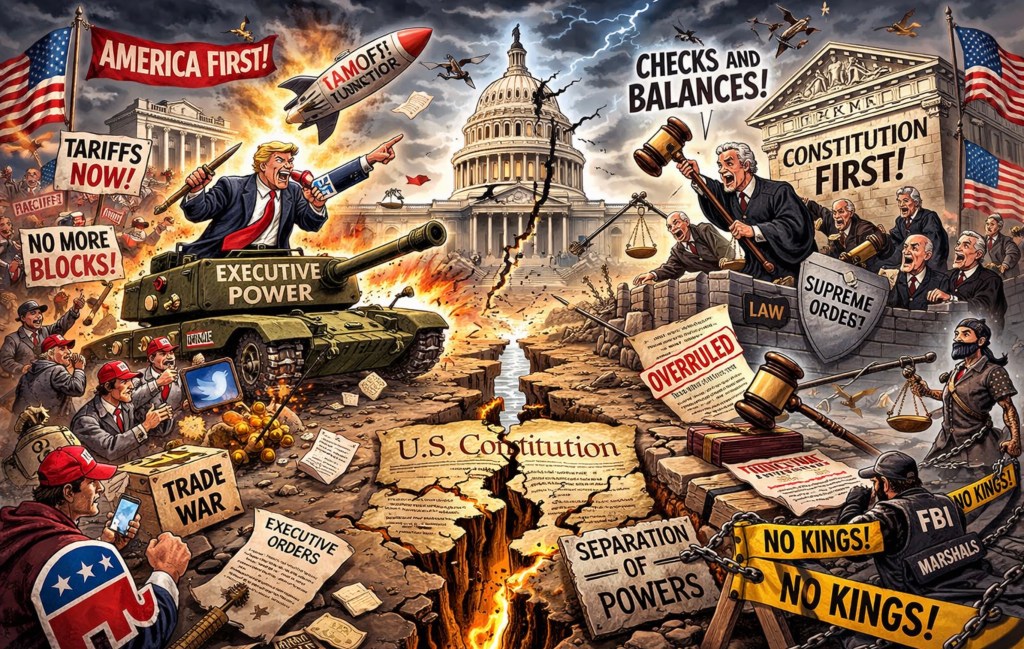
At 5:55am GMT, the economic chessboard caught fire.
The Donald Trump’s sweeping global tariffs? Struck down.
The Supreme Court of the United States said the president did not have the authority to impose them using executive powers.
And in true Trumpian fashion, the response wasn’t retreat.
It was escalation.
A vow of 10% blanket tariffs on all imports.
Because when the gavel falls… apparently you build a bigger hammer. 🔨🔥
⚔️ The Battle of the Branches: Executive Ego vs. Judicial Robes
The Court delivered a constitutional reminder:
Executive power has limits.
But this isn’t just legal fine print — this is political theatre at full volume.
Picture it:
Nine justices in solemn robes.
One president with a megaphone.
Markets watching nervously.
Allies blinking twice.
And somewhere in the West Wing basement (at least in the public imagination), a whiteboard appears:
“Plan B: Make Them Regret It.”
Will the judges be “sitting so pretty” now? Or have they stepped directly into the rhetorical crosshairs?
Because when a president frames the judiciary as obstructive elites blocking “America First,” the fallout doesn’t stay confined to law journals.
It spills into:
- Markets 📉
- Trade relationships 🌍
- Political polarization ⚡
- Public trust in institutions 🧨
💰 Who Pays the Price?
Tariffs aren’t mystical punishment spells cast on foreign governments.
They’re taxes on imports.
Which means:
- Businesses pay more.
- Consumers pay more.
- Supply chains tighten.
- Retaliatory tariffs follow.
Trade wars rarely produce clean winners.
They produce higher costs and louder speeches.
If this escalates into a constitutional tug-of-war — executive orders vs. judicial injunctions — uncertainty becomes the most expensive commodity in America.
Markets hate uncertainty.
Voters eventually do too.
🏛️ “Do We Even Need Them?” — The Dangerous Question
Here’s where the rhetoric turns radioactive.
If a president begins publicly questioning the necessity or legitimacy of the Supreme Court, the issue isn’t tariffs anymore.
It’s separation of powers.
The American system was built on friction — deliberate friction — between branches.
The Court checks the president.
Congress checks the president.
The president checks them back.
It’s not elegant.
It’s designed to prevent concentrated power.
But when friction becomes feud, institutions start looking like opponents instead of partners.
And that’s when political conflict morphs into constitutional stress.
🎭 Revenge Politics or Strategic Posturing?
Is this a revenge arc?
Or is it strategic theatre for domestic audiences?
Trump’s vow of 10% blanket tariffs may be:
- A pressure tactic
- A campaign positioning move
- A test of constitutional boundaries
- Or simply escalation as spectacle
But every escalation carries real economic ripples.
Trade partners respond.
Markets respond.
Courts respond again.
And suddenly, what began as a legal ruling becomes a global chess match.
🔥 The Bigger Question
This isn’t just about tariffs.
It’s about whether American governance remains a system of negotiated power — or becomes a stage for dominance politics.
If presidents ignore judicial rulings, you drift toward executive supremacy.
If courts aggressively curb executive power, you risk political backlash.
The cost?
Public trust.
And once that erodes, rebuilding it is harder than rebuilding trade agreements.
🔥 Challenges 🔥
Is this healthy constitutional tension… or the beginning of institutional erosion? 🤯
Who ultimately pays for a war between the White House and the bench?
And here’s the uncomfortable one:
If economic nationalism clashes with constitutional limits, which side should win?
Take it to the blog comments — not just social media noise. Real debate. Real argument. 💬
👇 Like. Share. Comment.
Are we watching democracy flex its muscles… or strain them?
The sharpest, boldest responses will be featured in the next issue of the magazine. 📰⚖️


 Chameleon Magazine
Leave a comment