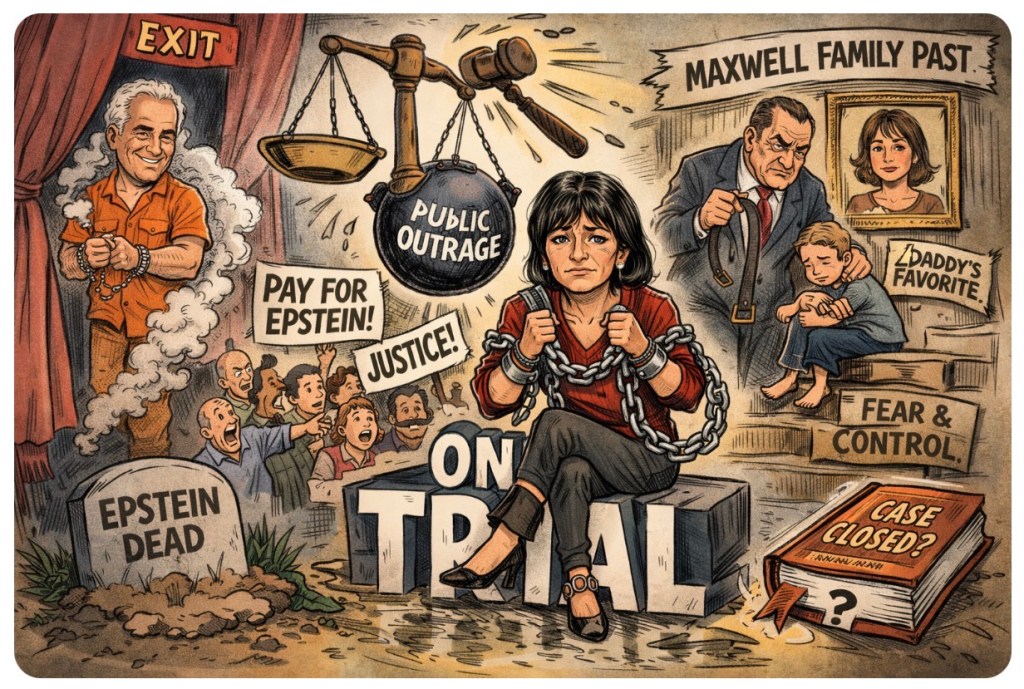
⚖️🕳️When Jeffrey Epstein died in a jail cell, the narrative engine didn’t stall — it accelerated. The spotlight pivoted sharply to Ghislaine Maxwell, whose later conviction seemed, to many, like the final chapter in a saga of wealth, abuse, and impunity. Case closed. Curtain down. Justice served.
But her brother offers a counter-script: that she became the person who “had to pay the price” because Epstein no longer could. Not a denial of his crimes. Not even a wholesale denial of hers. Instead, a reframing — that in the absence of the principal offender, the remaining defendant becomes both participant and proxy.
And that’s where the discomfort lives.
🎭 The Proxy Problem: When One Defendant Carries the Weight of Two
Legal systems prosecute the living. Media cycles prosecute the symbolic. When the central figure vanishes, institutions still require resolution — juries still deliberate, headlines still need conclusions, the public still demands moral punctuation.
So what happens when the story’s main antagonist exits before sentencing?
The remaining defendant risks becoming more than an individual. They become narrative closure. A container for unresolved fury. A human full stop.
That does not erase culpability. Maxwell was convicted in court. Evidence was weighed. A jury decided. But her brother’s argument isn’t about technical guilt — it’s about proportional gravity. Would the distribution of outrage, blame, and punishment have felt different had Epstein stood trial beside her?
We cannot test the counterfactual. We can only examine the structure.
And structurally, when a system loses its primary villain, it still seeks equilibrium. ⚖️
🏛️ Inheritance of Power: The Maxwell Household as Origin Story
To support his claim, her brother points back to their upbringing under Robert Maxwell — a man whose own life ended in scandal and mystery.
He describes a household ruled by hierarchy and fear. Academic failure allegedly met with belts for boys and hairbrushes for girls. Affection conditional. Status stratified. Ghislaine, he says, was the “golden girl” — favoured, yet not exempt from discipline.
This context does not establish innocence. It does not function as exoneration. It operates as explanation — or at least an attempt at one.
The implication hovers rather than lands: that formative instability might shape later loyalties, blind spots, or complicity. But biography is not absolution. Many endure harsh childhoods without entering criminal conspiracies. Context informs; it does not acquit.
Still, origin stories matter in public imagination. We crave psychological symmetry as much as legal clarity. 🧠
🧩 Closure vs. Accountability
The deeper question is institutional, not personal.
When the central perpetrator dies, societies still demand closure. Governments still prosecute available defendants. Media narratives still seek a clean arc. But closure and proportional accountability are not always identical.
Was Maxwell punished for her role — or did she absorb, symbolically, the moral debt of a dead man?
That is the unresolved tension.
Her brother’s defence hinges on an unknowable alternative timeline: if Epstein had lived, perhaps blame would have been distributed differently. Perhaps the architecture of public fury would have been more evenly shared.
But counterfactuals do not enter evidence. Only records do.
And the record delivered a conviction.
Yet the philosophical question lingers: when the primary villain exits the stage, does justice narrow — or does it concentrate? 🎯
🔥 Challenges 🔥
If the architect of a crime dies before trial, does justice become compressed into whoever remains? Is that accountability — or narrative convenience?
We want your sharpest take. Is this proportional justice or symbolic substitution? Don’t argue on social media — bring it to the blog where the debate actually lives. 💬⚡
👇 Comment. Challenge the premise. Defend the system. Or dismantle it.
Like and share if you think justice and closure aren’t always twins.
The most incisive, fearless comments will be featured in the next issue of the magazine. 📰🔥


 Chameleon Magazine
Leave a comment