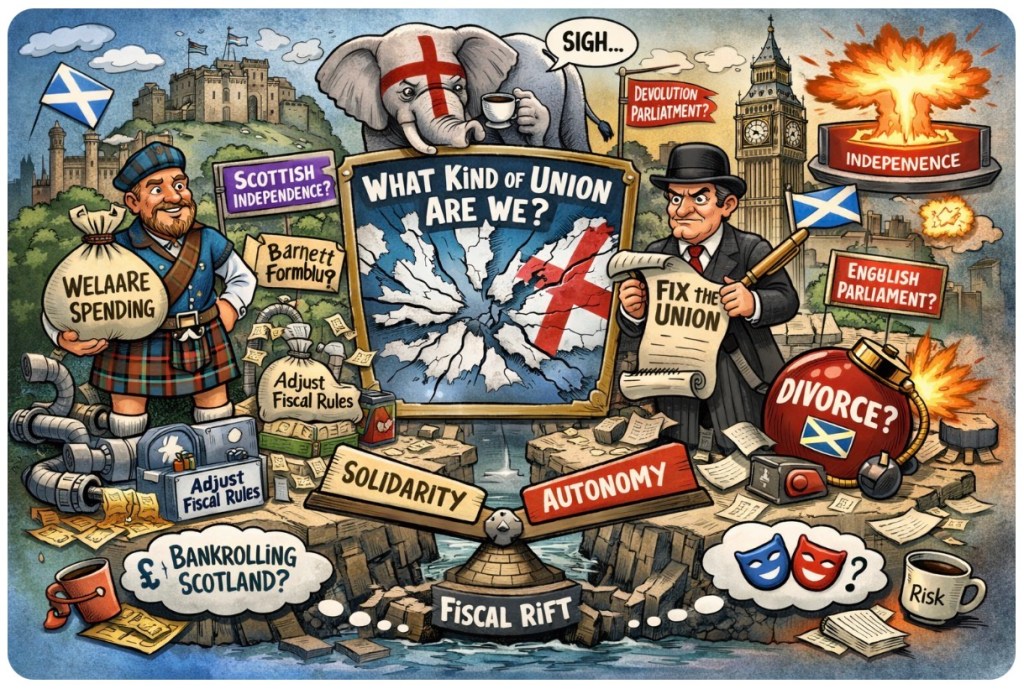
💷🏴Scotland spends more on welfare. England notices. Eyebrows rise. Someone mutters “we’re paying for it.” And just like that, what looks like a spreadsheet squabble morphs into a full-blown constitutional identity crisis. 🧾🔥
Is this a tidy accounting issue? Or is it the UK staring into a mirror and realising it never decided what kind of family it actually is?
🏛️ The Union’s Awkward Money Talk Nobody Wants to Have
Let’s start with the polite version. If Westminster believes Scotland’s welfare generosity is stretching the system, it can tinker. Adjust the fiscal framework. Revisit the Barnett formula. Tighten borrowing limits. Refine “no detriment” rules. In short: recalibrate the plumbing without tearing down the house. 🚰📊
But plumbing in a centuries-old constitutional mansion isn’t simple. Touch the pipes and suddenly it’s “Westminster clawback!” 🛠️⚡ Cooperation would be required — which in 2026 politics is roughly as common as a calm Twitter thread.
Option two? Harder devolution. Scotland raises nearly all its own revenue. The block grant shrinks. Welfare generosity must be matched by Scottish taxation. Accountability sharpens. The subsidy narrative fades. 💸🔍
But so does risk pooling. Economic volatility increases. And the political distance between systems widens. Congratulations — you’ve clarified responsibility and quietly strengthened the case for separation at the same time. 👀🏴
Then there’s the elephant wearing a St George’s flag: England has no devolved parliament of its own. That asymmetry fuels grievance politics. An English Parliament? Stronger regional devolution? A revival of “English Votes for English Laws”? 🇬🇧🗳️
Structural symmetry sounds tidy. In practice, it means redesigning the machinery of the state mid-flight. Turbulence not included — because it’s guaranteed.
And finally, the nuclear option: dilute or end the fiscal union entirely. Separate budgets. Limit redistribution. Or go all the way to independence. 🚪💥
At that point, the welfare debate stops being about benefits and starts being about sovereignty, currency, trade, debt, defence — and who gets custody of the awkward family WhatsApp group.
But here’s the quiet truth: divergence was the point of devolution. Different policy choices were not a bug; they were a feature. If Scotland chooses higher welfare and England prefers restraint, that’s self-government operating within agreed rules — not necessarily a malfunction. 🧩
The phrase “England is bankrolling Scotland” assumes a tightly controlled fiscal state with narrow behavioural limits. The phrase “shared risk in a union” assumes diversity bounded by rules. 🏦🤝
Pick your philosophy. Because you can’t have both at full volume.
The deeper tension isn’t about benefits. It’s about whether the UK is a unified fiscal state with strict discipline — or a union that tolerates policy divergence in exchange for shared stability.
Every technical tweak collides with that unresolved question.
So what looks like a dispute over welfare spending is really a proxy war between solidarity and autonomy, clarity and stability, unity and self-government. 🎭
And until the UK decides what kind of fiscal union it wants to be, the argument won’t go away — it will just keep resurfacing in different spreadsheets.
🔥 Challenges 🔥
Is this about fairness — or fear of divergence? 🤔
Is Scotland testing the limits — or is the Union testing its own identity?
And if England holds the constitutional pen, what story should it actually write?
Drop your take in the blog comments — not just the socials. Bring your data, your sarcasm, or your constitutional philosophy. 💬📣
👇 Comment. Like. Share. Argue responsibly (or gloriously).
The sharpest insights — and the spiciest disagreements — will be featured in the next issue of the magazine. 📰🔥


 Chameleon Magazine
Leave a comment