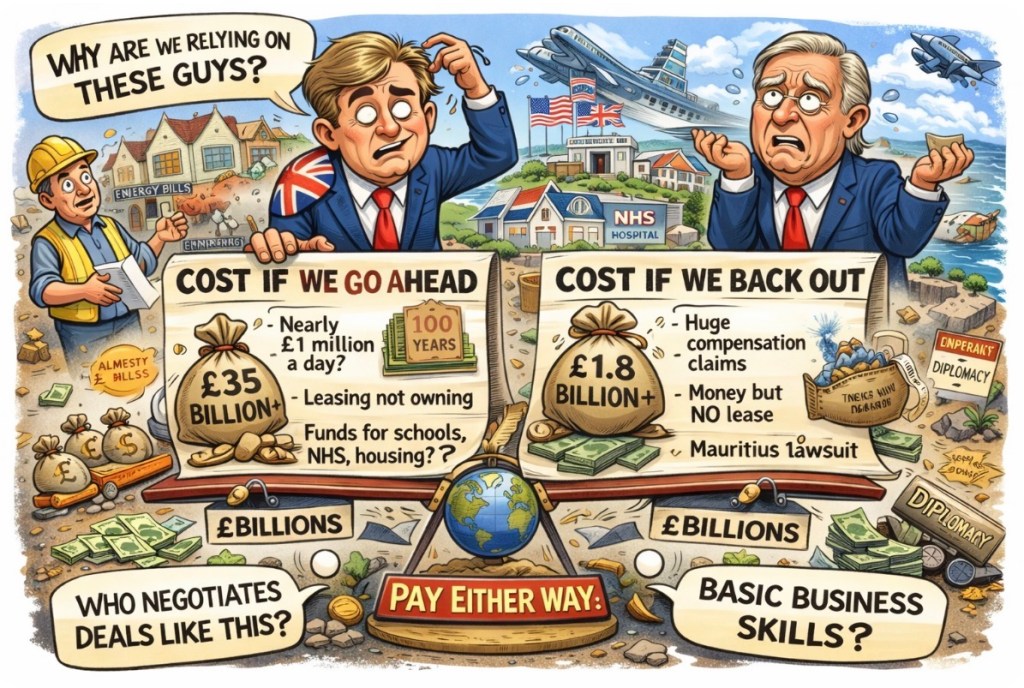
99-Year IOU: Why Are We Paying Billions Either Way? 💷🏴
Here’s the simple version.
The government agreed to hand over sovereignty of the Chagos Islands to Mauritius — but lease back the military base on Diego Garcia for 99 years.
They say it gives us “legal clarity” while keeping the base secure.
But when you strip away the fancy words, it boils down to this:
We’re either paying a fortune to go ahead…
or paying a fortune to back out.
And working people will foot the bill. 💸
💰 What It Costs If We Go Ahead
Reports suggest the deal could cost around £35 billion over 100 years.
That’s roughly:
- £350 million a year
- Nearly £1 million a day
- Money that could fund nurses, housing, schools or energy bills relief
And what do we get? A lease. Not ownership. A rental agreement.
If future U.S. politics change or global tensions shift, the “security guarantee” could weaken. A lease only works if both sides stay happy for nearly a century.
That’s a big gamble.
⚖️ What It Costs If We Pull Out
If Britain withdraws after agreeing in principle:
- Mauritius could take legal action.
- We could face huge compensation claims.
- Early payments already discussed are reportedly around £1.8 billion.
- Long-term claims could run much higher.
So walking away doesn’t mean saving money.
It means paying — without getting the lease.
That’s like putting down a deposit on a house, cancelling the purchase, and still owing the seller a fortune.
🧠 Where It Starts to Look Like Failure
For ordinary people, here’s what doesn’t make sense:
- Why agree to something that costs billions no matter what?
- Why put the country in a position where both options are financially painful?
- Why wasn’t this negotiated in a way that protects taxpayers first?
This isn’t about empire nostalgia.
It’s about basic deal-making.
In business, a good negotiation protects your downside.
Here, the downside seems to exist either way.
If you proceed — you pay billions.
If you retreat — you pay billions.
That’s not leverage.
That’s exposure.
🏗 What That Money Really Means
£35 billion is not abstract.
That could mean:
- Thousands of new council homes
- Major NHS investment
- Lower energy costs support
- Infrastructure upgrades across struggling regions
Instead, it may go into smoothing over a diplomatic headache.
And that’s where frustration grows.
🤔 The Bigger Question
Why are we relying on politicians — many of whom have never run a business, negotiated major commercial contracts, or been trained in high-stakes financial bargaining — to handle deals worth tens of billions?
Why do ego, headlines and legacy often seem to matter more than airtight negotiation for the British public?
If this were a private company and leadership locked shareholders into a deal where both the “yes” and the “no” cost billions, serious questions would be asked.
So why don’t we ask them here?
Are we getting strategic leadership…
or political theatre with a very expensive invoice?
Over to you.Here’s the simple version.
The government agreed to hand over sovereignty of the Chagos Islands to Mauritius — but lease back the military base on Diego Garcia for 99 years.
They say it gives us “legal clarity” while keeping the base secure.
But when you strip away the fancy words, it boils down to this:
We’re either paying a fortune to go ahead…
or paying a fortune to back out.
And working people will foot the bill. 💸
💰 What It Costs If We Go Ahead
Reports suggest the deal could cost around £35 billion over 100 years.
That’s roughly:
- £350 million a year
- Nearly £1 million a day
- Money that could fund nurses, housing, schools or energy bills relief
And what do we get? A lease. Not ownership. A rental agreement.
If future U.S. politics change or global tensions shift, the “security guarantee” could weaken. A lease only works if both sides stay happy for nearly a century.
That’s a big gamble.
⚖️ What It Costs If We Pull Out
If Britain withdraws after agreeing in principle:
- Mauritius could take legal action.
- We could face huge compensation claims.
- Early payments already discussed are reportedly around £1.8 billion.
- Long-term claims could run much higher.
So walking away doesn’t mean saving money.
It means paying — without getting the lease.
That’s like putting down a deposit on a house, cancelling the purchase, and still owing the seller a fortune.
🧠 Where It Starts to Look Like Failure
For ordinary people, here’s what doesn’t make sense:
- Why agree to something that costs billions no matter what?
- Why put the country in a position where both options are financially painful?
- Why wasn’t this negotiated in a way that protects taxpayers first?
This isn’t about empire nostalgia.
It’s about basic deal-making.
In business, a good negotiation protects your downside.
Here, the downside seems to exist either way.
If you proceed — you pay billions.
If you retreat — you pay billions.
That’s not leverage.
That’s exposure.
🏗 What That Money Really Means
£35 billion is not abstract.
That could mean:
- Thousands of new council homes
- Major NHS investment
- Lower energy costs support
- Infrastructure upgrades across struggling regions
Instead, it may go into smoothing over a diplomatic headache.
And that’s where frustration grows.
🤔 The Bigger Question
Why are we relying on politicians — many of whom have never run a business, negotiated major commercial contracts, or been trained in high-stakes financial bargaining — to handle deals worth tens of billions?
Why do ego, headlines and legacy often seem to matter more than airtight negotiation for the British public?
If this were a private company and leadership locked shareholders into a deal where both the “yes” and the “no” cost billions, serious questions would be asked.
So why don’t we ask them here?
Are we getting strategic leadership…
or political theatre with a very expensive invoice?
Over to you.


 Chameleon Magazine
Leave a comment