🎭🏛️
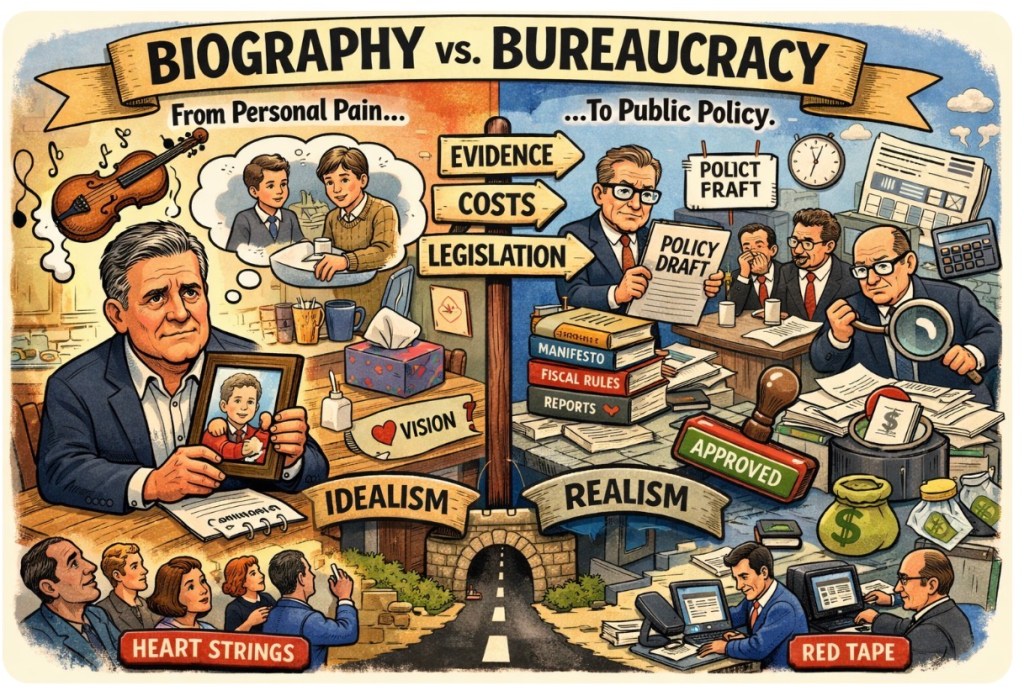
When a political leader reaches into their past and pulls out a deeply personal story, it feels like we’re witnessing the origin story of a reform superhero. Trauma becomes legislation. Memory becomes mandate. Grief becomes green paper.
Keir Starmer has spoken movingly about his late brother Nick’s struggles in school — a system that, in his words, “never had any expectations for him.” He’s described keeping his brother “in his mind’s eye” when thinking about education reform and inclusivity.
Cue the violins. 🎻
The narrative writes itself: private pain births public purpose. If you’ve seen the system fail someone you love, surely you’ll fix it.
But here’s the awkward, uncinematic truth: policy is not drafted at the family kitchen table. It’s forged in the fluorescent-lit trenches of committees, costings, manifestos, and late-night parliamentary wrangling.
🧾 The Myth of the Kitchen-Table Constitution
Let’s gently deflate the fantasy.
Democratic reform in the UK isn’t an autobiographical diary entry with a Treasury stamp. It has to survive:
- Party manifestos
- Fiscal constraints
- Parliamentary negotiation
- Civil service consultation
- Institutional frameworks
- And that ever-romantic force: “budget realism” 💷
Starmer’s education commitments — from SEND funding reform to tackling inequality — were pitched during the election campaign as part of Labour’s broader strategy. They weren’t scribbled on the back of a sympathy card.
And they can’t be.
Because while personal history may shape what rises to the top of a priority list, it cannot substitute for evidence, trade-offs, impact assessments, or political mandate.
Here’s the tension:
Personal story humanises. Institutions operationalise.
One gives you moral urgency. The other gives you spreadsheets.
And if you’ve ever met a spreadsheet, you’ll know — they are not moved by memory.
That doesn’t make the story irrelevant. Quite the opposite. Lived experience signals seriousness. It tells voters: this matters to me. It provides an emotional anchor in a sea of white papers and policy briefings.
But framing is not formation.
Motivation is not mechanism.
A leader may carry a sibling “in their mind’s eye,” but policy must pass through the public machinery of democracy.
Which leads to the uncomfortable civic question:
Are we evaluating the reform — or the narrative wrapped around it?
Because empathy can spotlight an issue.
Only governance can solve it.
🔥 Challenges 🔥
Are we too easily swayed by compelling backstories? Or do we demand enough evidence when billions are at stake? 🤔
Next time a leader tells you a deeply personal tale, ask yourself:
Is this the engine of policy — or the marketing?
Head to the blog comments (not just social media!) and tell us where you draw the line between moral motivation and measurable outcomes. Should biography earn trust — or must bureaucracy prove it?
👇 Comment. Like. Share. Disagree loudly but intelligently.
The sharpest insights will be featured in the next issue of the magazine. 📝✨


 Chameleon Magazine
Leave a comment