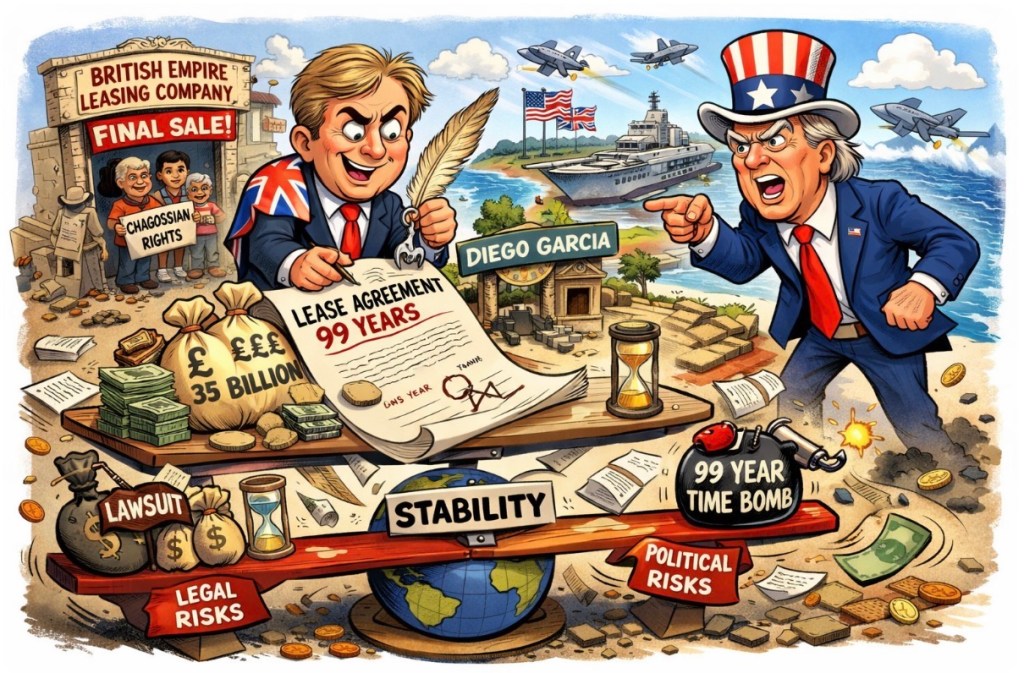
🏴☠️📝Britain appears to believe that empire can be concluded like a gym membership — a signature here, a direct debit there, and voilà: sovereignty transferred, conscience cleared, base secured. In 2025, the UK agreed to hand sovereignty of the Chagos Archipelago to Mauritius while leasing back Diego Garcia for 99 years, reportedly to the tune of £35 billion over a century. Legal alignment meets strategic continuity. Clean. Orderly. Sensible.
Except history rarely accepts instalment plans.
🧾 Sovereignty for Sale (Base Included, Terms & Conditions Apply)
At the centre of this geopolitical tightrope sits Diego Garcia — no palm-fringed postcard, but a linchpin of UK–US military operations stretching from the Middle East to the Indo-Pacific. The theory behind the agreement is elegant: legal sovereignty can change hands while operational control remains steady. Law bows; strategy carries on.
Enter Donald Trump, who publicly branded the arrangement a mistake and warned Keir Starmer against “giving away” strategic territory. Suddenly the 99-year lease looks less like granite and more like parchment. Because leases, unlike aircraft carriers, float on politics.
And politics shift.
If Washington’s consensus wobbles, London’s confidence follows. A base agreement is only as strong as the alliance mood sustaining it. What was marketed as strategic certainty now looks suspiciously like geopolitical Jenga. 🧱
Domestically, the split is just as sharp. Critics cry surrender. Supporters call it overdue compliance with international legal opinion and post-imperial reality. The same document reads as either prudent diplomacy or strategic retreat. It’s Schrödinger’s sovereignty — both bold and weak, depending on which newspaper you open. 📰
Then come the exit costs. If Britain pulls back after agreeing in principle, Mauritius could pursue arbitration or litigation. Early-decade payments alone reportedly approach £1.8 billion, with long-term projections much higher. Collapse the deal and you may still pay — just without the stability you thought you’d purchased.
Proceed, and face political backlash.
Withdraw, and face legal and financial consequences.
Choose your poison. 🍷
Meanwhile, the displaced Chagossians remain the moral core of the dispute. Any settlement that tidies up legal theory but sidesteps resettlement and recognition risks looking procedurally elegant and morally unfinished. The empire may be footnoted, but the people are not.
The contradiction is glaring: a deal designed to reduce uncertainty may have redistributed it instead — across alliance politics, domestic credibility, international law and long-term finance. Law, strategy and politics are not modular components. Tug one, and the others twitch.
If Britain ends up paying billions whether it proceeds or retreats, was this ever a clean solution? Or was it an expensive attempt to square pressures that were never truly compatible? 💸⚖️
History doesn’t close with a signature. It lingers in the fine print.
🔥 Challenges 🔥
If sovereignty can be transferred but uncertainty can’t, what exactly was secured here? Strategic stability — or strategic ambiguity with a payment plan?
Is this overdue legal realism? Or the illusion that paper guarantees can anchor geopolitical tides?
Drop your sharpest take in the blog comments (not just Facebook 👀). We want fury, logic, satire — or all three. 💬🔥
👇 Comment. Like. Share.
Let’s see who can draft the most ruthless verdict on Britain’s 99-year gamble.
The best comments will be featured in the next issue of the magazine. 📝✨


 Chameleon Magazine
Leave a comment