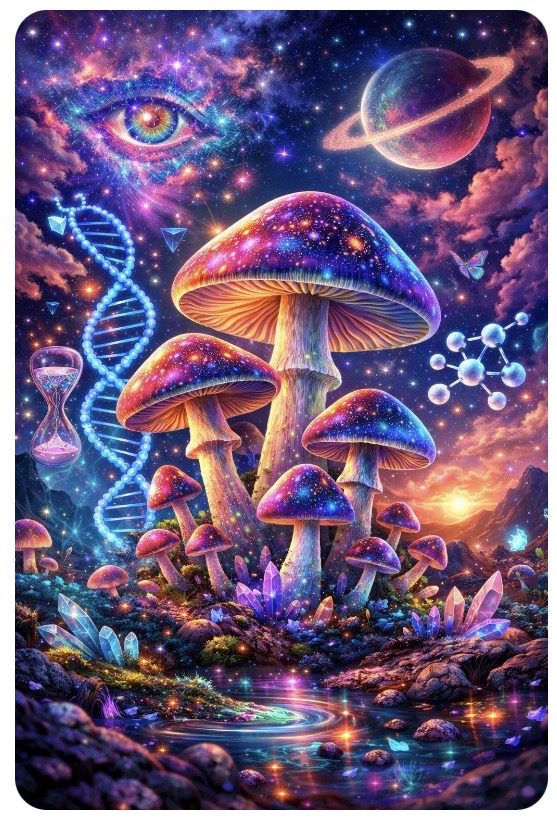
Psychedelics have long been filed under “mind-bending curiosities” — filed neatly between therapy breakthroughs and festival mishaps. The working assumption? They start in the brain and politely stay there.
A 2025 study from researchers at Emory University and Baylor College of Medicine just kicked that assumption squarely in the mitochondria.
Instead of asking what psilocybin does to your perception of the universe, scientists asked what its metabolite, psilocin, does to your cells. And the answer? Apparently, it tells them to hang in there a little longer.
Human skin cells exposed to psilocin survived about 51% longer than untreated cells. Fetal lung cells stretched that to a 57% lifespan boost. Not exactly immortality — but for cells, that’s the biological equivalent of discovering Pilates and green juice at 92.
In ageing mouse models, the results grew whiskers. Mice receiving monthly psilocybin treatments showed an 80% survival rate compared to 50% in untreated mice. They also aged more gracefully — less fur whitening, less physical decline. Basically, rodent Botox without the frozen expression.
🧬 The Trip That Doesn’t Stay in Your Head
Here’s where things get awkward for tidy scientific categories.
For decades, psychedelics have been discussed as tools for mood disorders, trauma processing, or existential redecoration. But if these findings hold, psilocybin may also interact with cellular senescence — the slow bureaucratic shutdown where cells stop dividing and start deteriorating.
In other words: the compound once accused of “just messing with your mind” might be whispering sweet motivational slogans to ageing tissue.
This doesn’t mean magic mushrooms are about to replace retirement planning. These findings are preliminary. They come from lab dishes and mice — not 78-year-old humans running marathons after microdosing smoothies.
There is no evidence that psilocybin extends human lifespan. Clinical trials would be required before anyone prescribes a psychedelic anti-ageing spa day.
But what has shifted is the framing.
Compounds once studied purely through a psychological lens may intersect with stress resistance pathways and the molecular mechanics of ageing itself. That possibility doesn’t just widen the conversation — it stretches it across the entire body.
The brain, it seems, may not have exclusive rights to the trip.
🔥 Challenges 🔥
If psychedelics turn out to influence ageing biology, what else have we lazily boxed into “just psychological”? What other compounds are quietly working overtime in places we never bothered to look? 🧠⚡
Drop your sharpest take in the blog comments — not just a scroll-by reaction. Is this the first crack in the anti-ageing industry’s Botox empire, or just another lab-coat fever dream? 🍄💉
👇 Comment. Like. Share. Stir the petri dish.
The boldest, smartest, and most unhinged takes will be featured in the next issue of the magazine. 📝🔥


 Chameleon Magazine
Leave a comment