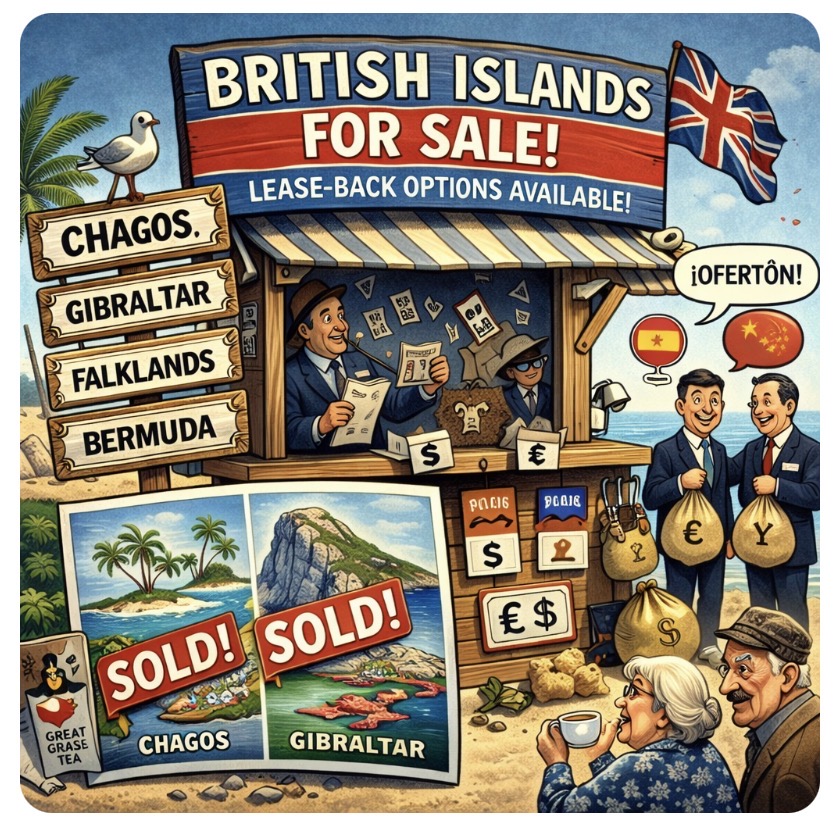
🏝️🪨🇬🇧Not content with the Chagos Islands dominating headlines, the rumour mill is now grinding out whispers that Labour has turned its wandering eye toward Gibraltar. Yes, the Rock. The limestone legend. The sunburnt geopolitical chess piece at the bottom of Spain.
According to a “secret source” — which in British political terms could mean anything from a senior insider to Dave in the Dog & Duck — discussions are allegedly brewing. And just like that, the empire’s attic is being rummaged through again. 📦
Cue outrage. Cue patriotic playlists. Cue someone dusting off a Union Jack the size of a trampoline.
🕵️♂️ Operation: Whisper & Panic
Let’s pause before we all start engraving “Hands Off the Rock” on commemorative mugs. Gibraltar isn’t a spare coaster you misplace at Cabinet meetings. It’s a strategically significant British Overseas Territory with its own elected government and a population that has repeatedly voted — overwhelmingly — to remain under British sovereignty.
The idea that it could be casually “given away” makes for explosive headlines, but geopolitics rarely works like a late-night eBay listing. 🛒
That said, timing matters. When sovereignty debates flare up — whether about Chagos or Gibraltar — emotions run hotter than a Costa del Sol pavement in July. 🇪🇸🌡️
For critics, any suggestion of negotiation smells like retreat. For supporters, diplomacy is simply realism in a post-Brexit, post-empire world. And for the rest of us? It’s another reminder that Britain’s map still comes with footnotes.
But here’s the thing about “secret sources.” In politics, they’re either courageous truth-tellers… or narrative confetti. Without evidence, it’s speculation with better lighting. 💡
Is there serious discussion? Is it routine diplomatic noise? Or is someone stress-testing the outrage cycle?
The Rock has weathered sieges, referendums, and decades of Spanish pressure. It’s unlikely to crumble because of a whisper. 🪨
And yet — to be fair — Spain does have an argument. 🇪🇸
Madrid’s long-standing position is rooted in geography and history. Gibraltar sits on the Iberian Peninsula. Spain argues that the 1713 Treaty of Utrecht, which ceded Gibraltar to Britain, contains limitations — particularly regarding territorial waters and expansion beyond the original footprint. From their perspective, this isn’t random grievance; it’s unfinished business.
Spain also frames the issue as one of territorial integrity — the same principle nations invoke worldwide. To Spanish politicians, Gibraltar is a colonial relic on European soil, an anomaly in a continent that has largely dismantled empire.
Of course, there’s one rather large complication: the people who actually live there. Gibraltar has held referendums — most notably in 1967 and 2002 — where voters overwhelmingly rejected Spanish sovereignty. That democratic reality makes any “hand-over” scenario politically radioactive. ☢️
So yes, Spain has an argument.
Britain has a counterargument.
And Gibraltar has a population with a ballot box. 🗳️
Which brings us back to the present rumour storm. Sovereignty debates are never just about land. They’re about history, identity, pride, and power. And once those ingredients mix, the temperature rises fast.
🔥 Challenges 🔥
Should historic treaties still dictate modern borders?
Does geography outweigh self-determination?
And if sovereignty is negotiable, who actually gets the final say — governments, history books, or the people on the ground?
Take this debate to the blog comments, not just your social feed. 💬
Defend the Rock. Challenge Madrid. Question Westminster.
👇 Comment. Like. Share.
The sharpest geopolitical hot takes will be featured in the next issue of the magazine. 📝✨


 Chameleon Magazine
Leave a comment