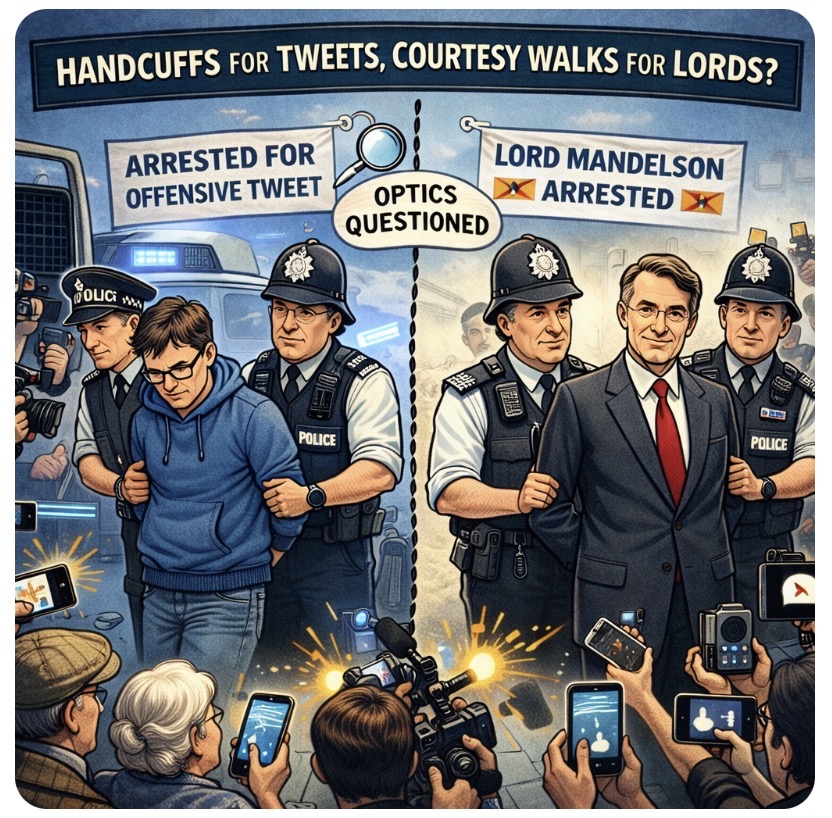
🚔🎩📸So the headlines scream: Lord Mandelson arrested.
Cue the dramatic music.
But then comes the detail that makes people squint at their screens: no visible handcuffs. No perp walk shuffle. Just an escorted exit. Calm. Composed. Almost… administrative.
And suddenly the internet jury is in session. ⚖️
🎬 Justice or Just Optics?
You’re not imagining the contrast. In many high-profile arrests — especially involving ordinary citizens — the visual ritual is almost cinematic: handcuffs, flashing lights, stern faces, slow walk past cameras. Even people arrested over online posts have been shown leaving in cuffs.
So when a titled political heavyweight appears to be “escorted” rather than physically restrained, it raises eyebrows. 👀
But here’s where things get less dramatic and more procedural.
Handcuffs in the UK (and elsewhere) are typically used based on risk assessment — risk of escape, risk of harm, risk of interference. They’re not legally mandatory for every arrest. If someone is cooperative, presents no threat, and isn’t considered a flight risk, officers may choose not to cuff them.
Now — does that stop the optics debate? Not remotely.
Because public perception doesn’t operate on police manuals. It operates on what it sees. And what people see looks like tiers of treatment.
When ordinary individuals are cuffed for low-level offences and a senior political figure walks out appearing composed and unrestrained, it feeds a long-standing suspicion:
Is justice equal — or just differently staged depending on who you are? 🎭
That perception matters. Even if procedures were followed to the letter.
There’s also another factor: media choreography. In high-profile cases, timing, location, and visibility can all be controlled. Sometimes it’s not about special treatment — it’s about minimizing spectacle. Other times, spectacle is exactly the point.
The uncomfortable truth? Arrests have always had a public relations dimension. Some are loud. Some are quiet. And which is which can shape narratives before a single charge is tested in court.
So the real question isn’t “Why no handcuffs?”
It’s “Why does it feel like there are different scripts?”
🔥 Challenges 🔥
Should every arrest look the same — regardless of status?
Are handcuffs about safety… or symbolism?
And if public trust hinges on optics, who controls the stage?
Take this to the blog comments, not just your timeline. 💬
Defend the procedure. Challenge the perception. Question the theatre.
👇 Comment. Like. Share.
The sharpest takes will be featured in the next issue of the magazine. 📝✨


 Chameleon Magazine
Leave a comment