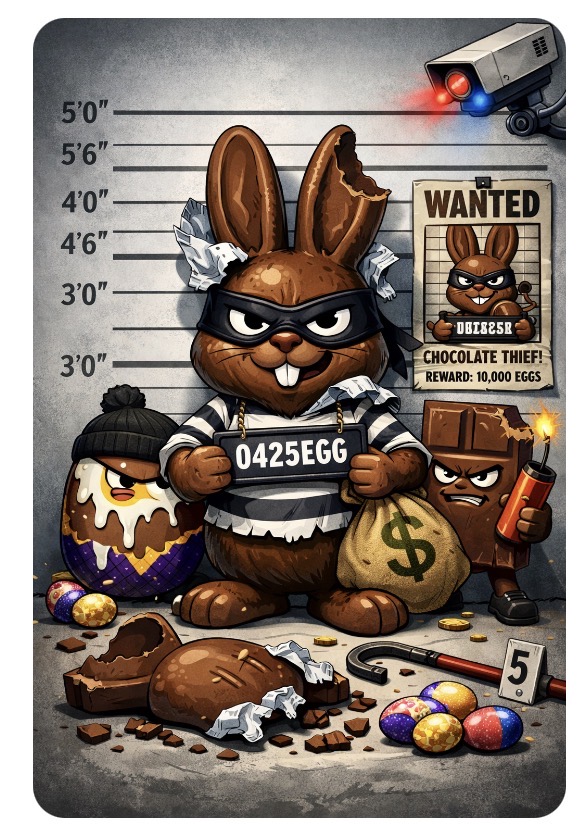
🐣🍫⚖️We tell ourselves that slipping an extra Easter egg through self-checkout isn’t really theft. It’s inflation’s revenge. It’s corporate redistribution. It’s a tiny, foil-wrapped rebellion against billion-pound brands who “won’t even notice.”
It’s also a story we tell very quickly.
And that speed — that reflexive justification — is the part worth examining.
🍬 Ocean’s Seven Pounds Fifty: The Confectionery Crime Wave
As Easter creeps closer, supermarkets report rising chocolate theft. Creme Eggs vanish in clusters. Once-peaceful confectionery aisles now glare with security tags. Self-checkout zones — once temples of trust — hum under watchful cameras and hovering staff.
The satire imagines the inevitable escalation: a courtroom drama. Chocolatiers filling the benches like aggrieved aristocracy. CCTV footage replayed with the gravity of a national scandal. A defendant accused of scanning one egg and bagging six.
“This isn’t Ocean’s Eleven,” the prosecution declares.
“It’s Ocean’s Seven Pounds Fifty.”
The humour lands because the scale is small. 🍫
But small does not mean insignificant.
If this were trivial, why the tags? Why the surveillance? Why the staff interventions? Retailers do not respond to comedy. They respond to loss.
The defence pleads inflation. Temptation. Confusion at self-checkout. A momentary lapse in barcode-based diplomacy.
Yet every argument rests on the same fragile assumption: that mild economic pressure dissolves personal responsibility.
And here’s the uncomfortable bit — the CCTV image is rarely accidental. It’s not chaos. It’s choreography. A glance at the camera. A pause. A decision. A bunny into a sleeve.
The real tension lies in the gap between how we narrate the act and how we perform it.
We call it harmless.
We execute it deliberately.
That gap is doing a lot of moral heavy lifting.
Because the Chocolate Wars aren’t about organised crime rings in cocoa-stained balaclavas. They’re about narrative permission. 🐰🎭
When we justify minor dishonesty as a reasonable response to pricing, we rehearse a broader logic: inconvenience entitles exception.
Retailers react structurally — tags, monitoring, enforcement.
Consumers react narratively — jokes, memes, inflation-based rationalisations.
Both are responding to the same friction: rising prices meeting declining restraint.
The chocolate becomes symbolic not because it is sacred — but because it is optional. A seasonal luxury framed as emotional necessity. “It’s Easter,” we whisper, as if that were a legal defence.
And maybe the satire stings because it’s recognisable.
If we laugh at the image of someone scanning one egg and bagging six, we should also ask why it feels familiar.
At what point does “it’s only chocolate” become rehearsal for something larger?
When does small-scale self-exemption become habit?
And in the quiet courtroom of our own reasoning… are we convicting?
Or are we already reaching into our pocket for one more mini egg? 🍬👀
🔥 Challenges 🔥
Think this is harmless? Or think this is the beginning of a bigger cultural shrug?
Is it resistance to pricing — or resistance to accountability?
Drop your verdict in the blog comments (not just social media 👀). We want the sharp takes, the moral philosophers, the unapologetic mini-egg bandits, and the self-checkout saints.
👇 Comment. Like. Share.
The best arguments — guilty or not guilty — will be featured in the next issue of the magazine. 📝🏆


 Chameleon Magazine
Leave a comment