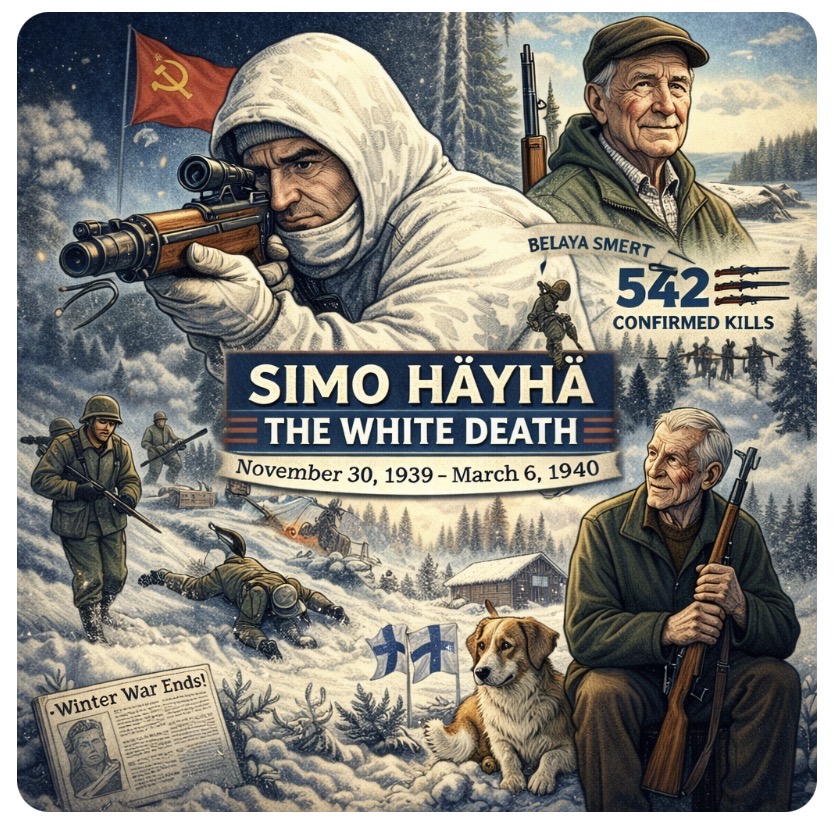
❄️🎯He killed 542 men in 100 days without ever looking through a scope—then disappeared into a life so ordinary, the world nearly forgot he existed.
Simo Häyhä stood five foot three. His hands knew plows better than triggers. In the quiet forests of rural Finland, neighbors knew him as a decent hunter, a hard worker, a man who kept to himself.
Nothing remarkable. Nothing legendary.
Then November 30, 1939 arrived—and with it, the Winter War.
Half a million Soviet soldiers crossed the border expecting a swift victory. The Soviet Union outnumbered Finland three to one. They had tanks, aircraft, artillery, supply chains that stretched beyond the horizon.
What they didn’t account for was winter. And the men who understood it.
❄️ The Ghost in the Snow
Häyhä became something the Soviets couldn’t comprehend: a shadow stitched from snow and patience.
He dressed entirely in white, blending into landscapes where temperatures plunged to -40°F. He packed snow beneath his rifle barrel to prevent muzzle blast from spraying powder into the air. He chewed snow to keep his breath from forming visible clouds. He lay motionless for hours—sometimes days—waiting.
And he refused to use a scope.
While other snipers relied on telescopic sights, Häyhä used iron sights. A scope could glint in sunlight. It forced a shooter to raise his head higher. In sub-zero cold, lenses fogged and frosted.
He trusted what he knew: the rifle he’d carried since youth and eyes trained by decades of hunting in those same forests.
In less than 100 days, he recorded over 500 confirmed kills—some estimates place the number at 542.
The Soviets gave him a name: Belaya Smert — The White Death.
They sent counter-snipers. They shelled forests. They bombed suspected positions. Officers reportedly moved in fear of a man they never saw.
Then, on March 6, 1940, an explosive bullet shattered his jaw. The left side of his face was destroyed. Fellow soldiers believed he was dead.
Seven days later, he woke up.
The war ended shortly after. Finland had survived.
🌲 The Man Who Refused to Be a Myth
And here is where the story becomes quieter—and arguably greater.
No book tours.
No victory parades.
No self-mythologizing interviews.
Häyhä returned to his farm in Rautjärvi. Back to hunting moose. Back to tending land. He lived until 2002, reaching the age of 96.
When asked decades later how he felt about killing hundreds of men, he reportedly said:
“I did what I was told to do, as well as I could.”
No bravado. No theatrical guilt. No attempt to craft a legend.
Just a man who defended his country when it was invaded—then stepped out of the story.
🔥 Challenges 🔥
What defines a hero: the body count—or the life lived afterward?
Is restraint after violence the truest measure of strength?
And in a world obsessed with self-promotion, what do we make of someone who chose silence instead of spotlight?
Take this to the blog comments, not just social media. 💬
Debate the myth. Question the morality. Reflect on the humility.
👇 Comment. Like. Share.
The most thoughtful reflections will be featured in the next issue of the magazine. 📝✨


 Chameleon Magazine
Leave a comment