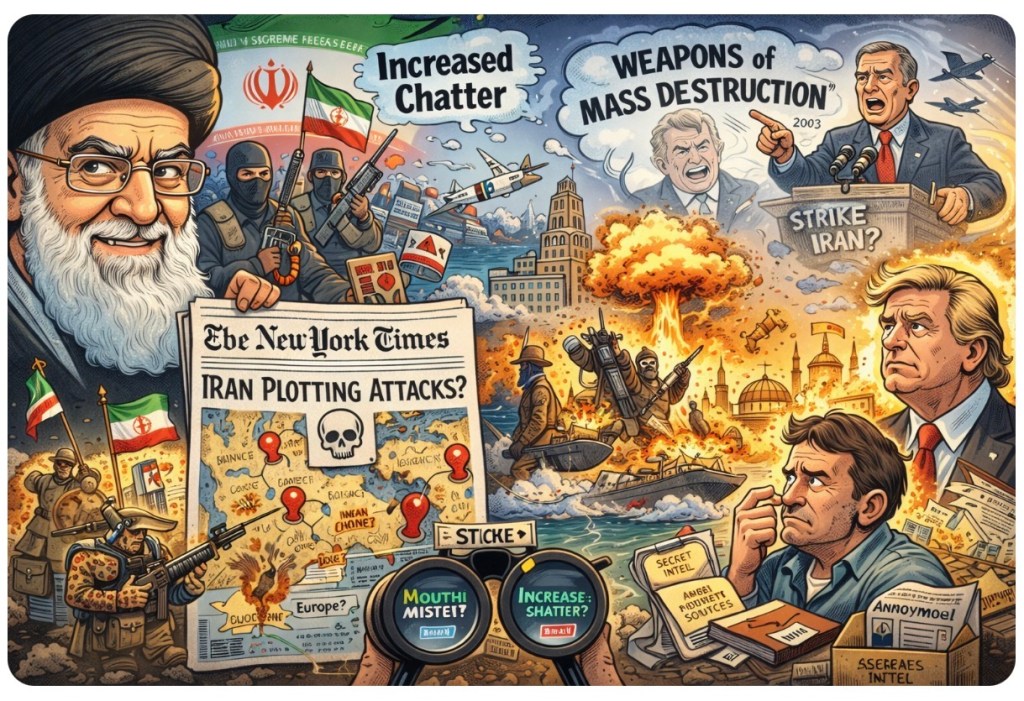
Reports claim Iran may be preparing proxy terror responses against US targets in Europe and the Middle East if Donald Trump launches strikes. Increased “chatter.” Electronic interceptions. Maritime threats in the Red Sea. The usual ominous drumroll. 🥁🌍
According to coverage by The New York Times, nothing specific has been uncovered—no concrete plot, no coordinates circled on a map—just signals, whispers, digital static. Meanwhile, nuclear talks are scheduled in Geneva, because geopolitics loves multitasking. 🕊️📡
And hovering over it all is the spectre of history’s most overused phrase: “We know they have weapons of mass destruction.”
Ah yes. That line. The one that aged like milk in the desert sun. 🥛🏜️
🔍 Intelligence, Intentions & the Ghost of 2003
The modern playbook seems familiar:
- Heightened threat language.
- Anonymous officials.
- Intercepted “chatter.”
- Public anxiety simmering nicely.
To be clear—intelligence warnings aren’t automatically propaganda. States do monitor hostile actors. Proxies like the Houthis have targeted shipping before. Maritime disruption in the Red Sea isn’t theoretical; it’s happened. ⚓🚢
But here’s where public scepticism kicks in: when governments cite unnamed sources and vague signals while floating military options, people remember Iraq. They remember confident podium speeches and missing stockpiles. They remember certainty presented as inevitability. 🧾
That doesn’t mean today’s warnings are false. It does mean trust is thinner than it used to be.
And that’s the uncomfortable reality: once credibility fractures, even legitimate threats sound like marketing copy for intervention. 📢
The world in 2026 isn’t 2003. Intelligence ecosystems are different. Proxy warfare is different. Media scrutiny is different. But public memory? Razor sharp.
When officials say “increased chatter,” citizens hear:
“Show us the receipts.” 🧾👀
🔥
Challenges
🔥
Are these warnings prudent risk management in a volatile region—or narrative scaffolding for escalation?
Is scepticism healthy democratic instinct… or dangerous complacency?
Don’t just recycle 2003 memes—dig in. Drop your sharpest analysis, your calmest counterpoint, or your fiercest warning in the blog comments (not just social media). 💬⚖️
👇 Like. Share. Debate responsibly.
The most insightful comments will be featured in the next issue of the magazine. 📝🏆


 Chameleon Magazine
Leave a comment