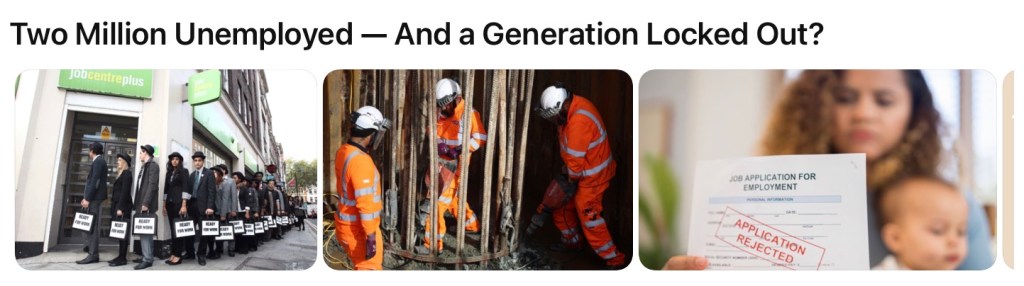
If joblessness approaches two million, the impact will not be confined to spreadsheets. It will show up in missed rent payments, delayed mortgages, shuttered high-street shops, and rising anxiety in households already stretched by inflation. For young people — particularly those without degrees, networks or financial buffers — the consequences will be immediate.
And here is the uncomfortable part: in a contracting labour market, increases in labour supply intensify competition.
That is not an ideological statement. It is arithmetic.
The Collision Point
When economic growth slows, vacancies shrink. Firms freeze hiring. Apprenticeships are postponed. Entry-level roles disappear first.
At the same time, net migration continues — including those arriving primarily for economic opportunity. Once in the country, they participate in the same labour market as domestic workers. In sectors such as hospitality, logistics, agriculture, retail, delivery services and parts of construction, the overlap with youth employment is obvious.
To insist there is “no competition” between new labour supply and young jobseekers is implausible in a downturn. When demand falls and supply rises, selectivity increases. Employers may choose experience over potential. They may favour flexibility. They may prioritise reliability. Young workers seeking their first foothold can find themselves edged out.
Government Policy and Labour Scale
The sharper question is not about individuals. It is about policy sequencing.
If the government fails to control illegal migration while the economy weakens, the labour pool expands at precisely the moment opportunity contracts. That mismatch amplifies tension. It places additional pressure on entry-level wages. It raises the threshold for securing first employment.
Young people already face structural barriers:
• Skills mismatches.
• Declining apprenticeships in some regions.
• Automation reducing low-skill roles.
• Weak productivity growth limiting expansion.
Layer sustained labour inflows onto that fragility during a downturn, and competition becomes more visible — and more politically combustible.
Resentment Is Predictable, Not Mysterious
Resentment does not arise from abstract theory. It emerges when lived experience contradicts official reassurance.
If a 19-year-old applies for dozens of entry-level roles and hears that unemployment is rising while migration remains high, the perception of displacement becomes personal. Whether the macro-data show overall fiscal benefit is irrelevant in that moment. The competition feels direct.
Dismissing that perception as ignorance only deepens it.
The Core Issue: Opportunity Supply
If unemployment rises toward two million, the government’s responsibility is to:
• Align migration levels with economic capacity.
• Expand targeted youth employment schemes.
• Protect and scale apprenticeships.
• Stimulate sectoral growth where youth entry is strongest.
• Enforce border and labour rules consistently to avoid informal labour distortions.
Without that coordination, young workers carry disproportionate risk.
This Is About the Young
This debate is not about abstract morality. It is about safeguarding opportunity for the next generation during economic contraction.
When banks forecast rising unemployment and policy does not adapt to labour supply realities, the burden falls on those with the least leverage — the young.
If two million people are competing for work, the question is not whether labour markets feel tighter.
The question is why government policy would allow supply to expand while opportunity shrinks — and who pays the price when that imbalance hardens into a lost generation.
If you’d like, I can turn this into a satirical blog-style piece in your usual format — or break down the economic forecast in more detail.


 Chameleon Magazine
Leave a comment