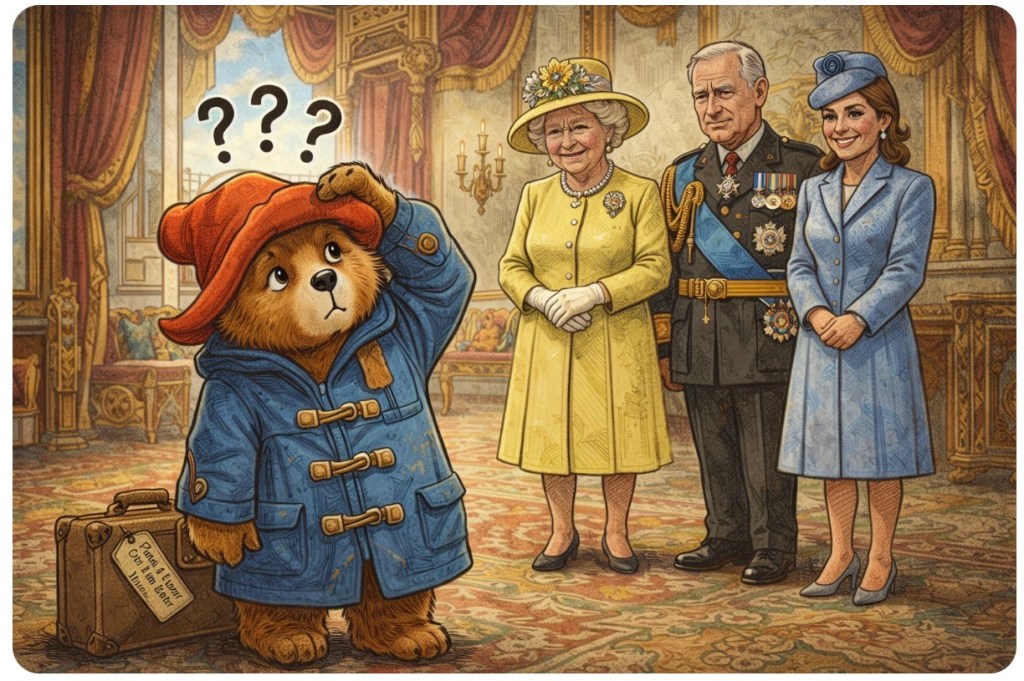
When Paddington Bear tipped his red hat to Elizabeth II inside Windsor Castle, the nation collectively melted faster than marmalade in July.
There he was — the Peruvian polite machine himself — fresh from the grand final of BBC’s 500 Words competition, clasping royal hands in the Grand Reception Room like it was the most natural crossover episode in British history.
The Queen, ever the literary matriarch, thanked him for coming “all the way from Peru” and cheekily asked for a marmalade sandwich. On a warm day usually reserved for medals and ceremonial gravitas, she even remarked that the little bear must be feeling hot in his famous duffle coat.
It was adorable. It was wholesome. It was peak Britain.
But… was it political? 👀
🎩 A Bear Above the Fray — Or In It?
Paddington has always represented something bigger than himself:
- Immigration done kindly.
- Politeness in chaos.
- Optimism wrapped in duffle wool.
He’s not partisan. He’s not ideological. He’s a suitcase, a label reading “Please look after this bear,” and a belief in basic decency.
So when he meets the monarch, is he endorsing the institution? Or simply embodying British cultural continuity?
For most, it felt like harmless pageantry — a children’s character meeting a head of state who champions literacy. The symbolism was soft, not sharp. Marmalade, not manifestos.
Yet in an era where everything becomes a statement, even a bear can be accused of “taking a side.”
🍊 Risk to the Brand?
Let’s be honest.
Paddington’s brand is built on:
- Innocence.
- Inclusion.
- Warm humour.
- Tea-time diplomacy.
Courting the royal family doesn’t automatically politicise him. In fact, it arguably reinforces the idea that British identity can be welcoming and gentle rather than combative.
If anything, the risk isn’t that Paddington looked political.
It’s that we now live in a climate where even a marmalade sandwich requires ideological analysis.
And perhaps that says more about us than it does about the bear.
Because if a fictional immigrant bear can bridge palace and playground without causing a diplomatic incident, maybe there’s hope for the rest of us. 🧸✨
🔥 Challenges 🔥
Should beloved fictional characters stay completely neutral — or is meeting a monarch simply cultural, not political?
Are we over-analysing symbolism in an age of constant outrage?
Or does every public appearance carry reputational weight now?
Drop your take in the blog comments (not just on social media). 💬👇
👇 Like it. Share it. Pass the marmalade.
The sweetest (and sharpest) comments will feature in the next issue of the magazine. 📝🍊


 Chameleon Magazine
Leave a comment