There are speeches… and then there are moments.
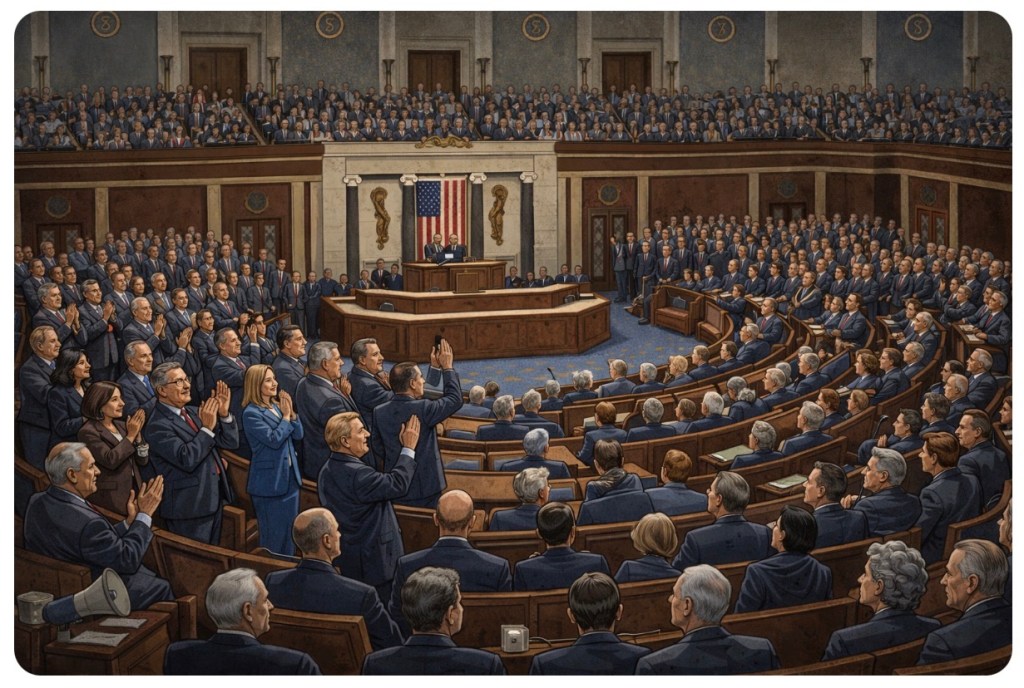
When Donald Trump called on lawmakers during a State of the Union-style address to stand for “putting American citizens first,” the cameras did the rest. Half the chamber rose. Half remained seated. And in that split-screen second, the message wasn’t just delivered—it was branded into the national psyche. 📺⚡
This wasn’t just rhetoric. It was visual strategy.
🎬 The Trap Was Set — And Televised
Here’s the brilliance: you frame a principle so broadly that disagreeing looks unthinkable.
“Support American citizens first.”
Who argues with that? It’s motherhood. It’s apple pie. It’s flag-draped common sense. 🍎🇺🇸
So when only half the chamber stands, the optics don’t whisper—they roar.
To millions watching at home, the image says:
- Half your representatives didn’t stand for you.
- Half hesitated.
- Half chose party posture over patriotic symbolism.
Whether that interpretation is fair is almost irrelevant. Politics at that level isn’t about white papers—it’s about frames.
And then came the follow-up: voter ID.
By comparing it to everyday identification requirements—something as mundane as proving eligibility for basic civic tasks—the contrast sharpened. When some lawmakers refused to stand again, the visual narrative doubled down: common sense vs. resistance.
It was a communications checkmate. ♟️
🧠 Why It Worked
This wasn’t spontaneous. It was choreography.
- Simple language.
- Universal framing.
- A forced, immediate visual reaction.
- Live cameras.
- No time for nuance.
Half the chamber appeared caught between instinct and optics. Stand and validate the moment? Sit and risk being cast as opposing the principle?
Some stood. Some stayed planted. And somewhere mid-applause, a few likely realized: this wasn’t just a policy moment—it was a political mirror.
📸 What That Image Says to Citizens
It says division. Loudly.
It says that even on broadly framed patriotic themes, unity is fractured.
But it also says something else: messaging matters. Presentation matters. Visual politics is the modern battlefield.
To supporters, it looked like strength and clarity.
To critics, it looked like a calculated loyalty test.
But to undecided viewers? It looked like contrast. And contrast wins attention every time.
In an age where a three-second clip can define a narrative, that moment will replay far longer than the policy details ever will.
🔥 Challenges 🔥
Was this statesmanship—or stagecraft?
Did half the chamber miscalculate the optics?
Or does refusing to stand send its own deliberate message?
What did that split-screen say to you?
Drop your take in the blog comments (not just on social media). Don’t just react—analyze. 💬👇
👇 Like it. Share it. Debate it.
The sharpest breakdowns will be featured in the next issue of the magazine. 📝🔥


 Chameleon Magazine
Leave a comment