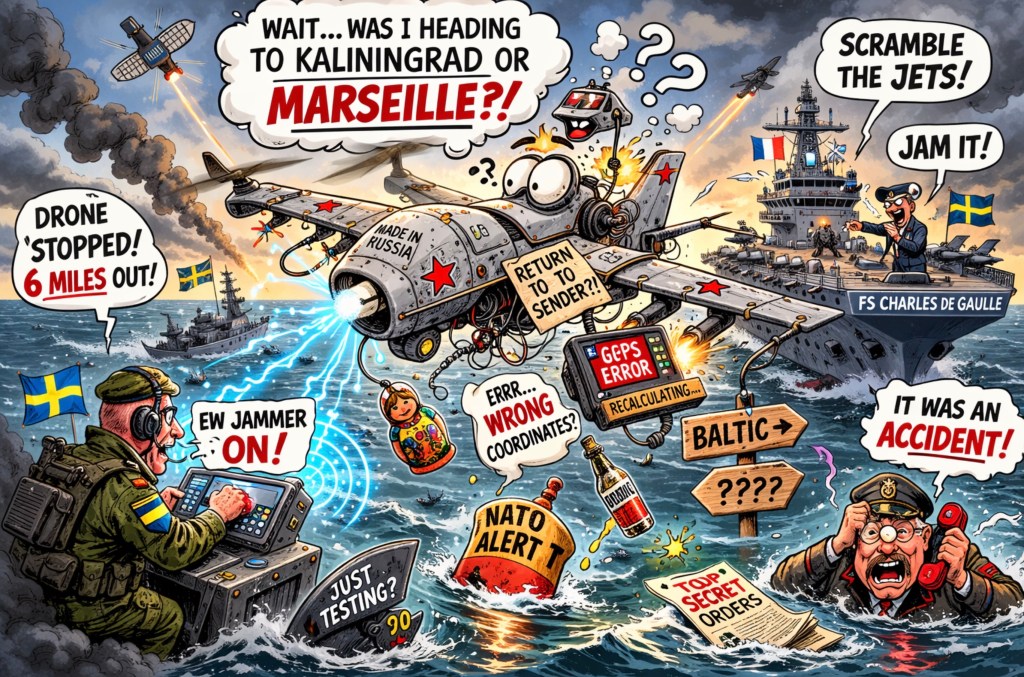
Drone Drama Over the Deck: Accidental Airspace Oops… or Testing Europe’s Nerves?
🚁⚓🔥NATO forces reportedly intercepted a Russian drone heading toward a French aircraft carrier — and Swedish military units jammed the weapon just six miles from an 800-foot floating fortress. Close enough to raise eyebrows. Far enough to avoid an explosion.
Now the million-euro question: was this Moscow knocking on Europe’s door with a clenched fist… or just a very expensive piece of lost luggage?
🛰️ “Oops, Wrong Warship” — or Strategic Shadowboxing?
Let’s break this down.
A drone doesn’t just wander off like a confused tourist asking for directions to Tallinn and ending up in Toulon. Modern military UAVs are programmed, tracked, and guided. If one was heading toward a NATO carrier strike group, someone somewhere punched in coordinates.
But here’s where it gets murky:
- Russia has frequently tested NATO response times near Baltic and North Sea airspace.
- Electronic warfare “probing” is common — see how fast they react, how they jam, how they coordinate.
- Sweden jamming it suggests NATO treated it as a live threat, not a hobby drone from a fishing trawler.
Declaring war? Not quite. 🚨
An act of provocation? Much more plausible.
Russia has historically used “plausible deniability” like it’s diplomatic bubble wrap. A drone strays too close. A missile “malfunctions.” A plane “miscalculates.” Each incident stops just short of triggering Article 5 — but keeps the tension dial permanently stuck on simmer.
Declaring war on Europe would mean knowingly crossing a bright red NATO line. And despite rhetoric, Moscow knows that’s not a chess move — that’s flipping the board and setting it on fire. ♟️🔥
More likely? This was reconnaissance, electronic warfare testing, or a calibrated show of pressure — designed to remind NATO that Russian hardware can reach uncomfortable distances.
But accidental? Highly unlikely. Military drones don’t just get lost like a sock in the dryer.
⚡ So What Does This Mean?
It signals:
- Europe’s northern waters are increasingly militarised
- NATO response times are under constant scrutiny
- The line between “testing” and “triggering” is getting dangerously thin
The real danger isn’t one drone. It’s miscalculation. One jammed signal too late. One commander reading intent instead of accident. And suddenly the “just testing” narrative collapses.
🔥 Challenges 🔥
Is this brinkmanship that Europe should brush off — or a warning flare we’re pretending is a firework?
Would you call this aggression, intimidation, or geopolitical theatre?
Drop your sharpest take in the blog comments — not just the socials. Let’s see who can dissect this without accidentally declaring war in the replies. 💬💣
👇 Comment. Like. Share.
And tell us — accident… or escalation rehearsal?
The best comments will be featured in the next issue of the magazine.
https://chameleon-news.com 🚁⚓🔥
NATO forces reportedly intercepted a Russian drone heading toward a French aircraft carrier — and Swedish military units jammed the weapon just six miles from an 800-foot floating fortress. Close enough to raise eyebrows. Far enough to avoid an explosion.
Now the million-euro question: was this Moscow knocking on Europe’s door with a clenched fist… or just a very expensive piece of lost luggage?
🛰️ “Oops, Wrong Warship” — or Strategic Shadowboxing?
Let’s break this down.
A drone doesn’t just wander off like a confused tourist asking for directions to Tallinn and ending up in Toulon. Modern military UAVs are programmed, tracked, and guided. If one was heading toward a NATO carrier strike group, someone somewhere punched in coordinates.
But here’s where it gets murky:
- Russia has frequently tested NATO response times near Baltic and North Sea airspace.
- Electronic warfare “probing” is common — see how fast they react, how they jam, how they coordinate.
- Sweden jamming it suggests NATO treated it as a live threat, not a hobby drone from a fishing trawler.
Declaring war? Not quite. 🚨
An act of provocation? Much more plausible.
Russia has historically used “plausible deniability” like it’s diplomatic bubble wrap. A drone strays too close. A missile “malfunctions.” A plane “miscalculates.” Each incident stops just short of triggering Article 5 — but keeps the tension dial permanently stuck on simmer.
Declaring war on Europe would mean knowingly crossing a bright red NATO line. And despite rhetoric, Moscow knows that’s not a chess move — that’s flipping the board and setting it on fire. ♟️🔥
More likely? This was reconnaissance, electronic warfare testing, or a calibrated show of pressure — designed to remind NATO that Russian hardware can reach uncomfortable distances.
But accidental? Highly unlikely. Military drones don’t just get lost like a sock in the dryer.
⚡ So What Does This Mean?
It signals:
- Europe’s northern waters are increasingly militarised
- NATO response times are under constant scrutiny
- The line between “testing” and “triggering” is getting dangerously thin
The real danger isn’t one drone. It’s miscalculation. One jammed signal too late. One commander reading intent instead of accident. And suddenly the “just testing” narrative collapses.
🔥 Challenges 🔥
Is this brinkmanship that Europe should brush off — or a warning flare we’re pretending is a firework?
Would you call this aggression, intimidation, or geopolitical theatre?
Drop your sharpest take in the blog comments — not just the socials. Let’s see who can dissect this without accidentally declaring war in the replies. 💬💣
👇 Comment. Like. Share.
And tell us — accident… or escalation rehearsal?
The best comments will be featured in the next issue of the magazine.


 Chameleon Magazine
Leave a comment