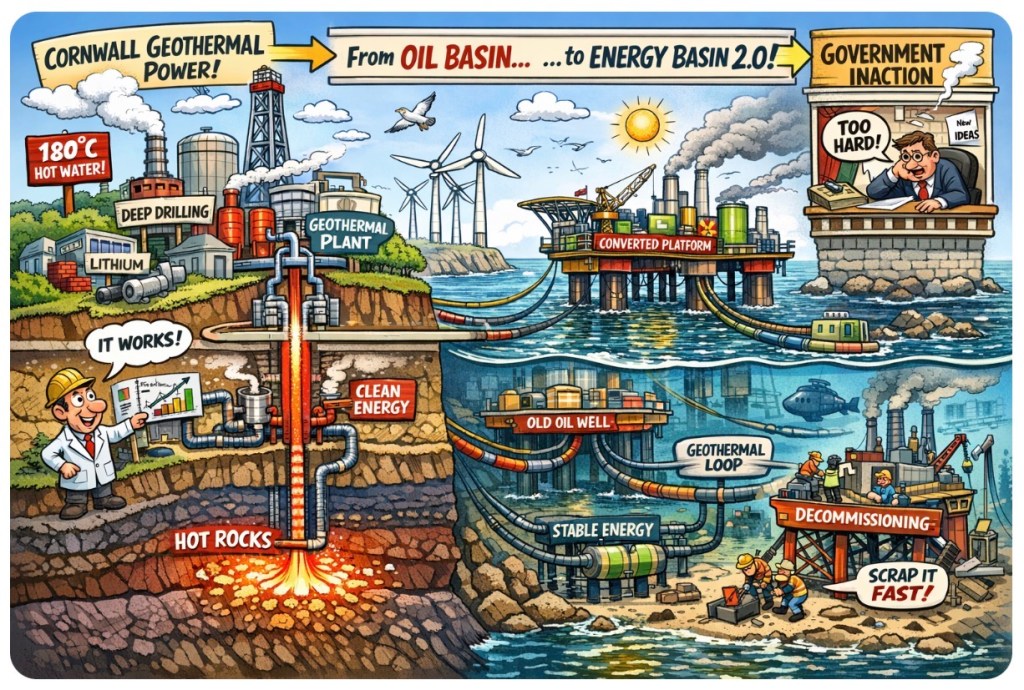
🔥🇬🇧Cornwall just quietly did something radical — it proved Britain can drill five kilometres into granite, tap 180°C water, generate round-the-clock electricity, and even extract lithium for batteries… from the same hole in the ground.
It works.
It’s operational.
It’s embarrassingly sensible.
So naturally, Westminster’s response appears to be: “Let’s ignore it.” 🤦♂️
🧠 The Great British Brain Fog Beneath Our Feet
While ministers argue over wind turbines blocking someone’s countryside selfie and solar panels daring to exist on farmland, deep geothermal is just… there. Working. Patient. Boringly reliable.
Wind? Variable. 🌬️
Solar? Variable. ☁️
Interconnectors? Political footballs. ⚽
Geothermal?
Winter. Summer. Night. Still air. Geopolitical chaos. It does not care. It just runs.
This isn’t experimental wizardry. It’s thermodynamics — the same physics that powered the Industrial Revolution, only this time without setting everything on fire. 🔥➡️🔌
And here’s the kicker: Britain already mastered deep, high-pressure drilling in the North Sea. For decades we punched holes into hostile geology miles offshore. We trained the engineers. Built the rigs. Laid the subsea cables. Managed extreme temperatures.
Now we’re dismantling it.
Instead of asking:
“How do we repurpose this for geothermal?”
We’re asking:
“How fast can we scrap it?” 🛠️🚮
It’s like owning a world-class bakery and deciding bread is passé.
⚙️ From Oil Basin to Energy Basin 2.0
Picture this:
• Convert high-temperature oil wells into geothermal loops.
• Pair offshore platforms with wind.
• Use geothermal as baseload stability.
• Feed steady power into existing subsea cables.
• Produce green hydrogen without power fluctuations.
Same workforce. Same marine grit. Different molecule.
But that would require strategic thinking longer than the next headline cycle. And we can’t have that. 🗞️
💸 “It’s Too Expensive” — The National Excuse
Deep wells cost tens of millions.
So did North Sea oil.
So did offshore wind.
So does nuclear.
Every British energy success story had one thing in common: government underwriting early risk.
Geothermal’s problem isn’t cost.
It’s optics.
No spinning blades for drone footage.
No gleaming reactor domes.
No ribbon-cutting skyline moment.
Just steel pipes quietly producing stable power for decades.
Which, inconveniently, is exactly what an increasingly fragile grid needs.
Gas peaker plants are filling the stability gap — locking in imports while literal heat flows beneath our feet every second.
This isn’t a physics failure.
It’s a prioritisation failure.
🏛️ The Real Barrier: Institutional Imagination Deficit
Deep geothermal demands:
• 20–40 year planning horizons
• Upfront capital
• Strategic patience
Whitehall prefers:
• Consultations
• Pilot schemes
• “Stakeholder engagement”
One is infrastructure design.
The other is theatre. 🎭
So we fret about energy shocks, imported gas, industrial decline, and losing engineering talent — while sitting atop a domestic, 24/7 thermal resource.
Cornwall proved it works.
The North Sea proves the heat is there.
The only missing component appears to be policy coherence.
And tragically, that’s the one thing you can’t drill for.
🔥
Challenges
🔥
Is Britain strategically asleep at the wheel — or is this just political risk-aversion masquerading as prudence?
Are we witnessing a once-in-a-generation industrial pivot… or the slow dismantling of capability we’ll regret in 20 years?
Drop your sharpest take in the blog comments (not just social media — bring it to the source). Challenge the premise. Defend the status quo. Or propose something bolder. 💬⚡
👇 Comment. Share. Agitate intelligently.
The best insights (and best burns) will be featured in the next issue of the magazine. 📰🔥


 Chameleon Magazine
Leave a comment