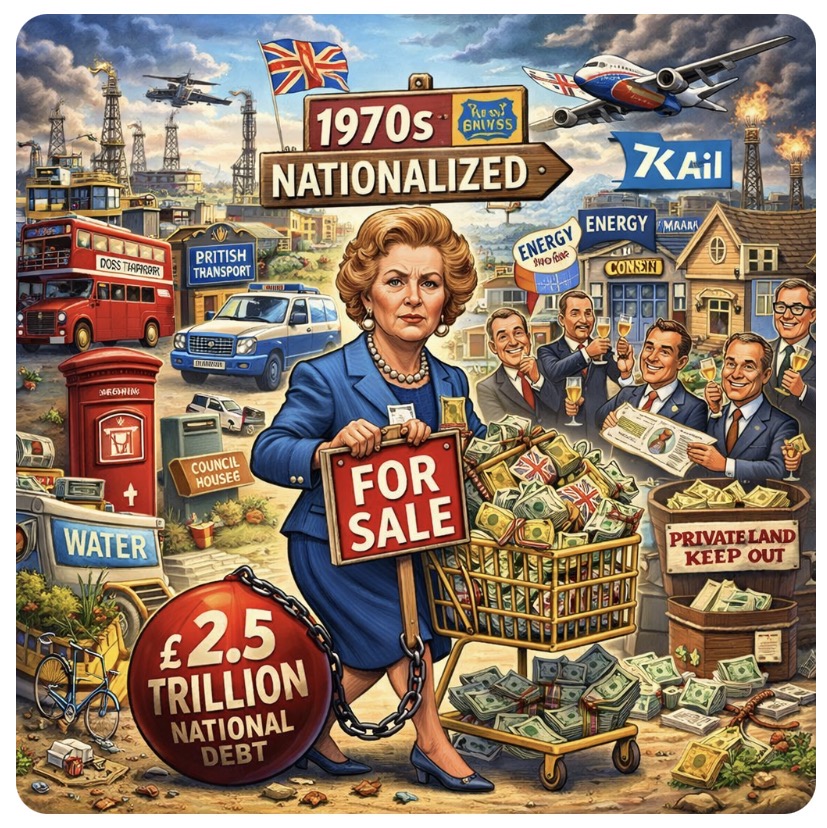
🇬🇧💸In the 1970s, Britain owned its water, transport, mail, and energy. Millions lived in council houses. North Sea oil was flowing. The national debt sat at a (now quaint-sounding) £80 billion.
Fast forward to 2022: the family silver’s been flogged, the cupboard looks bare, and the national debt has ballooned to £2.5 trillion.
Some call it progress. Others call it a clearance sale that never ended. 🏷️🔥
🛒 The Great British Car Boot Sale (Everything Must Go!)
Once upon a time, the state ran the taps, the trains, the post, and the power stations. It wasn’t glamorous. It wasn’t always efficient. But it was publicly owned. The profits—at least in theory—cycled back into the country.
Then came the 1980s revolution. Enter Margaret Thatcher and the gospel of privatisation. The pitch? Sell inefficient state industries, unleash competition, empower shareholders, and let the market work its magic. ✨📈
The result? Water companies owned by global investors. Rail franchises stitched together like a patchwork quilt. Energy giants paying dividends while households debate whether to boil the kettle or heat the living room.
And those council houses? Sold off at a discount, often never replaced. Homeownership rose—but so did housing shortages. 🏠📉
North Sea oil, once hailed as a generational windfall, flowed through the economy… but unlike Norway’s sovereign wealth strategy, Britain largely spent rather than saved. Easy come, easy go. 🛢️💷
Meanwhile, debt crept upward—through recessions, financial crashes, wars, pandemics, and policy choices of every stripe. By 2022, £2.5 trillion became the new normal. A number so large it barely feels real anymore.
🧾 Asset-Rich to Asset-Light: What Changed?
Supporters of neoliberal reforms argue that privatisation modernised outdated industries, reduced state inefficiency, and boosted investment. Critics argue it stripped long-term public control for short-term cash injections and shareholder returns.
So here we are: higher debt, fewer publicly owned assets, and essential services that feel… expensive.
Was it inevitable? Was it ideological? Was it mismanagement? Or was it simply the bill coming due after decades of economic shocks layered on top of structural change? 🤔
One thing’s certain: the argument isn’t going away anytime soon.
🔥 Challenges 🔥
Did Britain modernise—or did it mortgage its future? 💷 Was privatisation a necessary evolution, or the biggest “buy now, regret later” scheme in history?
We want your take—but not the polite dinner-party version. The sharp one. The informed one. The furious one.
Head to the blog comments and tell us:
Was neoliberalism liberation… or liquidation? 💬🔥
👇 Comment. Like. Share. Tag the armchair economists and the pub philosophers.
The best arguments (and the boldest rebuttals) will be featured in the next issue of the magazine. 📰🏆


 Chameleon Magazine
Leave a comment