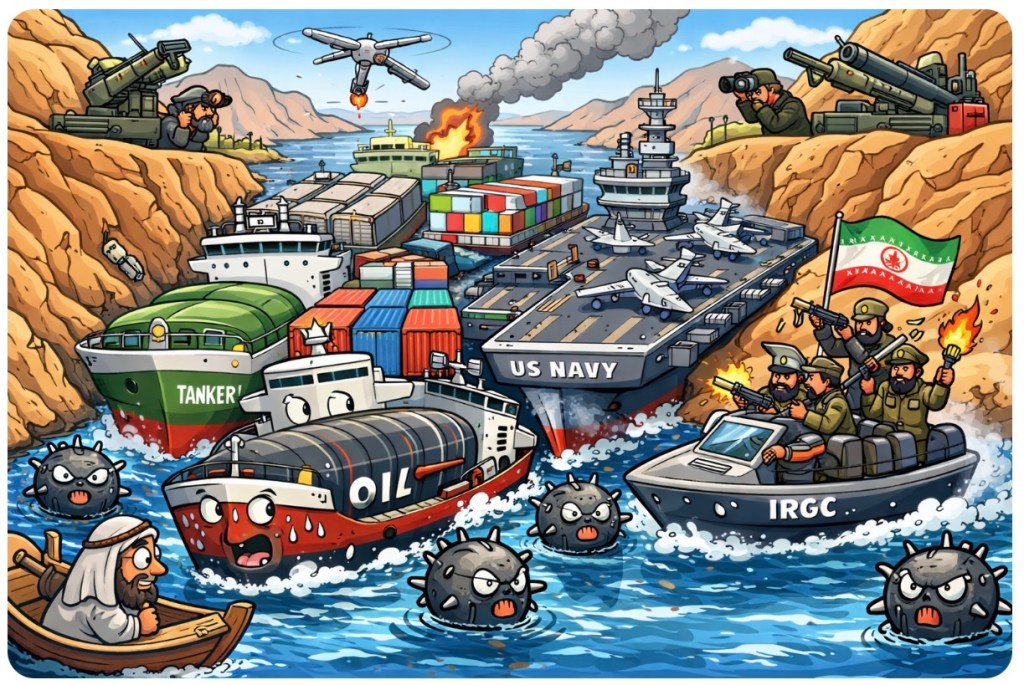
🌍🚢⛽When Iran threatens to burn any ship daring to cross the Strait of Hormuz, it sounds less like modern diplomacy and more like a pirate captain screaming from the deck of a burning galleon. Yet beneath the theatrical threats lies a brutally clever reality: this sliver of water is one of the most powerful pressure points on Earth.
It’s barely 21 miles wide at its narrowest point. You could drive across that distance in under half an hour if there were a bridge. And yet this tiny maritime bottleneck carries roughly 20% of the world’s oil supply.
Which raises the obvious question people keep asking:
How can a country that many assume is isolated, chaotic, or even “leaderless” challenge the world’s most powerful military through what is essentially a narrow shipping lane?
Because geography, unfortunately, doesn’t care about superpower status.
⚓ The World’s Most Valuable Traffic Jam
Every day massive oil tankers squeeze through the Strait of Hormuz, carrying energy exports from the Persian Gulf.
Countries like Saudi Arabia, United Arab Emirates, Kuwait, Iraq, and Qatar all rely on this single maritime exit to ship their oil into global markets.
Think of it like the world’s most important motorway junction—except instead of traffic jams causing commuters to be late for work, a blockage here sends global fuel prices into orbit overnight.
And right beside this crucial corridor sits Iran, watching every tanker slide past its coastline.
🪤 The Strategy: Don’t Beat the Superpower—Bleed It
Iran doesn’t need to defeat the United States Navy. That would be military suicide.
Instead, the strategy is something far more irritating: make the waterway so dangerous that policing it becomes an endless headache.
Using asymmetric tactics, Iranian forces—particularly the Islamic Revolutionary Guard Corps—can deploy:
- Naval mines hidden beneath shipping lanes
- Fast attack boats swarming tankers
- Coastal anti-ship missile systems
- Armed drones
- Seizures of passing vessels
It doesn’t take a massive naval battle. One damaged tanker or a few floating mines can be enough to scare insurers, halt shipping traffic, and send markets into panic.
Suddenly the world’s most powerful navy finds itself stuck doing the maritime equivalent of permanent airport security patrols.
Escort ships.
Clear mines.
Protect tankers.
Repeat forever.
That’s the trap.
🤔 “Did Nobody Think About This Before?”
Actually… they did.
Military planners in the United States, NATO, and across the Gulf have been gaming out Hormuz scenarios for decades.
The problem is that there’s no clean solution.
You can’t move the strait somewhere safer.
You can’t permanently occupy Iran’s coastline without triggering a massive war.
And even a single well-placed mine can shut down shipping lanes temporarily.
Some oil pipelines have been built to bypass the strait, especially in Saudi Arabia and the UAE—but they only carry a fraction of the oil normally flowing through this choke point.
In other words: the vulnerability is baked into the map.
🧩 The “Leaderless Country” Myth
The idea that Iran operates without leadership is a common misunderstanding.
At the top of the system sits Ali Khamenei, who holds ultimate authority over the country’s military and strategic decisions. Beneath him sits a complex web of political institutions and powerful security forces.
That layered system actually allows for bold and provocative strategies, because units like the Islamic Revolutionary Guard Corps are specifically designed to operate in unconventional ways.
In short, Iran doesn’t need to win a war outright.
It just needs to make the cost of controlling the strait painfully high for whoever tries.
And if a confrontation escalated under a US administration led by figures like Donald Trump, Tehran would likely hope to drag American forces into a slow, grinding maritime standoff that tests political patience back home.
🌊 The Brutal Lesson of the Strait
The Strait of Hormuz is proof that in geopolitics, size means nothing if the location is right.
A strip of water narrower than many cities can threaten:
- global energy markets
- international shipping
- military stability in the Middle East
All because the world still depends on oil that must pass through this single maritime choke point.
Which means every tanker that glides through those narrow waters carries more than crude oil—it carries the constant risk of turning a quiet stretch of sea into the world’s most dangerous flashpoint.
🔥 Challenges 🔥
So here’s the question that should keep everyone awake at night:
Why does the global economy still rely on a 21-mile-wide bottleneck sitting next to one of the world’s most volatile power struggles?
Is this strategic negligence… or just the unavoidable cost of a fossil-fuel world?
Drop your thoughts, rants, conspiracy theories, or geopolitical genius in the blog comments. 💬
👇 Hit comment, like, and share if this made you rethink the map of global power.
The sharpest, funniest, and most savage takes will be featured in the next issue of the magazine. 📝🔥


 Chameleon Magazine
Leave a comment