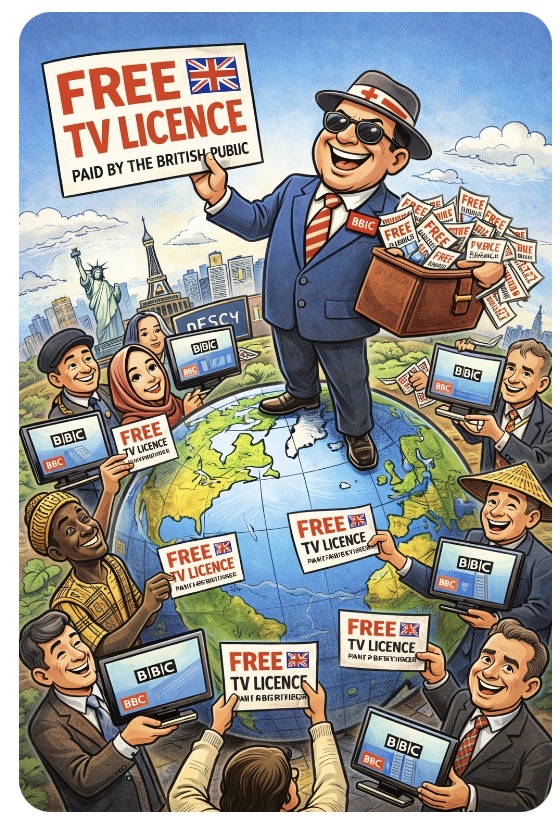
🌍📺💷For decades the argument for the TV licence was simple: British households funded the BBC so the country could have a national public broadcaster.
Pay the licence, watch the programmes.
Don’t watch it? In theory, don’t pay.
But now the conversation has shifted. With the licence fee under pressure, the idea of replacing it with a general tax is gaining traction. And once that happens, something remarkable occurs.
The British public stops being viewers funding a broadcaster…
…and becomes taxpayers funding a global media operation.
Because the BBC doesn’t just broadcast to Britain.
It broadcasts to the entire world.
🌍 Broadcasting Britain… to Everyone Except the People Paying
The BBC’s international reach is enormous.
Its news websites, radio services and television output are consumed across continents. Its journalism is quoted globally. Its broadcasts reach hundreds of millions of viewers and listeners every week.
And here’s the curious part.
Most of those people don’t pay a licence fee.
The farmer in Argentina.
The student in India.
The commuter in New York.
The café owner in Berlin.
They can read BBC news online, watch clips, or listen to broadcasts without ever contributing a penny to the system funding it.
Meanwhile the British public — the people actually paying for the infrastructure — are told the funding model must become more compulsory, not less.
In other words:
Britain becomes the financial engine behind a broadcaster serving the world.
Whether we like it or not.
💰 A Global Service, A Domestic Bill
Supporters say this global reach is a source of national pride. They argue it projects British values, supports international journalism and strengthens the country’s cultural influence.
Critics hear something slightly different.
They hear British taxpayers being asked to fund an organisation whose audience increasingly lies outside Britain itself.
And if the licence fee becomes taxation, that funding becomes unavoidable.
No opting out.
No switching off.
No saying “I don’t watch it.”
Just a line on the national bill.
🎬 The World’s Broadcaster — Sponsored by Britain
The BBC has long described itself as a public service broadcaster.
But its global footprint makes it something else as well:
A publicly funded international media brand.
Which raises a perfectly reasonable question.
If Britain is effectively financing a broadcaster with worldwide reach…
should the rest of the world be contributing too?
• Should international audiences contribute financially?
• And should the BBC remain a national broadcaster — or openly acknowledge it’s become a global one?
Drop your thoughts in the blog comments, not just social media.
👇 Comment. Like. Share. Start the debate.
The sharpest responses will be featured in the next issue of the magazine. 📝🔥


 Chameleon Magazine
Leave a comment