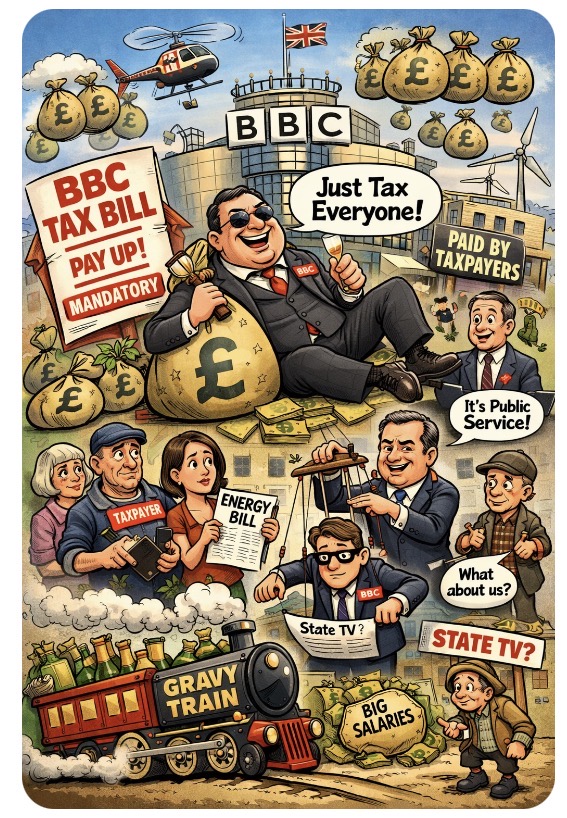
📺💷The British tradition of choosing whether to fund the national broadcaster may soon disappear. The BBC is discussing replacing the TV licence fee with a general tax, a model used in parts of Europe.
Translation: everyone pays, whether they watch it or not.
Right now households technically have a choice. Don’t watch live TV or BBC services and you can opt out of the licence fee. Under a tax-funded system, that option disappears into the Treasury paperwork.
Congratulations — you’re automatically paying.
🎩 The Most Comfortable Subscription in Britain
The licence fee has always been controversial, but it at least contained a hint of consumer choice:
Watch the BBC? Pay for it.
Don’t watch it? Don’t.
A tax flips that completely.
Now it becomes: everyone pays — full stop.
Which raises an obvious question. If millions truly value the BBC, why remove the option to opt out?
Because when revenue becomes taxation, it stops behaving like a market and starts behaving like a guaranteed income stream — funded by taxpayers already juggling energy bills, rent, and rising living costs.
🎬 State TV by Stealth?
Moving funding into taxation also raises another issue.
If the broadcaster is funded directly through taxes, the government inevitably becomes tied to it financially. When mistakes happen or accusations of bias appear, critics won’t just blame the BBC.
They’ll blame the government funding it.
That creates a strange balancing act:
too much distance and politicians are paying without control, too much involvement and editorial independence is questioned.
📺 And If the BBC Gets a Tax… Why Not Everyone?
If broadcasting is important enough to justify mandatory public funding, why should only one organisation receive it?
Why not fund Sky Group or STV Group too?
They produce news, documentaries and entertainment as well. Yet only one broadcaster would receive a guaranteed stream of taxpayer money while the rest still have to convince viewers to pay voluntarily.
💰 The Guaranteed Revenue Machine
Replacing the licence fee with taxation would give the BBC something every organisation dreams of:
a guaranteed income backed by the state.
No cancelled subscriptions.
No persuading customers.
Just a steady pipeline from taxpayer to broadcaster.
🔥 Challenges 🔥
If the BBC becomes tax-funded:
• Should everyone be forced to pay for it?
• Does that effectively make it state-funded media?
• And if public funding is justified… why should only one broadcaster receive it?
Drop your thoughts in the blog comments, not just social media.
👇 Comment. Like. Share. Start the debate.
The best responses will be featured in the next issue of the magazine. 📝🔥


 Chameleon Magazine
Leave a comment