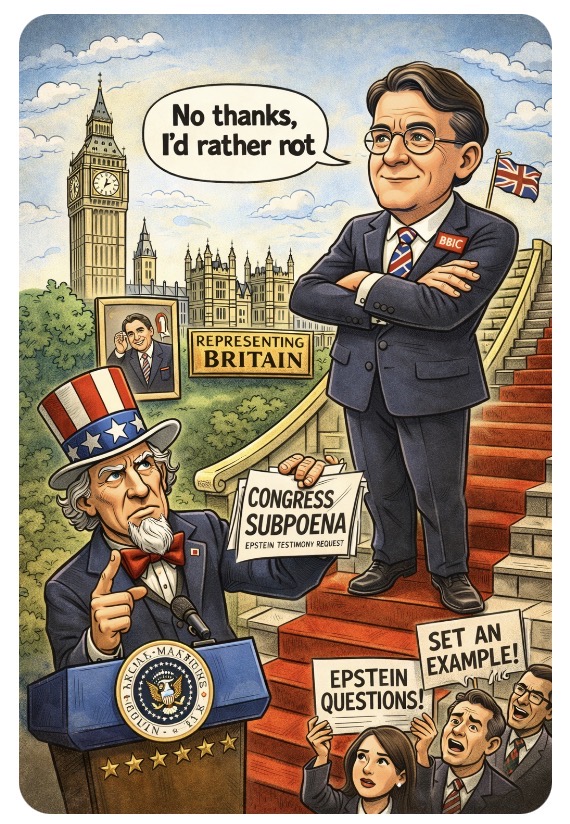
🇬🇧⚖️When someone holds senior public roles and represents their country on the world stage, the expectations placed upon them are naturally higher. That is the heart of the debate surrounding Peter Mandelson and the request from the United States Congress regarding his past connections with Jeffrey Epstein.
Legally, Mandelson may not be required to testify. As a British citizen outside U.S. jurisdiction, Congress cannot easily compel him to appear. So from a strict legal perspective, declining the request does not break any law.
But the question many people are asking isn’t really about law.
It’s about example.
🇬🇧 The Weight of Representing a Nation
People who represent Britain internationally carry more than just a title. They carry the reputation of the country itself.
Diplomats, ministers, ambassadors and senior political figures are often seen as reflections of national values. Fairness, transparency, accountability — these are principles the UK frequently promotes around the world.
So when questions arise, many people believe that those who have held high office should demonstrate those same principles.
Not because they are forced to.
But because they choose to.
In that sense, cooperating with inquiries — even when not legally required — can sometimes strengthen public trust rather than weaken it.
📰 The Problem With Refusing
Refusing to give evidence may be perfectly lawful, but politically it can create a different problem.
It leaves unanswered questions.
And in politics, unanswered questions rarely disappear — they usually grow louder.
For critics, declining to cooperate can look like avoidance. For supporters, it may simply be a matter of principle or jurisdiction.
But either way, the situation risks dragging Britain’s reputation into a controversy it never asked to be part of.
⚖️ Law vs Leadership
The real debate is not whether Mandelson must testify.
It’s whether figures who have held positions of national responsibility should lead by example, even when the law does not compel them.
Because sometimes the standard expected of those who represent a country isn’t defined by legal obligation.
It’s defined by public trust.
🔥 Challenges 🔥
If someone has represented Britain at the highest levels:
• Should they voluntarily cooperate with international investigations?
• Does refusing damage public confidence?
• Or should national figures only answer to their own country’s legal system?
Join the debate in the blog comments, not just on social media.
👇 Comment. Like. Share. Start the discussion.
The strongest responses will be featured in the next issue of the magazine. 📝🔥


 Chameleon Magazine
Leave a comment