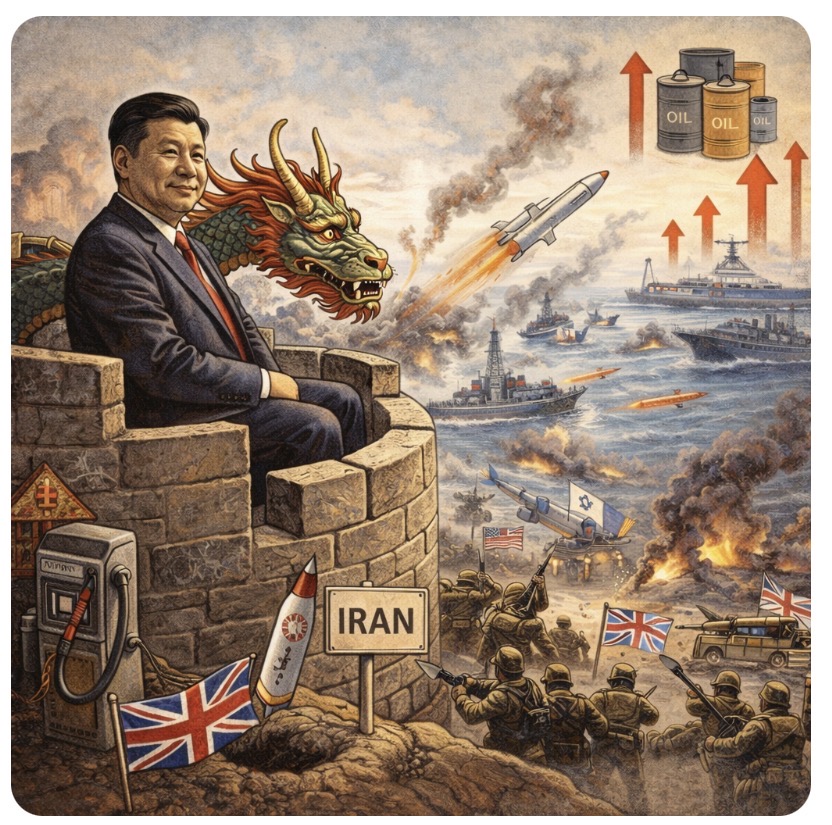
🐉🌍As tensions escalate and Western allies are pulled deeper into global conflicts, China is watching closely—and perhaps with a quiet sense of vindication. For years, Xi Jinping and Beijing’s strategic planners have argued that the US-led alliance system would eventually become its own weakness.
Now, from China’s perspective, that theory appears to be playing out in real time.
🎭 The Alliance Trap
China has long believed that Washington’s vast web of military alliances—from Europe to Asia—would ultimately drag the United States and its partners into conflicts they might otherwise avoid.
The current situation seems to reinforce that view.
The United States has moved quickly to mobilise allies, and many Western nations now face difficult choices:
- Provide military support and resources
- Host US forces and become potential targets
- Balance domestic political pressure with alliance commitments
For countries like United Kingdom, this means being drawn directly into the strategic orbit of US-led military responses—sometimes both supplying resources and facing the risks that come with hosting American military infrastructure.
From Beijing’s strategic lens, this isn’t just a regional crisis. It’s evidence of what they see as the structural fragility of Western alliances.
🐉 China’s Calculated Distance
Despite its relationship with Iran, China has been cautious about offering overt support.
The reason is simple:
Why step into a volatile conflict if the benefits are unclear?
China’s strategy often emphasises long-term positioning rather than immediate confrontation.
By keeping some distance, Beijing avoids:
- Direct military entanglement
- Additional sanctions pressure
- Escalating geopolitical tensions unnecessarily
Instead, China watches as global dynamics evolve.
⚓ Short-Term Pain, Long-Term Strategy
In the near term, China won’t escape the economic fallout.
Rising energy prices and disruptions to global shipping routes affect everyone—including the world’s largest manufacturing economy.
But Chinese strategists often think in decades rather than months.
From Beijing’s perspective, today’s instability fits into a broader narrative:
A gradual weakening of the post–Second World War international system dominated by Washington.
If Western alliances become strained by repeated conflicts and economic pressure, China believes it may create space for an alternative global model—one shaped more heavily by Beijing’s economic and political influence.
🌍 The Long Game
Whether that prediction proves accurate remains to be seen.
But one thing is certain:
China isn’t rushing to intervene dramatically.
Instead, it’s observing, calculating, and positioning itself for a future world where the balance of power may look very different from the one that has dominated global politics for the past seventy years.
🔥 Challenges 🔥
Is the current turmoil evidence that Western alliances are overstretched—or proof that collective security still matters in an unstable world?
And could China’s patient strategy eventually reshape global leadership in the decades ahead?
Drop your thoughts in the blog comments (not just Facebook). We want the sharpest geopolitical takes and the boldest predictions. 💬🔥
👇 Comment, like, and share if you think the global balance of power is entering a historic shift.
🏆 The best comments will be featured in the next issue of the magazine.


 Chameleon Magazine
Leave a comment