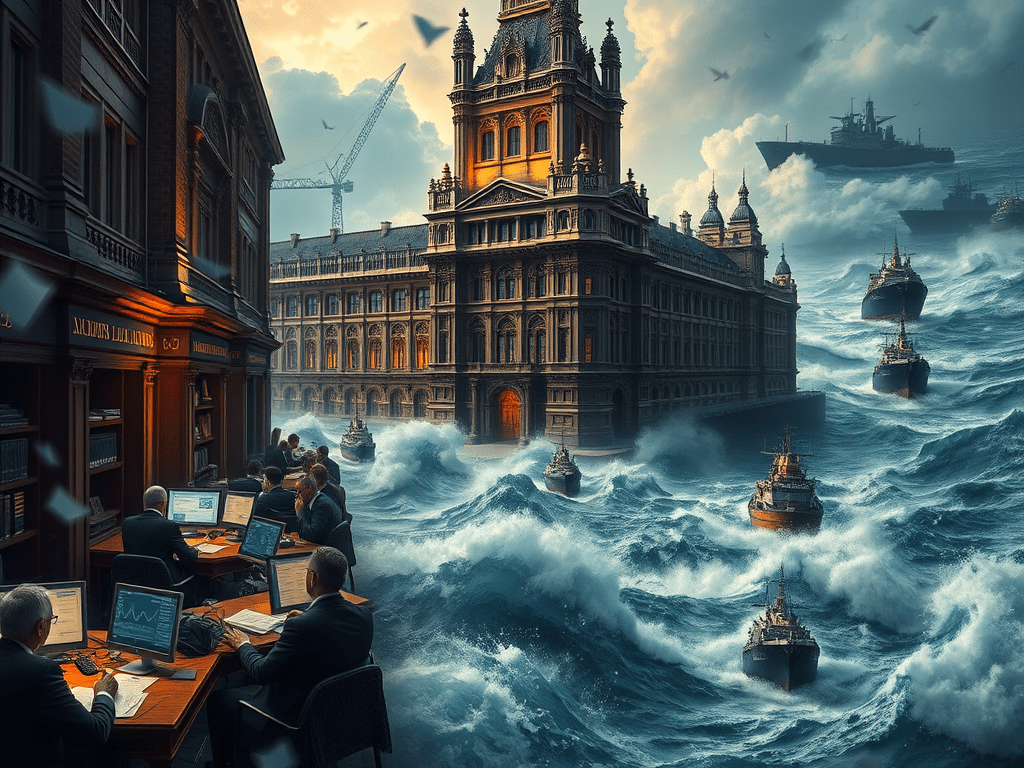
🌍💥Once upon a time Britain ruled the waves. Then it ruled the paperwork for the waves. And now? It mostly sits in London recalculating risk tables while the White House tosses geopolitical grenades into the global shipping lanes.
Welcome to the peculiar universe where one American president’s foreign policy can turn the world’s most famous insurance marketplace—Lloyd’s of London—into a caffeine-fuelled panic room of actuaries trying to price the cost of chaos.
Because when tensions explode somewhere between a warship and an oil tanker… someone has to insure the fallout. And historically, that someone is London. 🧾💣
🚢 When the White House Writes the Risk Tables
During the presidency of Donald Trump, geopolitics turned into something resembling a late-night reality show finale: sanctions flying, trade wars escalating, military posturing in the Persian Gulf, and the occasional “whoops, we just bombed something sensitive.”
Each headline landed squarely on the desks of London underwriters.
Why? Because Lloyd’s specializes in insuring things most sensible insurers would avoid like a radioactive kebab:
- Tankers sailing through missile range
- Satellites worth more than small countries
- Political revolutions mid-contract
- Cyber warfare and infrastructure meltdowns
- Governments collapsing halfway through a policy term
When tensions flare in places like the Persian Gulf, war-risk premiums can explode overnight. Ships suddenly require special coverage just to enter certain waters.
Translation: one geopolitical tantrum and suddenly every tanker captain is paying London a fortune just to leave port. 🛳️💸
💧 The Strait of Hormuz: The World’s Most Expensive Stretch of Water
Strait of Hormuz is where roughly 20% of global oil squeezes through a narrow strip of ocean that insurers treat like a floating minefield.
When tensions spike around Iran:
- War-risk insurance premiums surge
- Shipping companies hesitate or reroute
- Tankers stack up offshore
- Underwriters panic-price the danger
At several points during Gulf tensions, premiums reportedly jumped more than tenfold as insurers scrambled to adjust.
That’s not merely geopolitics.
That’s the global economy paying London a survival fee for sailing through somebody else’s standoff. 💣🚢
🧾 Sanctions: The Compliance Circus
Then came the sanctions avalanche.
Trump’s “maximum pressure” campaign—largely aimed at countries like Iran and Venezuela—meant insurers suddenly had to worry about accidentally covering:
- sanctioned oil shipments
- hidden shell companies
- oligarch-owned cargo masked behind offshore paperwork
One wrong policy and suddenly the lawyers from the U.S. Treasury are knocking with penalties large enough to buy a small island.
So London insurers built massive compliance systems just to determine whether a tanker belonged to a legitimate trader… or a sanctioned oligarch’s cousin’s Cayman Islands mailbox company.
Financial detective work, but with billion-dollar consequences. 🔎💼
🇺🇸 And Then Washington Floated Replacing Them
Just when the market thought it had priced the chaos, Washington tossed out another curveball.
The Trump administration briefly floated the idea that the U.S. government itself could provide insurance for tankers operating in Gulf waters.
In theory: government-backed coverage.
In practice: the geopolitical equivalent of opening a giant supermarket next door to Britain’s oldest pub.
Industry insiders raised eyebrows so high they nearly left the building. Many doubted any government could replicate the expertise and global network built over centuries by Lloyd’s underwriters.
But the mere suggestion rattled nerves.
Because if governments start underwriting global shipping risk themselves… London’s centuries-old insurance dominance suddenly looks a little less eternal. 🏛️⚓
📊 Did Trump Actually “Sink” Lloyd’s?
Not quite.
Lloyd’s of London still dominates large portions of the global war-risk insurance market and remains a critical pillar of maritime trade.
But the deeper story isn’t about one president.
It’s about where global shocks originate.
Politics creates risk.
Risk creates insurance demand.
Insurance demand shifts financial power.
And increasingly, the political earthquakes shaking global markets aren’t coming from London.
They’re coming from Washington.
Which means Britain’s legendary insurance hub now spends half its time doing the same thing the rest of the world does…
Trying to guess what the White House will do next. 🎲🌍
🔥 Challenges 🔥
Here’s the uncomfortable question:
If geopolitical chaos is written in Washington but insured in London… who actually controls the global risk economy?
Is Britain still the financial referee of world trade—or just the accountant cleaning up everyone else’s geopolitical mess?
Drop your take in the blog comments. Sarcasm encouraged. Rage optional. Truth bombs absolutely welcome. 💬🔥
👇 Hit comment, like, and share if this made you raise an eyebrow—or a pitchfork.
The sharpest takes and most savage burns will be featured in the next issue of the magazine. 🎯📝


 Chameleon Magazine
Leave a comment