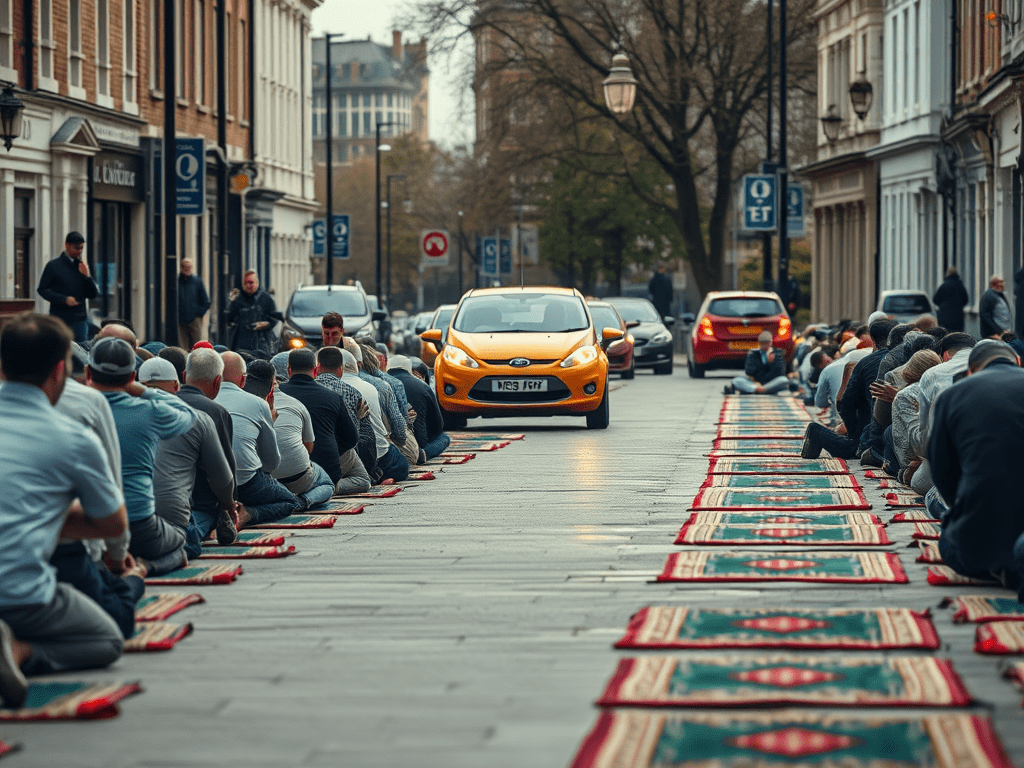
🚧🕌💥Once upon a time Britain exported two things to the world: parliamentary democracy and the sacred art of queuing politely. Now the nation that invented “after you, mate” is locked in a furious standoff over who gets priority on the asphalt — the Toyota Corolla or the prayer mat.
Recent viral videos showing drivers confronting (and in some cases attempting to inch their vehicles through) Muslim street prayers have detonated a social media firestorm. To some, it’s a defence of public roads. To others, it’s hostility toward religious expression.
Either way, the result is the same: Britain’s streets have become the newest arena for a culture clash nobody seems remotely equipped to referee. 🚨
🛣️ Pavements, Prayer Mats, and the Great British Traffic Jam of Tolerance
Picture the scene.
A quiet urban street.
Rows of worshippers kneeling in prayer.
And somewhere behind them, a Ford Fiesta driver slowly losing the will to live.
This is modern Britain’s most surreal traffic obstruction: not roadworks, not cyclists, not even a Royal Mail van parked diagonally — but a spontaneous outdoor congregation because the mosque has run out of space.
Supporters say it’s simple math: growing communities + limited buildings = occasional street overflow during Friday prayers or festivals like Eid.
Critics say something else entirely:
Roads are for cars. Pavements are for walking. Neither were designed to double as temporary mosques.
Cue the chaos.
Drivers honk. Someone films. A car edges forward. Someone shouts. Within minutes the clip is ricocheting around the internet faster than a Greggs sausage roll at lunchtime.
And suddenly what started as a local traffic headache becomes a full-blown national argument about identity, rights, and who exactly owns the pavement. 📱🔥
⚖️ Britain’s Legal Gymnastics Routine
Legally speaking, the UK tries to balance two ideas that increasingly glare at each other like strangers on a crowded Tube carriage:
1️⃣ Freedom of religion
2️⃣ Public order and safety
Under the Human Rights Act, people absolutely have the right to practise their faith and gather peacefully.
But there’s a catch.
Blocking highways, preventing emergency access, or creating safety risks can lead authorities to shut things down faster than a pub calling last orders.
Which leaves councils and police performing a delicate bureaucratic yoga pose:
“Please feel spiritually fulfilled… but ideally not in the middle of the A-road.”
Planning usually keeps things calm. But when crowds grow faster than buildings — or when organisation fails — the situation can unravel quicker than a cheap umbrella in a London storm. 🌧️
📱 The Internet: Where Nuance Goes to Die
The moment a video hits social media, the conversation instantly splits into two competing blockbuster narratives.
Narrative A:
Britain is losing control of its public spaces and letting religious gatherings block roads.
Narrative B:
Drivers confronting worshippers are proof of rising anti-Muslim hostility.
Reality, inconveniently, is often less cinematic.
A mix of poor planning, overcrowded mosques, frustrated drivers, and social media algorithms that reward outrage more than understanding.
But subtlety doesn’t trend. Conflict does.
And nothing fuels engagement like a culture war unfolding between a steering wheel and a prayer mat. 🧨
🌍 The Real Issue Nobody Wants to Admit
This argument isn’t really about traffic.
It’s about a deeper national anxiety: what happens when different expectations about public space collide in a country already nervous about identity, immigration, and cultural change.
For some, street prayer represents community and faith in action.
For others, it feels like the quiet rules of public life are being rewritten without anyone asking.
And when those two interpretations meet in the middle of a busy road… well, sparks are inevitable. ⚡
🔥 Challenges
🔥
Here’s the uncomfortable question Britain keeps swerving around like a pothole:
Where does religious freedom end — and where does public order begin?
Should cities create designated overflow prayer spaces?
Should blocking roads for worship be banned outright?
Or is this entire argument being amplified into a culture war that benefits nobody except angry algorithms?
We want your take. Not just the polite ones — the spicy ones too. 🌶️💬
👇 Drop your thoughts in the blog comments, hit like, and share this post if you think Britain needs a grown-up conversation about public space, faith, and coexistence.
The sharpest, funniest, and most brutally honest comments will be featured in the next issue of the magazine. 🎯📝


 Chameleon Magazine
Leave a comment