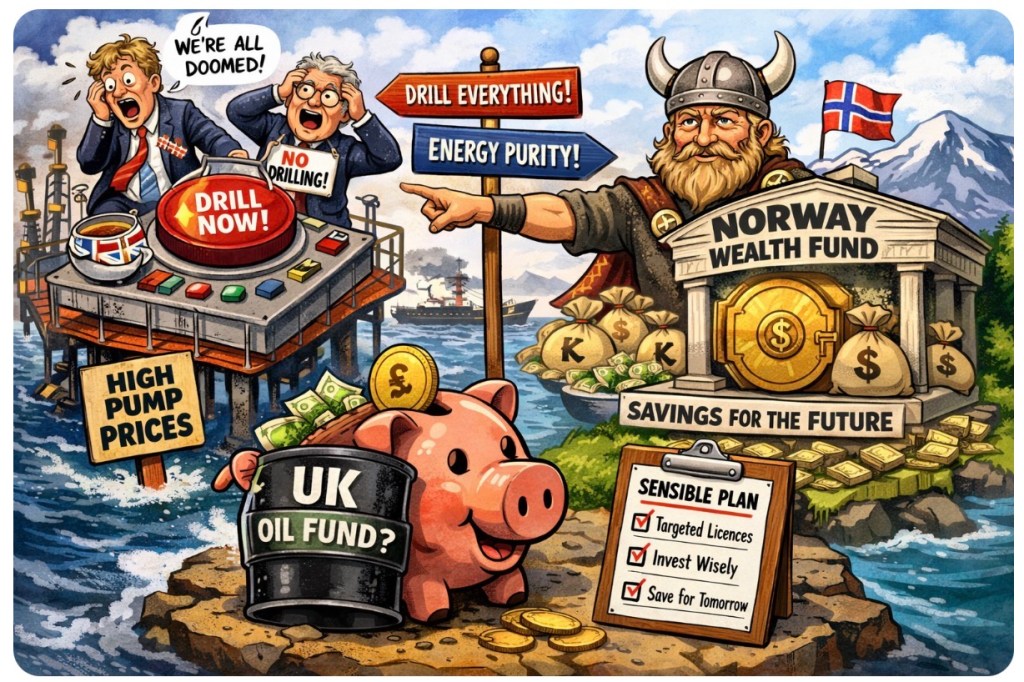
🛢️🇬🇧💷Britain’s debate over the North Sea has collapsed into a shouting match between “drill everything immediately” and “never drill again.” Meanwhile, reality sits awkwardly in the middle: new licences won’t magically slash petrol prices tomorrow, but pretending domestic production doesn’t matter is about as strategic as bringing a teabag to a flood.
🧠 The North Sea Isn’t a Panic Button — It’s a Long Game
Let’s clear up the fantasy first. Handing out a few shiny new licences tomorrow will not send petrol prices crashing by the weekend. Oil markets don’t work like a takeaway app where you order a barrel and it arrives in 30 minutes. Even the UK government admits new licences would not meaningfully change the global price UK consumers pay.
But here’s the equally awkward truth for the other side of the debate: Britain still uses oil and gas. Quite a lot of it. And unless the country plans to run the NHS, transport network, and industrial economy on interpretive dance and vibes, that will remain true for a while yet.
Existing North Sea production is already expected to continue during the energy transition. The real question isn’t whether hydrocarbons exist in the system — it’s whether Britain prefers producing some of them itself or importing them while polishing its climate halo. 🌍✨
🏦 Norway Didn’t Win by Shouting — It Won by Saving
The country that actually played this game properly is Norway. Instead of treating oil revenue like a lottery win to be blown on political sugar rushes, Norway created the Government Pension Fund Global, the world’s largest sovereign wealth fund.
The idea was disarmingly simple:
Take oil profits → invest them → save them for the future.
No slogans. No chest-thumping. No pretending fossil fuels vanished because a minister said the word “transition” three times into a microphone.
Today that fund is worth well over a trillion dollars and quietly bankrolls Norway’s future while politicians elsewhere argue over who gets the last biscuit in the policy tin. 🍪
Britain, meanwhile, discovered the North Sea decades ago and somehow managed to spend the windfall like a student who just found their overdraft limit.
🛢️ The Actual Sensible Middle Ground
If Britain wants to rediscover its strategic brain cells, the approach isn’t complicated:
- Release selected North Sea licences where projects are commercially viable.
- Use existing infrastructure so development isn’t absurdly expensive.
- Collect the tax revenue properly.
- Put a fixed portion into a British sovereign wealth fund.
- Invest that fund in long-term national resilience — infrastructure, energy systems, and future generations.
The institutional machinery already exists through the North Sea Transition Authority. What’s missing isn’t geology or bureaucracy.
It’s political nerve.
Because right now Britain’s energy strategy often resembles a diet where someone swears off cake while secretly ordering cupcakes from abroad.
🎭 The Real Problem: Policy Theatre
Both extremes love a dramatic storyline:
- “Drill everything and fuel will be £1 tomorrow!”
- “Stop drilling and the planet will instantly cool!”
Neither survives contact with reality.
New licences are long-term decisions, not emergency price levers. But ignoring domestic resources while importing the same fuel from elsewhere isn’t climate heroism either — it’s geopolitical outsourcing with a smug accent.
Britain doesn’t need a drilling frenzy.
It needs a grown-up plan.
🔥 Challenges 🔥
Here’s the uncomfortable thought experiment:
If Britain is still going to use oil and gas for decades, why shouldn’t the country capture some of the value instead of shipping the profits overseas?
Is refusing to produce domestic energy actually climate leadership — or just expensive virtue signalling with a tanker attached? 🚢💸
Drop your take in the blog comments, not just on social media.
Bring the arguments, the sarcasm, and the economic reality checks. 💬🔥
👇 Like, share, and comment.
The sharpest responses will be featured in the next issue of the magazine. 📝🎯


 Chameleon Magazine
Leave a comment