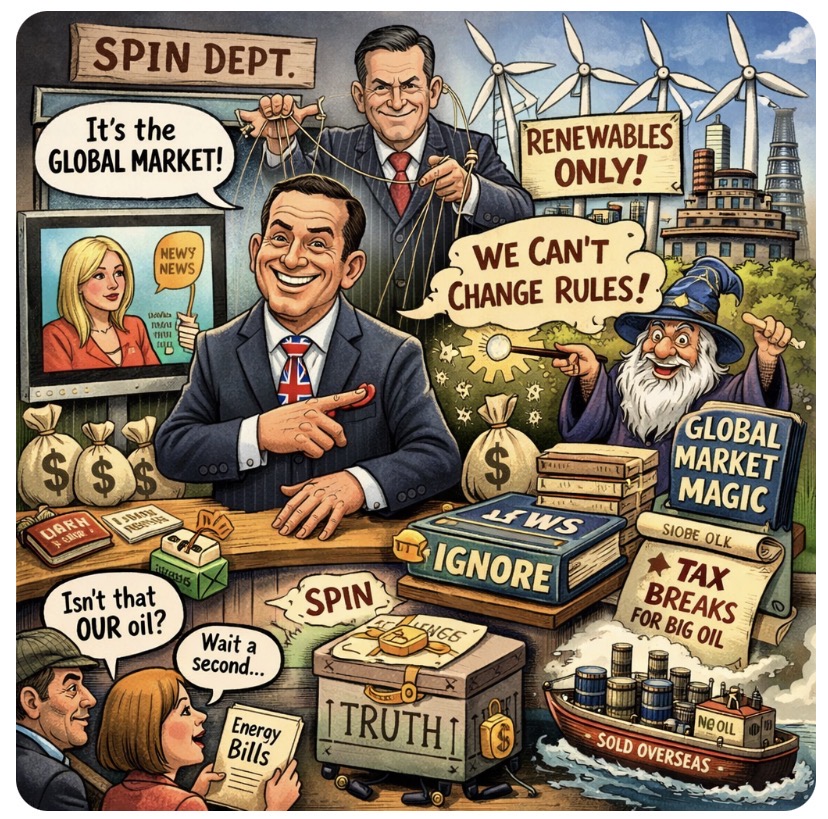
🌍⛽This morning’s performance on Good Morning Britain delivered a familiar script: ministers insisting that drilling more oil in the UK wouldn’t lower prices because oil is sold on the global market. Case closed, apparently. Except… that argument conveniently leaves out one rather awkward detail — governments write the laws that determine how markets work in the first place. Funny how that bit never makes it into the interview.
🎭 The Magical Disappearing Power of Government
Apparently, according to the political theatre on breakfast TV, governments are powerless spectators to “the global market.” Oil comes out of British waters, gets whisked away by invisible economic forces, and poof — there’s absolutely nothing policymakers could possibly do about pricing.
Except… governments regulate industries all the time.
They set windfall taxes.
They impose export restrictions.
They mandate domestic supply requirements.
They subsidise renewables.
They control licensing for drilling.
But the moment someone asks whether British resources could prioritise British consumers, suddenly the state transforms into a helpless bystander clutching a cup of tea and muttering, “Sorry, rules are rules.”
The truth is far less mystical: laws determine how resources are sold and where they go. If policymakers wanted a domestic supply obligation or a different pricing structure, they could legislate it. Governments reshape markets constantly when it suits them.
So when politicians say, “We can’t because the global market,” what they often mean is something closer to:
“We’ve chosen not to.”
Meanwhile, the national conversation gets funnelled into a false choice: oil bad, wind good, economy versus environment, drilling versus renewables — as if energy policy can only exist in two extreme boxes.
Reality, of course, is messier. Energy security, price stability, environmental goals, and economic policy are all tangled together like Christmas lights in the attic.
But messy conversations don’t fit neatly into a five-minute breakfast TV interview.
🔥 Challenges 🔥
If governments can rewrite tax codes overnight, bail out banks in a weekend, and redraw entire regulatory frameworks when crises hit… why do they suddenly become powerless when energy policy comes up? 🤔
Is the “global market” explanation genuine economics — or just political convenience wrapped in jargon?
Drop your take in the blog comments, not just on social media. We want the sharpest arguments, the best rants, and the boldest ideas. 💬⚡
👇 Comment, like, and share if you think the public deserves the full story — not just the TV soundbite.
The best comments will be featured in the next issue of the magazine. 📰🔥


 Chameleon Magazine
Leave a comment