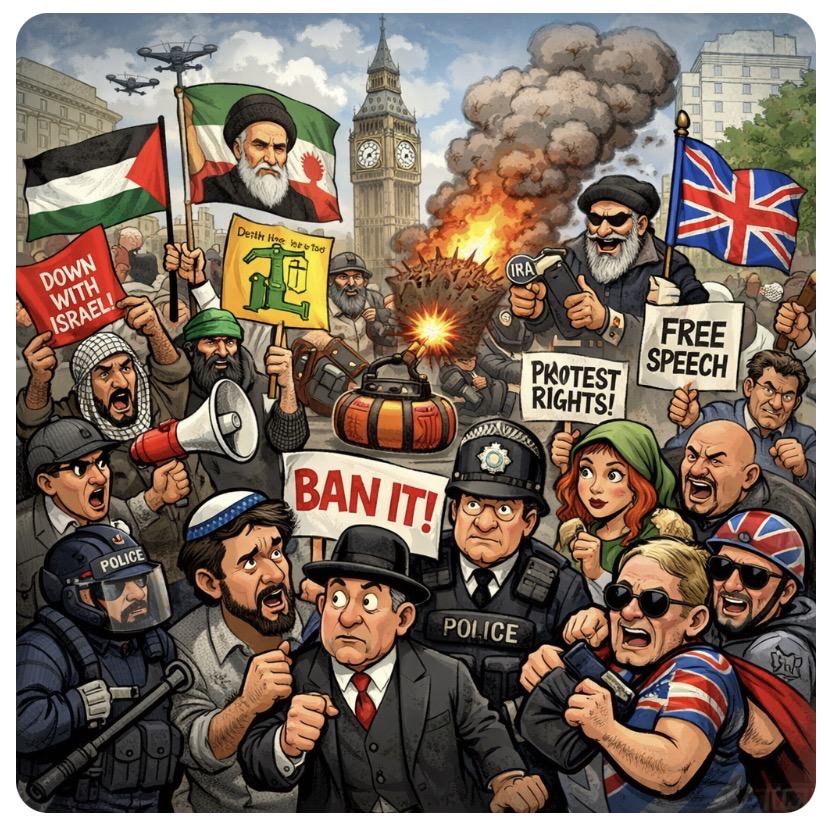
🇬🇧🌍Every year the Al-Quds Day march winds through London, a protest born in the 1979 Iranian revolution and designed to rally global opposition to Israel.
Supporters say it’s about Palestinian solidarity.
Critics say it’s soaked in Iranian revolutionary symbolism and extremist messaging.
But beyond the arguments about foreign policy, antisemitism, and free speech, a quieter frustration is bubbling up among ordinary Brits:
Why are Britain’s streets becoming the stage for everyone else’s wars?
🪧 When the World’s Conflicts Land on the High Street
The Al-Quds march—first created by Ruhollah Khomeini and organised in London by the Islamic Human Rights Commission—has long been pitched as a protest for Palestinian rights.
But in practice it often looks like something far bigger.
You’ll see Palestinian flags, yes.
But you’ll also see Iranian revolutionary imagery, chants about Israel’s destruction, and—historically—symbols associated with groups like Hezbollah, which the UK banned as a terrorist organisation in 2019.
And suddenly a protest about the Middle East isn’t happening in the Middle East.
It’s happening in London.
Outside tube stations.
Past cafes.
Through neighbourhoods where many people just wanted to buy groceries and go home.
For a lot of the public, that’s where patience starts wearing thin.
🧨 A Country Becoming a Political Battleground
In recent years Britain has hosted marches about:
- Gaza
- Israel
- Ukraine
- Iran
- Kashmir
- Eritrea
- Armenia
- Sudan
On any given weekend the capital can look like a global dispute resolution centre—except nobody is actually resolving anything.
The arguments just get louder.
The flags get bigger.
And the anger spills onto British streets.
Many people increasingly ask a blunt question:
Why should Britain become the protest ground for conflicts happening thousands of miles away?
🏛️ Westminster’s Impossible Balancing Act
Politicians now face growing pressure to ban events like the Al-Quds march.
About 90 MPs and peers have urged the government to block it, arguing it risks antisemitism, extremism, and public disorder.
But banning it creates another problem.
Britain has a long tradition of tolerating controversial protests—from far-right marches to anti-war demonstrations—because the moment governments start deciding which political views are allowed in public, civil liberties start shrinking fast.
So the government is stuck between two competing pressures:
- Public order and community safety
- Free speech and protest rights
Neither side is easy to abandon.
🧍 The Growing Public Mood: “Enough”
What’s increasingly clear is that many ordinary people feel caught in the middle of ideological battles they never signed up for.
They’re not debating Middle Eastern geopolitics.
They’re asking simpler questions:
Why are police stretched every weekend policing foreign conflicts?
Why are communities being dragged into disputes they have no connection to?
Why does every international crisis seem to explode on British streets?
For some, the frustration isn’t about Palestinians or Israelis.
It’s about Britain feeling like a stage for global grievances.
⚖️ The Awkward Reality
Britain is a diverse country with deep international connections. That means people here care passionately about conflicts abroad.
But there’s a growing sense that something has shifted.
When demonstrations become more about global power struggles than domestic politics, they start to feel less like protest and more like imported conflict.
And that’s where public patience begins to fray.
🔥 Challenges 🔥
Here’s the uncomfortable question:
Should Britain continue hosting protests about conflicts from every corner of the world…
—or is the public right to start asking whether enough is enough?
Where’s the line between legitimate protest and turning Britain into the world’s political pressure cooker?
Drop your take directly in the blog comments, not just social media. 💬🔥
👇 Like it, share it, and add your voice below.
The sharpest comments will be featured in the next issue of the magazine. 📝🎯


 Chameleon Magazine
Leave a comment