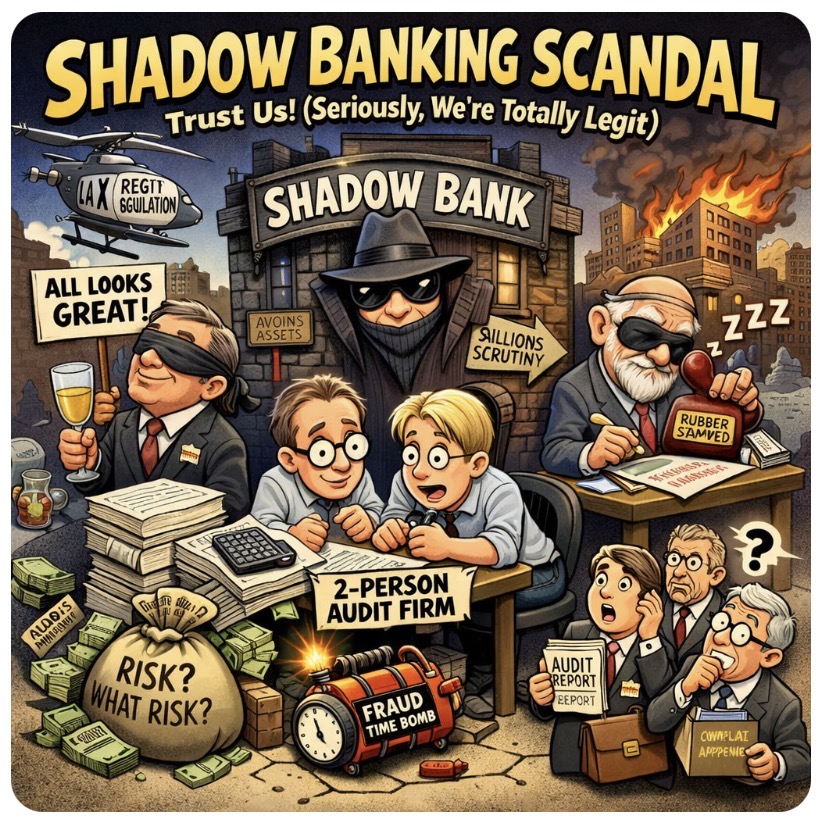
🏦🕶️Every financial disaster seems to begin the same way: a complex structure, billions in assets, impressive jargon… and somewhere in the middle, a suspiciously tiny gatekeeper quietly nodding everything through. Welcome to the world of shadow banking—where institutions act like banks, lend like banks, and move money like banks… but without the pesky inconvenience of proper banking rules.
And in this case? The oversight reportedly came from a two-person accounting firm responsible for watching over a structure worth billions. Yes, two people. That’s roughly the staffing level of a corner sandwich shop—except the sandwich shop usually has stricter hygiene inspections.
🧾 The Billion-Pound Paperwork Illusion
A shadow bank isn’t a spooky institution hiding in an alley. It’s simply a financial operation that performs bank-style activities outside traditional banking regulation.
Think:
• investment pools
• credit funds
• private lending vehicles
• complex financial structures moving massive capital
They’re legal. But the oversight can be… let’s say optimistically thin.
Unlike traditional banks, they often operate with:
• fewer regulatory checks
• limited disclosure of risks
• lighter supervision from financial authorities
And that’s where the danger creeps in.
Because when billions move through a system with minimal scrutiny, everyone assumes someone else already checked the numbers.
🧮 The Two-Person Audit Question
Here’s where the story turns from worrying to eyebrow-raising.
Major financial institutions typically use audit firms with:
• large accounting teams
• compliance specialists
• risk analysts
• established audit procedures
So discovering that a two-staff accounting firm was responsible for oversight naturally raises a few awkward questions:
• Could two people realistically audit a multi-billion-pound structure?
• Were proper auditing standards followed?
• Did regulators verify the firm’s capability before relying on its reports?
These are the kinds of questions investigators start asking after the money disappears, which is always slightly less helpful than asking them before.
🚨 The Classic Financial Scandal Pattern
If this story sounds familiar, it should.
Major financial collapses often follow the same script:
1️⃣ A complex financial structure nobody fully understands.
2️⃣ Trusted professional gatekeepers providing reassurance.
3️⃣ Investors assuming regulators already vetted everything.
4️⃣ A sudden collapse revealing that the safeguards were… theoretical.
When that happens, attention quickly turns to the people who were meant to spot trouble early:
• accountants
• auditors
• lawyers
• compliance officers
Because in finance, credibility is often outsourced. And when the outsourced credibility fails, the entire structure can crumble overnight.
🔥 Challenges 🔥
Here’s the uncomfortable question:
How many massive financial operations are currently being “supervised” by systems nobody has actually stress-tested?
Is this a rare oversight—or a symptom of a financial ecosystem where complexity hides risk until it’s too late?
Jump into the discussion on the blog and share your take. Are shadow banks a useful financial innovation… or just traditional banking with the safety rails removed? 💬
👇 Comment, like, and share if this story made you raise an eyebrow.
The sharpest insights and spiciest takes will be featured in the next issue of the magazine. 📰🔥


 Chameleon Magazine
Leave a comment