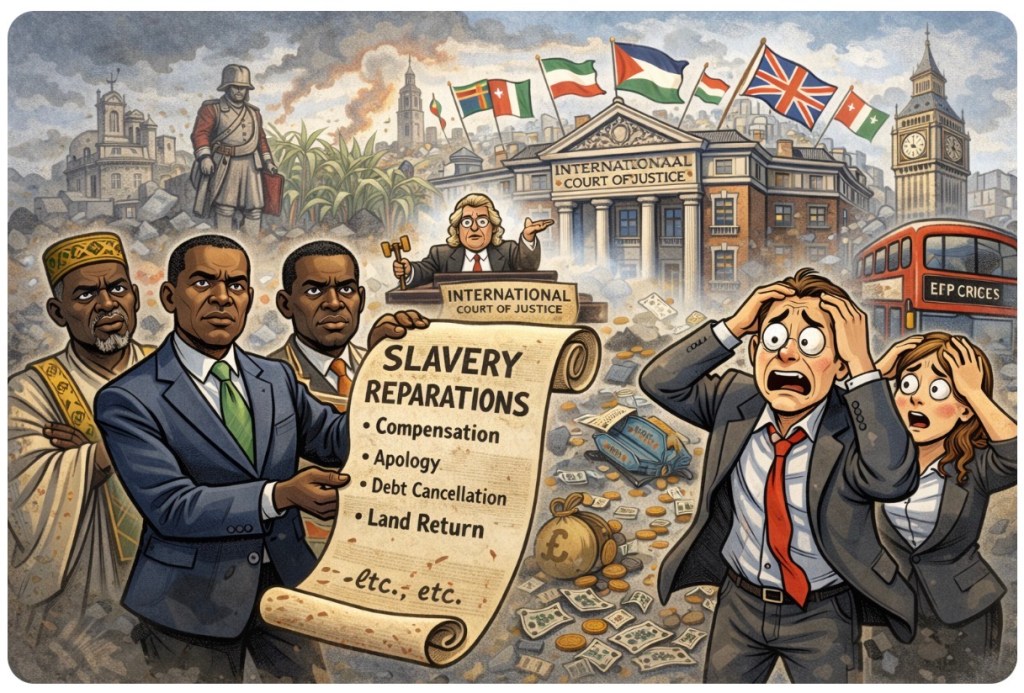
For decades Britain’s colonial past has simmered in academic debate and diplomatic tension. Now, some African nations are eyeing a strategy similar to Mauritius’ successful campaign over the Chagos Islands: take Britain to international courts and ask judges to rule on historic responsibilities tied to empire and slavery.
The idea is simple in theory and explosive in practice — if courts agree that colonial powers still carry legal obligations, the financial and political consequences could stretch for decades.
⚖️ The Reparations Domino Effect
Mauritius managed to put Britain on the defensive by pursuing international legal rulings over the Chagos Archipelago, eventually forcing negotiations about sovereignty and displaced islanders.
Now some African leaders are considering whether the same legal playbook could be used to push reparations claims for slavery and colonial exploitation.
In other words:
If the legal door opens once, others may try to walk through it.
And suddenly Britain finds itself staring down a potential wave of claims tied to events that happened centuries ago.
Cue the national debate.
Because the awkward reality is this: the people being asked to fund reparations today were not alive during the slave trade, colonial rule, or the policies now under scrutiny.
They didn’t vote for the governments that ran the empire.
Many didn’t even have ancestors in Britain at the time.
Yet the argument from campaigners is that modern states inherit the legal responsibilities of their predecessors — just as they inherit treaties, borders, and national debts.
Critics say that logic turns history into a permanent bill.
And if Britain begins conceding cases, other countries may quickly follow with their own claims.
It’s the diplomatic equivalent of spotting someone pay one parking ticket and deciding to invoice them for every parking violation since 1707.
🏛️ Who Owns the Past?
This debate sits right on the fault line between historical justice and modern accountability.
Supporters of reparations argue:
- Wealth built during empire helped shape modern economies
- Former colonies suffered long-term damage
- Recognition and compensation are necessary for justice
Opponents counter:
- Today’s taxpayers are not responsible for historical governments
- The empire involved many global actors, not just Britain
- Endless retroactive claims risk destabilising international law
And then there’s the political reality:
Britain already faces enormous fiscal pressure at home — energy costs, public services, debt, inflation.
The idea of potentially paying historic reparations on top of all that is bound to ignite a national argument.
Because when history sends the bill, the question becomes brutally simple:
Who should actually pay it?
🔥 Challenges 🔥
Should modern citizens be financially responsible for the actions of governments centuries before they were born?
Or does refusing reparations mean ignoring the lasting consequences of history?
Where do you draw the line between acknowledging the past and endlessly paying for it?
Drop your thoughts in the blog comments — fiery takes, careful arguments, historical facts, or brutal sarcasm all welcome. 💬🔥
👇 Comment, like, and share if you think this debate about history, responsibility, and money is only just beginning.
The best comments will be featured in the next issue of the magazine. 📝


 Chameleon Magazine
Leave a comment