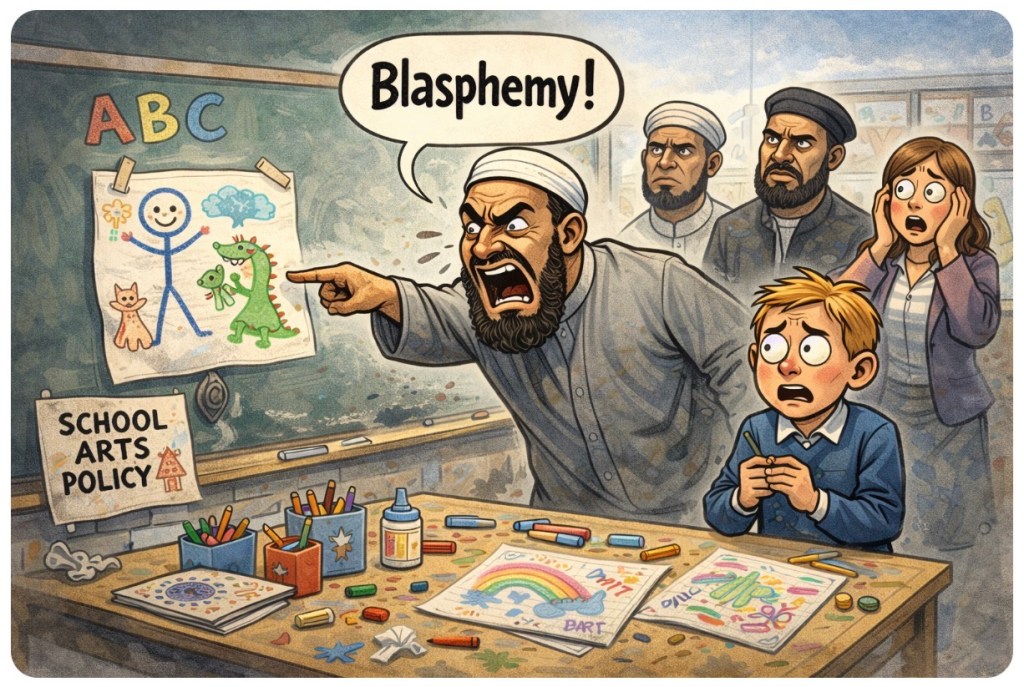
In the ever-expanding universe of British bureaucracy, we’ve now arrived at a particularly surreal destination: children’s drawings potentially being considered blasphemous.
Guidance circulated by some Labour-run councils reportedly warns schools and youth services that certain forms of art — including drawings of living beings — may conflict with Islamic interpretations that discourage idolatry. Add music, dance, and creative expression to the list of possible sensitivities, and suddenly the humble classroom art table looks like a theological minefield.
Yes, apparently Timmy’s stick-figure dinosaur might now require interfaith risk assessment paperwork.
🖍️ The Great Crayon Controversy
Let’s imagine the modern classroom under this logic.
A teacher sets out crayons, paper, and the timeless instruction: “Draw whatever you like.”
Five minutes later:
- A child draws a dragon 🐉
- Another sketches a superhero 🦸
- Someone else produces the inevitable lopsided family portrait
Under certain strict interpretations of Islamic law, depicting living beings can be considered problematic or even idolatrous. Historically this view applies mostly to religious contexts and imagery, not children’s doodles.
But once councils start issuing guidance about religious sensitivities around art, the bureaucratic reflex kicks in.
Soon we’re asking questions no civilisation previously needed to ask:
- Is a stick-figure person religiously sensitive?
- Is drawing a cat spiritually controversial?
- Does a Lego man count as idolatry?
At this rate the safest school project might just be a blank sheet of paper titled “Respectful Silence.”
🏫 When Inclusivity Collides With Common Sense
The intention behind such guidance is usually straightforward: avoid unnecessary offence and ensure communities feel respected.
Fair enough.
But there’s a delicate line between respecting religious diversity and rewriting everyday public life to accommodate the strictest interpretation of every belief system.
Because Britain’s classrooms aren’t religious schools governed by one doctrine — they’re public institutions serving families of every belief and none.
And if every cultural or religious restriction becomes a classroom rule, education quickly turns into a bureaucratic obstacle course.
At some point someone has to ask the uncomfortable question:
Is the goal respect and coexistence… or institutional paralysis by sensitivity memo?
🔥 Challenges 🔥
Should public schools adapt creative activities to avoid offending religious beliefs?
Or does restricting art, music, and expression in state schools cross the line into self-censorship and cultural overcorrection?
Where should the balance sit between respect for faith and freedom in public education?
Drop your thoughts in the blog comments — thoughtful arguments, satire, outrage, or philosophical doodles all welcome. 💬🔥
👇 Comment, like, and share if you think Britain’s classrooms should remain places for creativity — not religious compliance manuals.
The best comments will be featured in the next issue of the magazine. 📝


 Chameleon Magazine
Leave a comment