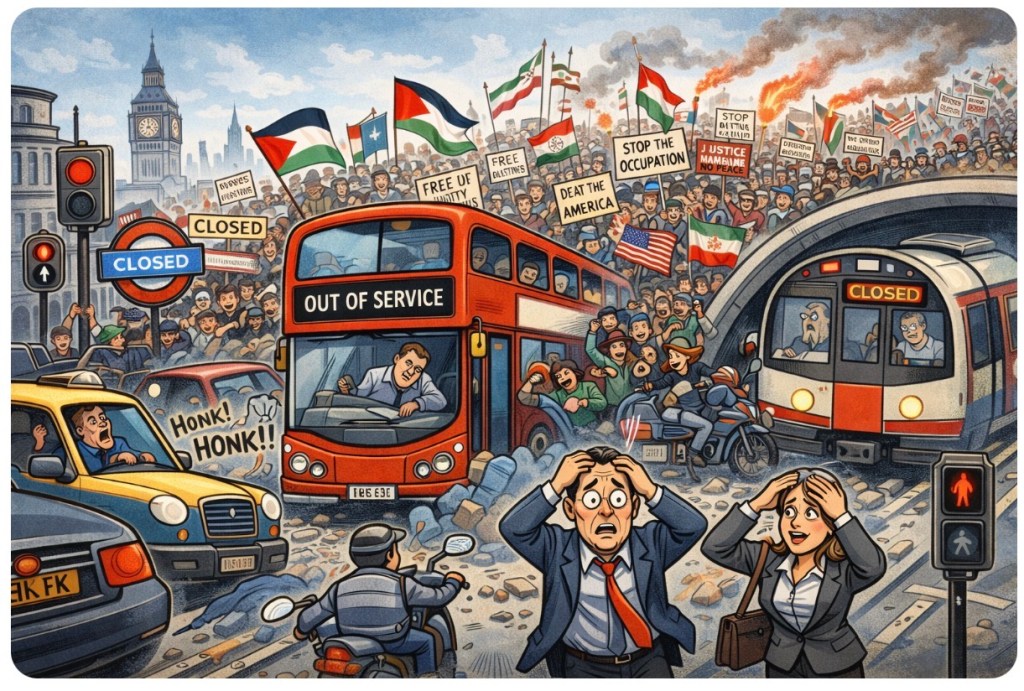
London has long been the global capital of many things: finance, theatre, history… and apparently every geopolitical protest imaginable. This week, the government finally slammed the brakes on one of them after the Home Secretary approved a police request to ban the annual Al-Quds Day march scheduled for Sunday.
Authorities said the decision was necessary to prevent “serious public disorder” given the scale of the march and the likelihood of multiple counter-protests amid heightened Middle East tensions.
It marks the first time a protest march in London has been banned since 2012, highlighting just how concerned the Metropolitan Police were about potential clashes.
Organisers insist the event is a peaceful demonstration for Palestinian solidarity, but critics argue it has historically been associated with pro-Iran rhetoric and displays linked to extremist groups, which has fuelled calls to stop it.
A static protest may still be allowed under strict conditions, but the march itself will not proceed.
🚧 The Protest Capital of the World
Let’s be honest: if aliens landed in central London on a Saturday afternoon, they’d probably assume Earth’s main export is marching with placards.
Every week, the capital hosts demonstrations about conflicts thousands of miles away — Gaza, Iran, Ukraine, climate policy, policing, monarchy, capitalism, anti-capitalism, and sometimes just the weather.
Meanwhile the average Londoner is just trying to:
- Get to work
- Catch a train
- Buy a sandwich
- Cross a road without walking into a megaphone
Instead they’re navigating drums, police cordons, flares, chanting crowds, and rerouted buses.
The uncomfortable truth is this:
London has become the global protest stage for causes Britain can barely influence.
Yes, the UK can speak diplomatically.
Yes, it can vote at the UN.
But a crowd shouting outside Parliament rarely changes events in Tehran, Gaza, or Jerusalem.
What it does change is London’s traffic flow and blood pressure levels.
🧭 The Real Question Nobody Wants to Ask
Democracy requires the right to protest.
But there’s a growing tension between two rights:
- The right to demonstrate
- The right of millions of residents to live their daily lives without constant disruption
The law allows the Home Secretary to restrict marches when police believe they could lead to serious disorder or major disruption.
Which raises the awkward debate quietly brewing in Britain:
Should London be the permanent protest arena for the world’s conflicts, or should there be tighter limits on demonstrations that repeatedly shut down the city?
🔥 Challenges 🔥
Here’s the uncomfortable question:
Should foreign political protests be allowed to continuously paralyse Britain’s capital, or is it time to rethink where and how demonstrations take place?
Is banning marches the start of restoring order…
or the first step down a slippery slope against free speech?
Drop your thoughts in the blog comments. Fury, logic, sarcasm — all welcome. 💬🔥
👇 Comment, like, and share if you think London deserves a break from being the planet’s protest playground.
The best comments will be featured in the next issue of the magazine. 📝


 Chameleon Magazine
Leave a comment