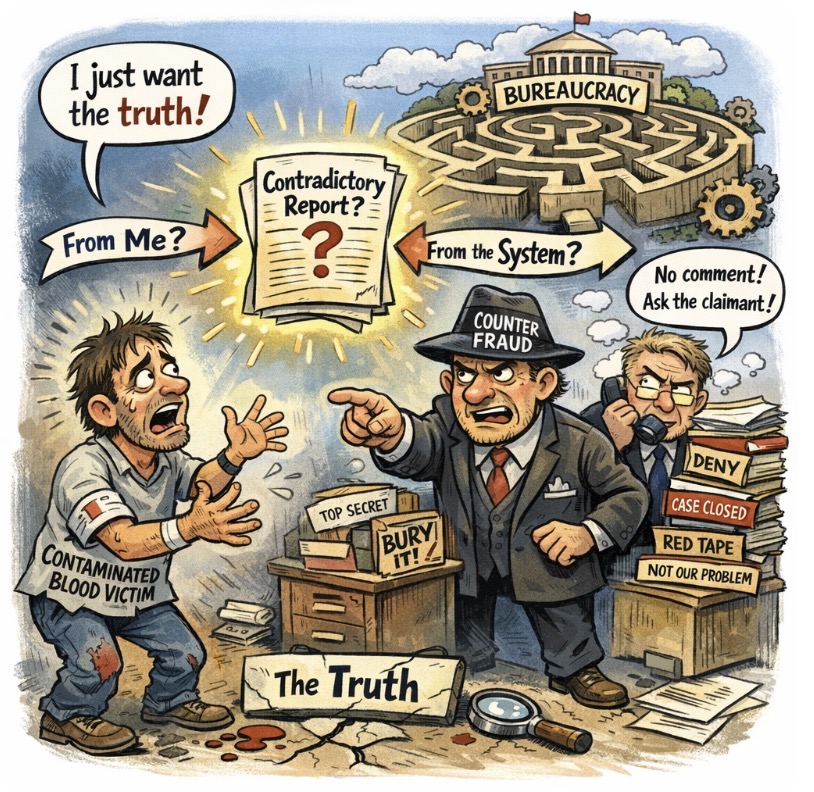
🩸📄When you spend six years trying to resolve something through official channels, you eventually discover a strange truth: systems designed to find answers can become remarkably skilled at avoiding them.
This is the story of a victim of the UK’s contaminated blood scandal who has now found himself in the surreal position of being treated as if he might be the dishonest party — because of a document that appears inside the government’s own records of his case.
The question that follows is almost painfully simple:
If the document is in the system’s records… who actually put it there?
And why, after years of correspondence, does nobody seem willing to answer that basic question?
🗂️ When the Paper Trail Starts Arguing With Itself
Like thousands of others affected by the UK’s contaminated blood tragedy — a disaster widely examined during the Infected Blood Inquiry — victims have spent years navigating compensation schemes, reviews, and bureaucratic labyrinths.
In my own case, I submitted a Subject Access Request (SAR) to obtain the official records relating to my claim.
What came back contained something unexpected.
Inside the released documents was a report assessing my case that appeared to reach a materially different conclusion from the one that was ultimately issued to me.
In other words:
The internal document suggested one outcome.
The official decision delivered another.
That alone raises a reasonable question.
But the situation escalated when the matter was referred to Counter Fraud Services, and it was implied — though not explicitly stated — that I may somehow have been responsible for introducing the document into the system.
Let’s pause on that for a moment.
A victim of one of the worst public health disasters in British history is now facing an implied suggestion of dishonesty because a document exists in the government’s own records.
Which leads to the central issue.
🔍 Two Possible Explanations — And Only Two
Strip away the bureaucracy, and the situation reduces to a very simple fork in the road.
Either:
1️⃣ The document originated from me.
Or
2️⃣ The document originated from within the system responsible for reviewing my case.
If the first were true, that would obviously be serious.
But if the second were true — if the document originated inside the government’s own review process — then the implications are far more significant.
Because the question would no longer be:
“Why did a claimant submit this document?”
It would instead become:
“How did a document generated within the system end up being attributed to the claimant?”
That is not a small administrative puzzle.
That would raise serious concerns about:
- the handling of evidence
- the integrity of case reviews
- the process by which allegations of dishonesty are directed at victims
🧾 The Paper Trail Exists — So Where Is the Explanation?
To be clear, this is not speculation.
The document exists.
It appeared within the official records released through my Subject Access Request, alongside the rest of the case file.
I have:
- the document itself
- the full SAR disclosure
- the correspondence surrounding the case
The only thing missing is the most obvious piece of information.
Where the document actually came from.
To encourage transparency, I have copied the government body responsible for the scheme and the Member of Parliament I have been corresponding with into the correspondence regarding this issue.
This was done deliberately.
If evidence exists that the document originated from me, then it should be presented.
But after six years navigating the system, I remain confident of one thing.
No such evidence exists.
🧠 Why This Matters Beyond One Case
This is not just about a single claim.
Occasionally, a story comes down to something deceptively small — a single document, a single entry in a record, a single unexplained step in a process.
But when that piece of evidence contradicts an official decision, it stops being a minor anomaly.
It becomes a question about how decisions are made in the first place.
And in cases involving victims of a national scandal, those questions matter.
Because the contaminated blood disaster already represents one of the most profound failures of public institutions in modern British history.
Which makes one final question unavoidable.
🔥 Challenges 🔥
If a document inside a government case file contradicts the decision that was issued…
who should be expected to explain it?
The claimant — or the system that created the file?
If you’ve ever dealt with a bureaucracy that seemed determined to avoid answering a simple question, this might feel familiar.
Drop your thoughts in the blog comments. Tell us what you think happened here.
Was this a clerical anomaly, a bureaucratic blind spot, or something far more troubling?
👇 Comment, like, and share if you believe victims deserve answers — not accusations.
The most insightful (or brutally honest) comments will be featured in the next issue of the magazine. 📝🔥


 Chameleon Magazine
Leave a comment