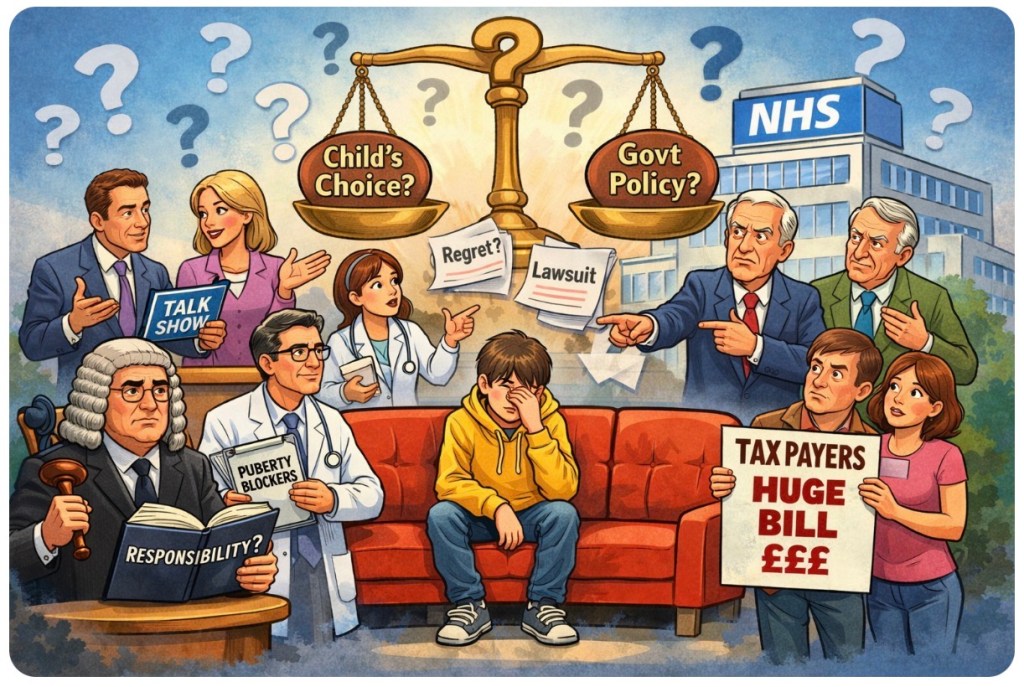
🧠⚖️When a society allows life-altering medical interventions for children, the question isn’t just whether the treatment exists. The real question is far more uncomfortable: who owns the consequences if the decision turns out to be wrong?
Is it the child who made the choice before their brain was fully developed?
Is it the doctors who approved it?
Is it the government that sanctioned it?
Or is it the public—who ultimately fund the healthcare system and pick up the bill if things go wrong?
This debate is now front and centre in Britain as the use of puberty blockers in gender medicine has been restricted following the findings of the Cass Review, which examined treatment practices within the National Health Service.
The report highlighted something uncomfortable for everyone: the evidence for long-term benefits was limited, while the potential risks and unknowns remained significant.
And suddenly the question changed.
Not “should people have freedom over their bodies?”—
but “who should carry the burden if the system gets it wrong?”
🧒 The Child, the State, and the £Billion Question
Let’s be brutally honest for a moment.
Children cannot:
- vote
- sign legal contracts
- buy alcohol
- get a tattoo in many places
because society recognises something obvious: children are still developing the judgment needed to make permanent decisions.
Yet in one of the most emotionally charged medical debates of the decade, the conversation often drifts toward allowing minors to make decisions that may permanently alter their bodies and futures.
That raises a dilemma.
If a child is considered mature enough to make such a choice, then logically the responsibility would rest with them.
But if they are not yet capable of fully understanding the lifelong consequences, then the responsibility shifts elsewhere—toward:
- parents
- doctors
- regulators
- and ultimately the state.
And when the state sanctions something within the National Health Service, the financial and moral consequences don’t disappear into thin air.
They land squarely on the shoulders of the public who fund it.
Because if a young person later believes they were harmed or misled, who pays for the decades of healthcare, support, or legal compensation?
Not the television studios.
Not the politicians who debated it.
The taxpayers.
🧪 Medicine or Social Experiment?
The uncomfortable truth about modern medicine is that many treatments begin before the long-term evidence is fully understood.
History is littered with examples where medical confidence later turned into national regret—from the Thalidomide scandal to the Infected blood scandal in the United Kingdom.
In those cases, the public eventually paid twice:
- First through the healthcare system.
- Then through compensation and long-term care.
No one sets out to harm patients.
But the line between innovation and experimentation can sometimes be thinner than anyone likes to admit.
🔥 Challenges 🔥
Here’s the question nobody on the morning TV sofas seems brave enough to tackle head-on:
If a child makes a life-altering medical decision and later regrets it—who should carry the responsibility?
The child who wasn’t yet fully developed?
The doctors who followed evolving guidelines?
The government that allowed the policy?
Or the public who fund the system?
This debate isn’t about shouting matches or political tribes. It’s about how cautious a society should be when children, medicine, and irreversible consequences collide.
Drop your thoughts directly in the blog comments. Not just on Facebook. Let’s have the real conversation where it belongs. 💬
👇 Like it. Share it. Comment with your sharpest take.
The best comments will be featured in the next issue of the magazine. 📝🔥


 Chameleon Magazine
Leave a comment