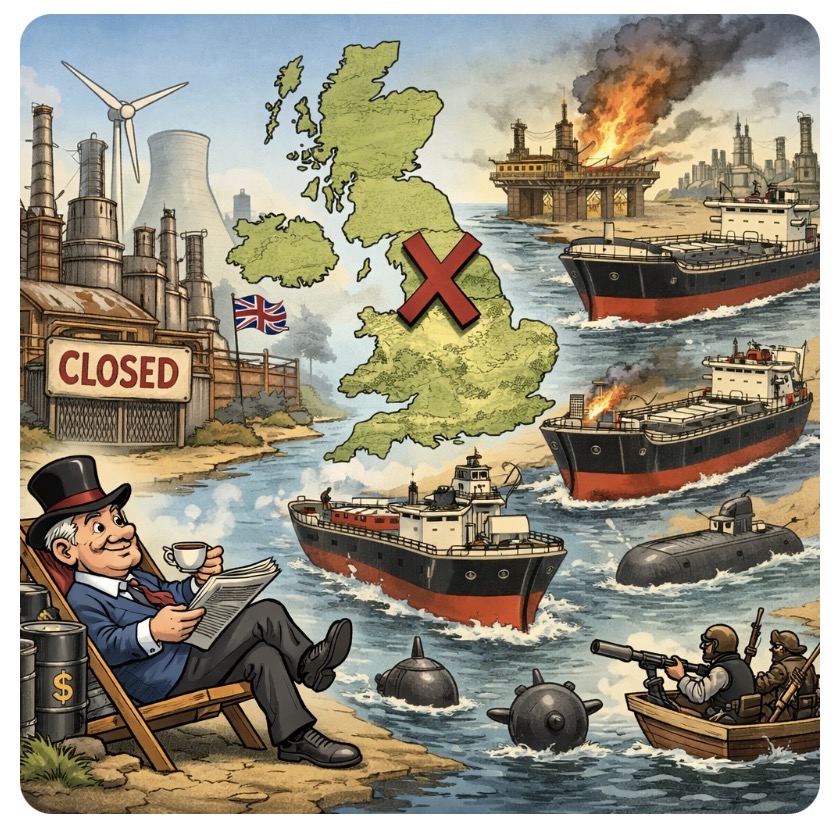
⛽🇬🇧For more than a century, Britain refined its own fuel—turning crude oil from the North Sea and global markets into the petrol, diesel, and jet fuel that powered the country. But with the shutdown of major facilities like the Grangemouth refinery in 2025, that era is quietly ending. What replaces it? A system where Britain increasingly imports finished fuels from massive overseas refineries, relying on tankers and global shipping lanes to keep the nation moving. Economically efficient? Perhaps. Strategically comforting? That’s another matter entirely.
🚢 Efficiency Today, Vulnerability Tomorrow
There’s a certain elegance to the modern global fuel market. Giant refineries in the Middle East, Asia, and the United States churn out oceans of refined fuel at lower costs than many aging European plants could ever hope to match. In spreadsheet terms, the logic is irresistible: why refine oil domestically when someone else can do it cheaper?
Problem solved. Job done. Spreadsheet closed. 📊
Except energy systems aren’t spreadsheets—they’re lifelines.
By closing domestic refineries and turning sites like Grangemouth into import terminals, Britain hasn’t eliminated its dependence on fossil fuels. It has simply outsourced the refining part of the process to other countries and inserted a few thousand miles of ocean between itself and the fuel it needs to function.
In calm waters, that’s fine. Tankers glide through global shipping lanes, markets rebalance supply, and petrol stations keep humming along like clockwork.
But energy planners don’t worry about calm waters.
They worry about chokepoints.
Tankers carrying refined fuel must pass through some of the most strategically fragile corridors on Earth: the Strait of Hormuz, the Red Sea’s Bab el-Mandeb, the Suez Canal, and busy Mediterranean routes. Any disruption—conflict, sanctions, piracy, missile attacks, or geopolitical tantrums—can tighten fuel supply faster than you can say “national resilience.”
And here’s the uncomfortable twist: crude oil is actually easier to source globally than finished fuel.
When a country still has refineries, it can buy crude from wherever it’s available and refine it at home. Lose those refineries, and suddenly you’re dependent on someone else’s finished product arriving on schedule across half the planet.
It’s the difference between owning a kitchen and waiting for takeaway.
One makes you self-sufficient.
The other leaves you hungry if the delivery driver gets stuck in traffic. 🍔🚚
For years, Europe leaned heavily into efficiency and decarbonisation policy. Fossil fuels were assumed to be fading out, global trade seemed stable, and geopolitical tensions looked manageable.
Then the world changed.
Energy became a weapon in the wake of Russia’s invasion of Ukraine. Shipping lanes grew more contested. Infrastructure started appearing on military target lists. Governments that once talked mainly about carbon targets suddenly rediscovered a very old concept:
Strategic resilience.
And that’s where Britain’s refinery closures begin to look less like tidy economic optimisation and more like a gamble made during a calmer geopolitical era.
Restarting closed refineries isn’t simple. Once the machinery stops, the workforce disperses, and the investment dries up, bringing a refinery back to life can take years—sometimes decades.
Which means the real question isn’t whether Britain should reopen the past.
It’s whether policymakers fully understood what they were trading away when they let it disappear.
Because in the grand global energy casino, efficiency wins you chips today.
Resilience is what keeps you in the game tomorrow. 🎲
Here’s the uncomfortable question: did Britain quietly dismantle a layer of its own energy security while everyone was busy celebrating “efficiency”?


 Chameleon Magazine
Leave a comment