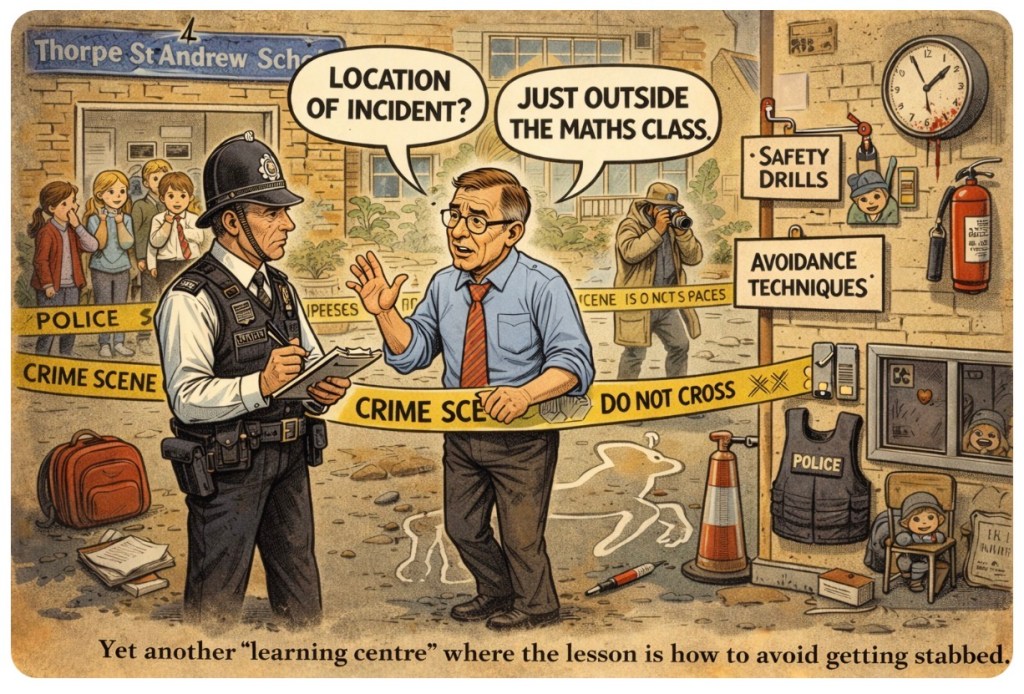
🎒🔪A 15-year-old boy has been charged with attempted murder after allegedly stabbing a schoolgirl in the back at Thorpe St Andrew School.
The words alone are enough to make parents pause: school… stabbing… attempted murder.
These are supposed to be places where children learn algebra, literature, and maybe how to survive a group project. Instead, stories like this make it sound like the most valuable lesson students need is situational awareness and escape routes.
🎓 From Classroom to Caution Zone
Schools were once described as safe spaces for learning. Now they increasingly sound like locations in police briefings.
Teachers are expected to educate.
Students are expected to behave.
Parents are expected to trust the system.
But when a child allegedly walks into school with a knife, the conversation changes dramatically.
Suddenly the curriculum nobody asked for appears:
- How to spot trouble early
- How to avoid violent confrontations
- How to stay safe in places meant to protect you
It’s a brutal shift in expectations.
Because education institutions are supposed to build futures — not prepare teenagers for the possibility of violence in the hallway.
🧠 When Society’s Problems Walk Through the School Gates
The uncomfortable truth is that schools rarely create these problems.
They inherit them.
Violence, social breakdown, lack of consequences, chaotic home environments — all of it eventually walks through the school gates wearing a backpack.
And teachers are left trying to manage situations they were never trained for.
They signed up to explain Shakespeare.
Not to navigate the kind of crisis that ends with police tape and court hearings.
🔥 Challenges 🔥
Here’s the question nobody likes to face:
When schools start dealing with attempted murder cases, is the problem the school… or the society feeding into it?
Are we expecting teachers to solve issues that begin far outside the classroom?
Drop your thoughts in the blog comments, not just on social media. This one deserves honest debate. 💬🔥
👇 Comment, like, and share.
The sharpest responses will be featured in the next issue of the magazine. 📝


 Chameleon Magazine
Leave a comment