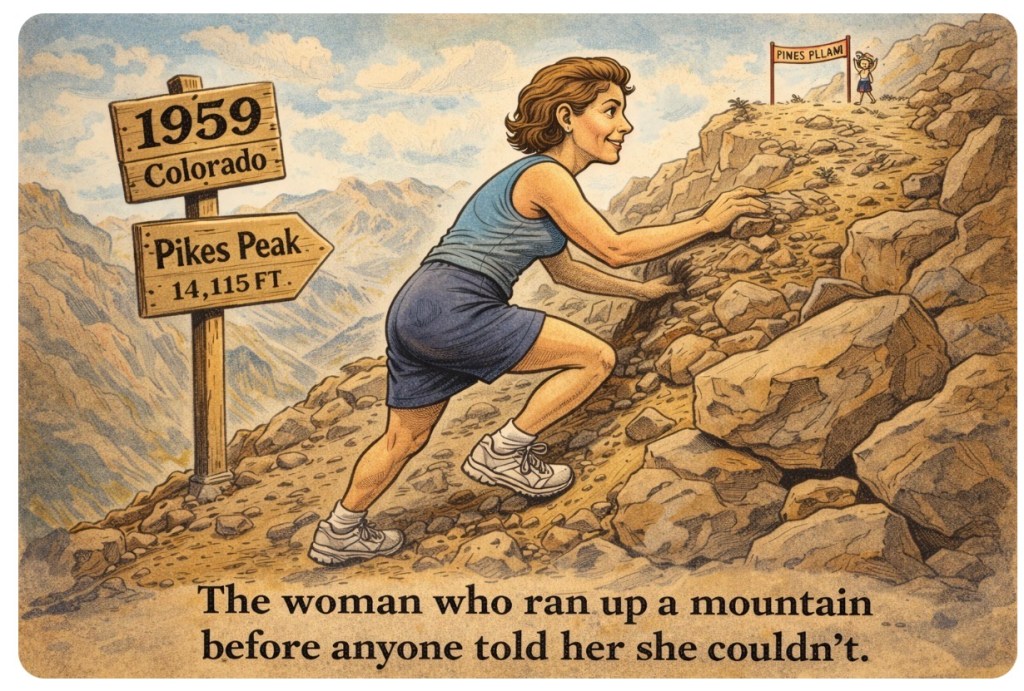
🏔️👟In 1959, a 29-year-old nurse and mother named Arlene Pieper quietly did something extraordinary.
She didn’t plan to break barriers.
She didn’t plan to start a movement.
She certainly didn’t plan to make history.
She just wanted to see if she could finish one of the hardest races in the world — the Pikes Peak Marathon.
So she showed up.
No elite gear.
No sponsorship.
No grand speeches.
Just a pair of ordinary sneakers and a stubborn curiosity about what she was capable of.
The course climbs from the streets of Manitou Springs, Colorado — already over 6,000 feet above sea level — all the way to the 14,115-foot summit of Pikes Peak and back down again. Twenty-six miles of punishing switchbacks, thin air, shredded lungs, and legs that quickly forget whose idea this was.
Today athletes train for years to attempt it.
Arlene just thought:
“I wonder if I can.”
🏃♀️ The Accidental History Maker
At the starting line, the other runners were men — dozens of them — surprised to see a woman there.
But Arlene wasn’t there to make a statement. She wasn’t protesting anything or demanding entry into a club.
She was simply curious.
So she ran.
Up the mountain through thinning air.
Across loose rock and brutal climbs.
Down a descent that punishes knees and nerves alike.
And when it was over, she crossed the finish line.
Her daughter was waiting.
Arlene went home, returning to her life as a nurse and mother. No press conference. No headlines. No idea that she had just done something historic.
Because what she didn’t know was this:
No woman in the United States had ever officially finished a marathon before her.
She had just broken a barrier she didn’t even know existed.
Then the moment quietly disappeared into the archives.
📜 The Record That Waited Fifty Years
For half a century the result sat unnoticed in race records.
Until 2009.
A historian combing through old marathon results spotted a name and paused.
Arlene Pieper.
He checked the numbers again. Then again.
Finally he reached for the phone.
When the call came, Arlene was in her late seventies.
The historian explained that the race she had run for herself — just to see if she could — had actually been something much bigger.
She had become the first woman in the United States to officially finish a marathon.
A barrier breaker.
A pioneer.
A piece of running history.
And she had done it completely by accident.
💡 The Quiet Power of Curiosity
There’s something wonderfully rebellious about that.
Today we often think history is made with speeches, campaigns, or massive public statements.
But sometimes history happens because someone quietly decides to try something difficult.
Not for applause.
Not for recognition.
Just for themselves.
Arlene Pieper didn’t run to prove women belonged in marathons.
She ran because a mountain was there.
And because she wondered if she could reach the top.
🔥 Challenges 🔥
Here’s the thought worth sitting with:
How many barriers still exist simply because nobody has tried to cross them yet?
What’s the “mountain” in your life that you’ve been quietly wondering about?
Drop your thoughts in the blog comments — not just on social media. Tell us about the moment you tried something difficult just to see if you could. 💬
👇 Comment, like, and share.
The most inspiring responses will be featured in the next issue of the magazine. ✍️


 Chameleon Magazine
Leave a comment