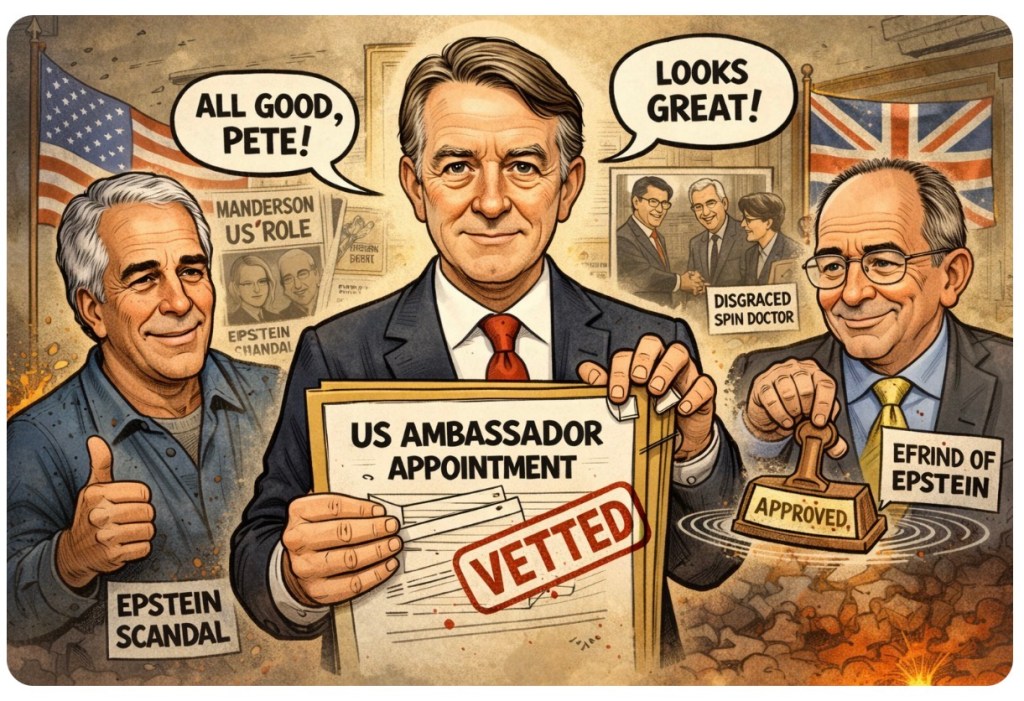
🕵️♂️🔥When a political appointment is supposed to be “carefully vetted,” the public imagines stern officials checking records, scrutinising reputations, and ensuring that the person representing the country isn’t carrying baggage the size of a cargo ship.
Instead, sometimes we discover the vetting process looks more like a group of old friends quietly nodding each other through the door while the alarm bells are duct-taped shut.
And when the man signing off on the appointment happens to be a disgraced spin doctor with links to a convicted child sex offender, the phrase “rigorous vetting” starts sounding like a punchline.
🎭 The Establishment’s Favourite Game: Friends Checking Friends
The scandal surrounding the appointment of Peter Mandelson as ambassador to the United States exposes one of Westminster’s favourite traditions: the revolving door of influence.
The official line says he was vetted.
The reality raises a far more awkward question:
Who vets the vetters?
Because when the person approving the appointment is themselves politically damaged—and publicly known for defending a convicted child sex offender—you’re no longer looking at oversight.
You’re looking at a closed circle protecting itself.
This is the classic establishment reflex:
- Powerful figure nominated.
- Old political ally signs it off.
- Media raises eyebrows.
- Public is told everything was “fully checked.”
It’s less a vetting process and more a gentleman’s club handshake.
And the public is expected to politely applaud the procedure.
But the optics are brutal. When someone tied to one scandal is quietly rubber-stamping someone tied to another, the message isn’t competence.
It’s arrogance.
The kind that assumes nobody is paying attention.
🧠 Why Power Networks Always Protect Their Own
This story isn’t really about one appointment. It’s about a system.
Political networks operate like tightly sealed ecosystems. Loyalty is rewarded, criticism is treated as betrayal, and reputations are maintained through strategic silence.
Which means the people doing the vetting are often the same people with every incentive not to look too closely.
Because once you start pulling threads in these networks, you rarely find just one problem.
You find an entire tapestry.
And the last thing a comfortable political class wants is sunlight hitting the stitching.
🔥 Challenges 🔥
So here’s the uncomfortable question:
How many political appointments are truly “vetted”… and how many are simply approved by friends of the same power circle?
Is this incompetence, arrogance, or something far more deliberate?
Drop your thoughts in the blog comments (not just social media). We want the sharpest takes, the historical parallels, and the questions the establishment would rather nobody ask. 💬🔥
👇 Comment. Like. Share. Stir the pot.
The best comments will be featured in the next issue of the magazine. 📝


 Chameleon Magazine
Leave a comment