📊🎭Trust in institutions is already fragile, and now even the pollsters are under the microscope. After a public clash with Nigel Farage, polling company YouGov says it will change how it presents certain polling results following accusations that its figures were displayed in a misleading way.
The dispute centred around polling involving Reform UK, with critics claiming the presentation of the data created a very different impression from the raw numbers themselves.
And that’s where the real issue begins.
Because statistics are powerful—but presentation is even more powerful.
The same data can look positive or negative depending entirely on how it’s framed, scaled, or compared.
🎩 The Old Trick: Turn Good News into Bad News
Here’s a simple example of how easy it is to change perception.
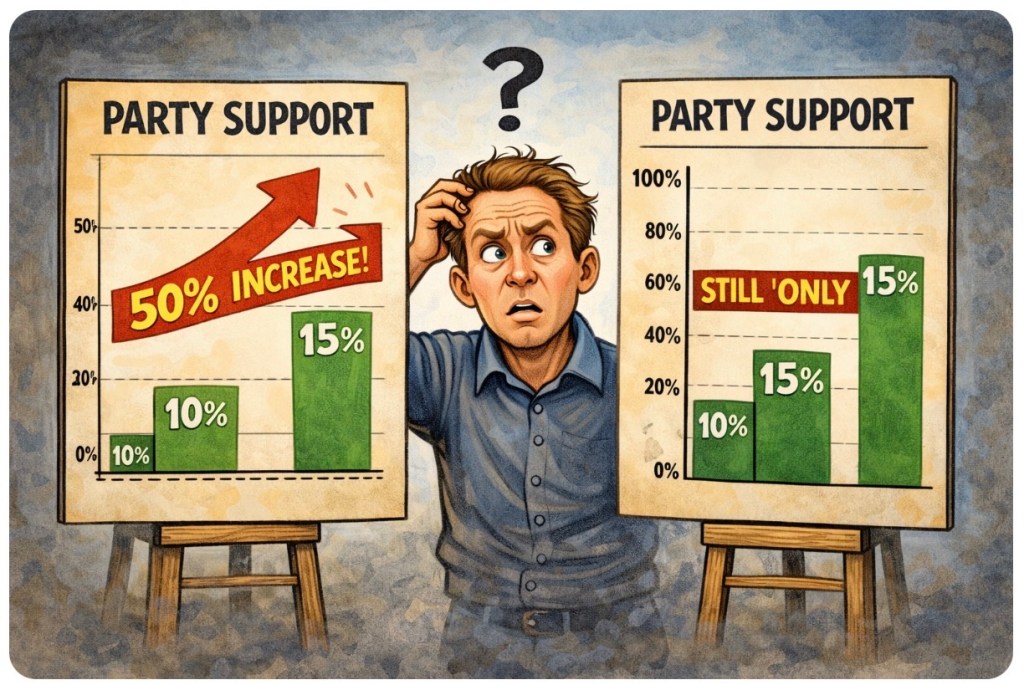
Imagine a poll shows a party’s support rising from 10% to 15%.
One headline could say:
“Party Surges with 50% Increase in Support!” 🚀
Technically true. A jump from 10 to 15 is indeed a 50% increase.
But the exact same data could be reported like this:
“Party Still Stuck at Just 15% Support.” 📉
Also true.
Same numbers.
Same poll.
Completely different impression.
And it doesn’t stop there.
Pollsters and media outlets can influence perception by:
- Choosing which comparison to show
- Highlighting percentage change instead of raw numbers
- Selecting specific demographic slices
- Displaying graphs with compressed or exaggerated scales
- Comparing different time frames
Suddenly the public isn’t just seeing data—they’re seeing a narrative built around it.
📉 The Fragile Currency Called Trust
Polling companies survive on one fragile commodity:
Trust.
If people believe pollsters are neutral observers, the numbers matter. But once the public suspects that the presentation of data might shape political narratives, that credibility begins to crumble.
And after shocks like the Brexit referendum, where polling struggled to predict the final result, many voters already view the industry with scepticism.
Now even small methodological changes risk feeding a bigger suspicion:
That polling doesn’t just measure public opinion…
Sometimes it might guide it.
🧠 Numbers Don’t Lie… But People Can Frame Them
Raw data is usually neutral.
The story built around it isn’t.
And when a polling company publicly says it will change how results are shown, even for legitimate methodological reasons, the optics are explosive.
Because once people start asking whether numbers are being interpreted or engineered, the credibility of every future poll becomes part of the debate.
🔥 Challenges 🔥
If the same poll can produce two completely different headlines, how do voters know what the truth actually is?
Are pollsters still neutral observers of public opinion—or are they becoming part of the political battlefield themselves?
💬 Jump into the blog comments and tell us what you think.
👇 Comment, like, and share your view.
The sharpest, funniest, and most brutally honest responses will be featured in the next issue of the magazine. 🎯📝


 Chameleon Magazine
Leave a comment